The short version: a good camper solar panel kit isn’t about squeezing out a few extra watts — it’s about picking components that survive washboard roads and weeks between hookups. Get the mounting right once, and you stop thinking about power for the rest of the trip.
Most camper owners don’t need a full electrical education — they need to know which kit keeps the fridge running without turning into a maintenance project. If you’re comparing a general RV solar setup against something sized for a truck camper or small trailer, the sizing math and panel basics are the same ground we already cover in our RV solar panel kit guide. What’s different for a camper is smaller, and the details below focus on exactly that: roof space, weight, and rougher rides.
- What’s actually different about a camper solar kit
- Sizing a kit for a truck camper or small trailer
- Why flexible panels often win on a small roof
- Mounting and wiring that survives rough roads
- Keeping your battery charged away from hookups
- Choosing a kit: a simple checklist
What’s actually different about a camper solar kit
In short
- Smaller, more fragile roof than a travel trailer or motorhome
- More vibration from truck bed and trailer suspensions on unpaved roads
- Tighter budget and weight limits — every pound counts on a truck camper
A truck camper or small travel trailer doesn’t have the roof space, payload capacity, or budget of a Class A motorhome — and it usually doesn’t need to. Most campers run a smaller battery bank and fewer appliances, so a camper solar panel kit is built around a different set of trade-offs than a full RV system: lighter components, a simpler build, and hardware that can take a rougher ride than a motorhome roof ever sees.
That’s also why generic RV solar advice doesn’t always transfer cleanly. A rigid panel that holds up fine bolted to a stationary RV roof can crack faster on a truck bouncing down a forest service road, and a pop-up camper’s soft, flexing roof rules out some mounting approaches that work on a hard-sided rig entirely.
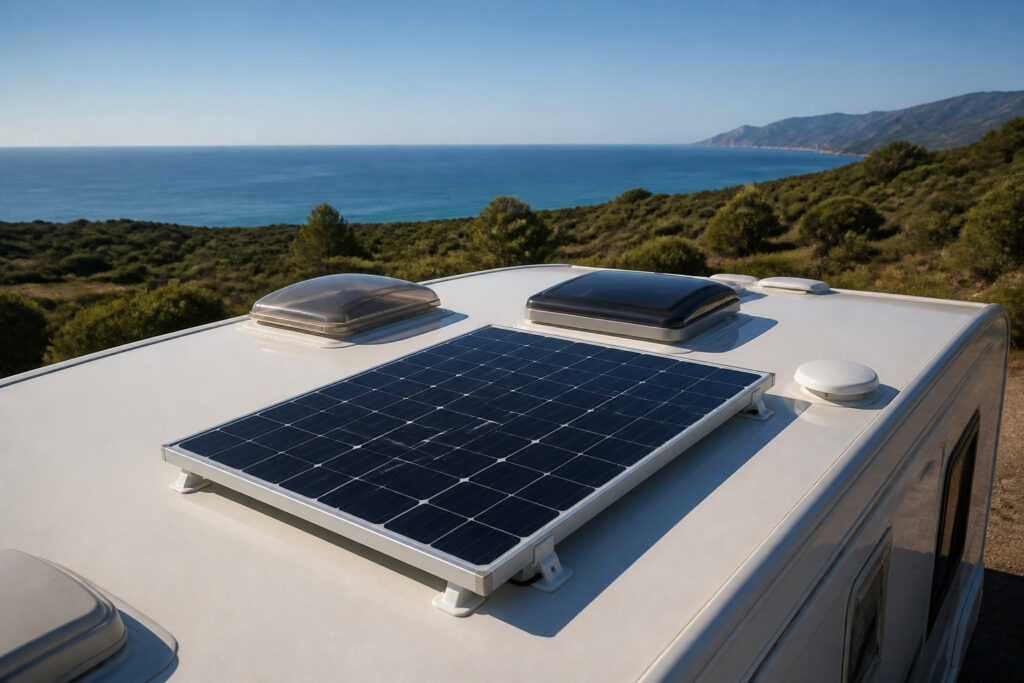
Sizing a kit for a truck camper or small trailer
The sizing logic itself doesn’t change — add up your daily watt-hours, then size your panel and battery bank to cover it with a buffer for cloudy days. Our RV solar panel kit guide walks through that math and a full sizing table in detail.
What’s worth knowing for a camper specifically: most truck campers land smaller than people expect. Two 100W panels (200W total) paired with roughly 200Ah of battery capacity is a common starting point for basic boondocking — fridge, lights, water pump, a laptop — without running AC. Truck Camper Adventure’s build guide uses this same 200W/200Ah baseline, and notes that anything much larger starts to run into roof space and weight limits on a typical truck camper. If you’re planning around air conditioning or an induction cooktop, you’re better off sizing against the larger RV table linked above.
Why flexible panels often win on a small roof
Our RV guide breaks down monocrystalline vs. polycrystalline and rigid vs. flexible panels in detail — that comparison still applies here. The one point worth calling out for campers specifically: flexible panels are the more common pick for pop-up and slide-in campers because they mount to a curved or less rigid roof without the standoff brackets rigid panels need, and they shave off real weight on a rig where every pound against your truck’s payload rating matters.
The trade-off is the same one we flag for RVs generally, just more pronounced on a camper: flexible panels run hotter against the roof (quietly cutting output) and tend to have a shorter service life than rigid panels. For a hard-sided truck camper with a flat roof and no strict weight limit, rigid is usually still the more durable long-term choice.
Mounting and wiring that survives rough roads
This is where camper-specific advice actually pays off. Washboard roads, gravel, and long stretches of highway all work loose fasteners and connectors over time — and mounting, not the panel itself, is where most camper solar problems start.
- Waterproof every screw with Dicor or a comparable sealant, and use VHB (very high-bond) tape underneath mounting brackets as a cushion between the bracket and the roof — standard practice among experienced truck camper builders, per Truck Camper Adventure.
- Minimize roof penetrations. Fewer screws through the roof means fewer places for water to eventually find a way in.
- Choose roof-rack mounting over direct-to-roof where your rig allows it — it typically holds up better against water intrusion over years of use than screwing brackets straight into the roof skin.
- Check MC4 connectors for a full click-lock every few trips — a half-seated connector is a far more common cause of a “dead” panel than actual vibration damage.
- Route cable away from moving parts like slide-outs and roof vents, where repeated flexing wears through insulation over time.
Worth knowing before you over-engineer this: experienced builders generally report that vibration itself rarely damages a properly mounted panel — the real failure points are water intrusion and loose connectors, not the panel cracking from washboard roads. Sealing and securing the mount well matters far more than adding extra vibration dampening.
Keeping your battery charged away from hookups
The point of a camper solar setup is simple: keep the battery topped up without a campground pedestal or a generator running all day. A charge controller sized to your panel output does the actual work — panels feed it, the battery bank stores the power, and everything else in the camper draws from there. The Department of Energy’s solar guide is a useful primer if you want the broader context on how solar charging works before comparing components.
If you’re running lithium batteries, confirm your charge controller and any DC-DC charger are actually configured for that chemistry — a setup tuned for lead-acid will undercharge a lithium bank. For a closer look at matching battery type to your setup, see our guide to solar panel batteries.
Choosing a kit: a simple checklist
The best camper solar kit isn’t the one with the highest wattage on the box — it’s the one sized to your roof, your weight limit, and mounted well enough that you forget it’s there.
- Match wattage to your real usage, not the biggest number available — 200W/200Ah covers most basic boondocking on a truck camper.
- Pick rigid or flexible based on your roof and weight limit, not price alone — a cheaper flexible panel that fails in two years costs more than a rigid one that lasts ten.
- Waterproof every roof penetration with proper sealant — this matters more than any vibration-dampening hardware.
- Confirm the charge controller matches your battery chemistry, especially on lithium.
- Leave room to add a second panel later if you’re unsure how much power you’ll need yet — cheaper than resizing the whole system down the line.
FAQ — Truck Camper Solar Kit
Everything you were wondering before you hit the road ☀️
How is a camper solar kit different from an RV solar kit? +
How much solar do I need for a truck camper? +
Do I need special vibration-resistant mounts for a truck camper? +
Are flexible panels worth it on a pop-up or slide-in camper? +
A camper solar panel kit sized to your roof, matched to your weight limit, and properly sealed at every mounting point will keep running quietly trip after trip. Start with the checklist above, and check our full RV solar guide if you need the deeper sizing and component breakdown.