To remember

The right battery, not just the panel, decides whether your kit works after dark or during a power outage. LiFePO4 batteries handle thousands of charge cycles, need zero maintenance, and are safe to install yourself in most shed, RV, van, or balcony kits. Get the size and chemistry right, and the rest takes care of itself.
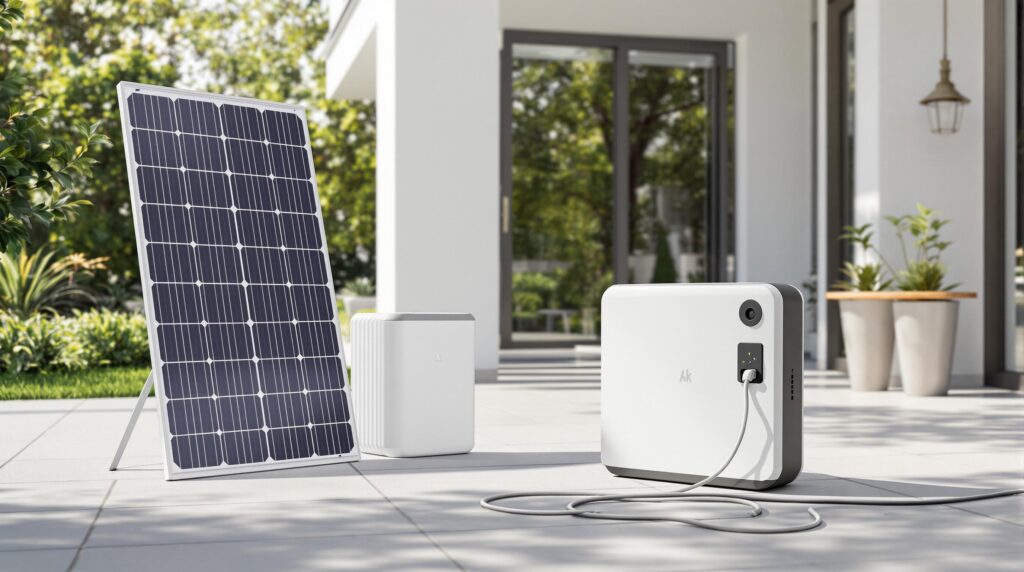
Why a Battery Changes What Your Solar Kit Can Actually Do
A solar panel kit without a battery only works while the sun is up. Add the right battery, and the same kit can run your shed lights after dark, keep your RV fridge cold overnight, or keep a lamp on during a blackout. Here’s why that one component matters more than people expect.
Power on your schedule, not the sun’s
Without a battery, a solar panel kit only powers whatever’s plugged in at that exact moment — fine for a few daytime tasks, useless the second the sun goes down or a cloud rolls in. Add a battery, and the kit becomes a small, self-contained power system: it banks the extra energy your panel produces during the day and releases it whenever you actually need it.
Backup power without a generator
That’s the difference between a shed light that only works “when it’s sunny” and one that works every night, or an RV fridge that survives a cloudy travel day. A battery-backed kit also doubles as backup power during an outage — no generator, no gas, no noise.
One upgrade, more kits it fits
If you haven’t picked a kit yet, our guide to how plug-and-play solar panels work walks through how the panel, charge controller, and battery fit together before you buy.
How a Solar Kit Battery Works
The trio: panel, charge controller, battery, inverter
Every kit follows the same basic path: the solar panel generates direct current (DC) electricity, a charge controller regulates how much reaches the battery so it doesn’t overcharge, and the battery stores what you’re not using right away. If you need to run standard AC devices — a mini-fridge, a fan, a laptop charger — an inverter converts the battery’s stored DC power into the AC your outlets expect. Plug-and-play kits bundle most of this into one unit, which is exactly why they don’t need an electrician; see our breakdown of why a plug-and-play setup is worth it for the full case.
Charging and discharging in practice
During the day, the charge controller feeds the battery while preventing overcharging. In the evening or whenever you draw power, the battery releases it back out. That back-and-forth is the “charge/discharge cycle,” and how deep you let it discharge each time is one of the biggest factors in how long the battery lasts — more on that in the sizing section below.
For a jargon-free primer on how batteries store and release electricity, the Department of Energy’s DOE Explains… Batteries is a solid starting point.
Lithium vs. Lead-Acid: Which Chemistry to Pick
Lithium (LiFePO4): the default choice for most kits
Short answer for most kit buyers: LiFePO4 (lithium iron phosphate). It’s lighter, safer, needs zero maintenance, and tolerates being drained much further than lead-acid without shortening its life — which matters for shed, RV, van, and portable setups where every pound and every square inch counts.
Lead-acid: still useful for tight budgets or occasional use
Lead-acid (flooded, AGM, or GEL) still has a place if your budget is tight and you don’t mind a bulkier, heavier battery with a shorter lifespan and some upkeep. It’s a reasonable choice for occasional or backup-only use, less so for a battery you’ll cycle daily.
Comparison table: the quick version
| Criteria | LiFePO4 (lithium) | Lead-acid (AGM/GEL/flooded) |
|---|---|---|
| Cycle life | Thousands of cycles | A few hundred cycles |
| Usable depth of discharge | 80–100% | ~50% |
| Weight | Light | Heavy |
| Maintenance | None | Regular for flooded models |
| Upfront cost | Higher | Lower |
| Cost over time | Lower (fewer replacements) | Higher (replaced more often) |
| Best for | Daily use: shed, RV, van, balcony | Tight budget, occasional/backup use |
We’ve broken down the full comparison — exact cycle life, depth of discharge, safety, and total cost of ownership — in a dedicated guide: Lithium vs. lead-acid for solar storage.
How to Size Your Battery: Capacity, Power, and Depth of Discharge
Two numbers matter more than any spec-sheet claim: capacity (how much energy it stores, in watt-hours or amp-hours) and power output (how much it can deliver at once, in watts). Undersize either one and you’ll run out of power or trip the system the moment you turn on something power-hungry. Start with what you actually plan to run, not the biggest battery you can afford.
- Capacity: add up the watt-hours of everything you’ll run between charges (a few LED lights for hours, a mini-fridge overnight, a laptop). That total, with some margin, is your target capacity.
- Power output: check the startup wattage of your biggest device — a fridge compressor or a power tool can briefly draw far more than its running wattage. Your battery/inverter combo needs to handle that spike.
- Depth of discharge (DoD): this is how much of the battery’s capacity you can safely use. LiFePO4 batteries typically allow 80–100% DoD; lead-acid batteries are usually capped around 50%, so you’d need roughly double the rated capacity to get the same usable power.
Typical configurations by use case
| Use case | Panel output | Recommended battery | Why |
|---|---|---|---|
| Shed (lighting, small tools) | 50–200W | 50–200Wh LiFePO4 | Small daily loads, no venting needed indoors |
| Balcony / apartment | 300–800W | Often none, or 1–2kWh if you want to store instead of exporting | Many balcony kits send excess power straight to your outlets |
| RV / camper / van (weekend trips) | 200–400W | 100–200Ah (12V) LiFePO4 | Balances weight and runtime for occasional use |
| RV / van (full-time or off-grid) | 400–800W+ | 200–400Ah (12V) LiFePO4 | Covers fridge, water pump, and electronics overnight |
| Portable / camping | 100–200W | 300Wh–1kWh all-in-one power station | Battery, inverter, and outlets built into one box |
These are starting points, not fixed rules — your actual numbers shift with climate, how many cloudy days you plan for, and how deep you’re willing to discharge the battery.
Best Battery Setup by Use Case
The right chemistry and capacity from the sections above still need to be matched to where the battery actually lives. Here’s what to prioritize for each kit type.
Shed
A shed battery mostly needs to survive temperature swings and sit unattended for days at a time. LiFePO4 handles both without maintenance. See our solar kit for shed guide for full kit recommendations, and check the safety standards for shed installs before you wire anything.
Balcony / apartment
Space and weight limits matter more here than raw capacity — most balcony setups are compact by design. Check our balcony solar kit guide, and if you’re mounting anything to a railing or wall, read how to install balcony solar panels safely first.
RV, van, and camper
Weight and vibration resistance are the priority on the road. LiFePO4’s lighter weight directly translates into more payload for everything else you’re hauling. Compare setups in our RV solar panel kit, camper solar panel kit, and solar panel for van guides.
Portable / off-grid backup
If you’re moving the whole setup between locations — camping, job sites, backup power — an all-in-one portable power station is usually simpler than assembling separate components. Battery performance also swings with temperature; if you’re using your kit somewhere hot or cold, see our guide to mobile solar efficiency in extreme climates.
Installation and Safety Basics
DIY is fine for most kits
Most plug-and-play kit batteries are built for DIY installation — no electrician, no permit, no inspection. That covers the vast majority of shed, balcony, RV, van, and portable setups. Stick to the basics: keep connections dry and out of direct weather unless the battery is rated for it, don’t mix battery chemistries or brands in the same bank, and follow the manufacturer’s wiring diagram for polarity and connector type (MC4 connectors are the standard on most kits).
When you need a licensed electrician
The line where you’ll want a licensed electrician is when a battery system ties directly into your home’s electrical panel for whole-home backup — that’s a different project from a standalone kit, and it typically involves local permitting. Requirements vary by state and utility, so check with your local building department before wiring anything into your home’s electrical system.
For general background on how home battery systems work, the Department of Energy’s homeowner’s guide to going solar and EnergySage’s home battery storage guide are both solid independent references.
Whatever you’re powering — a shed light, an RV fridge, or a backup lamp during an outage — the battery is the part of your kit that decides whether it actually works when you need it, not just when the sun is out. Get the sizing and chemistry right, and the rest of the setup takes care of itself.
FAQ – Solar Panel Battery Kits
LiFePO4 (lithium iron phosphate) is the default choice for almost every solar kit sold today — shed, balcony, RV, or portable. It’s lighter and safer than lead-acid, doesn’t need ventilation, and tolerates deeper discharges without damage. See our full lithium vs. lead-acid comparison for the details.
It depends on the use case. Some grid-tied balcony kits export excess power directly rather than storing it. But if you want backup during an outage or real autonomy — shed, RV, van, camping — a battery is what makes that possible. Our guide on how plug-and-play kits work covers how the components connect.
Usually, yes — as long as the charge controller and inverter are compatible with the battery’s voltage and connector type. Most modern kits use standard 12V or 24V systems with MC4 connectors, which makes mixing and matching straightforward.
For small plug-and-play kits — shed, balcony, portable — yes, most are designed for DIY setup. Larger battery systems wired into your home’s electrical panel for whole-home backup typically call for a licensed electrician and local permitting. See our shed safety standards and balcony installation safety guides before you start.
LiFePO4 batteries in typical kit use last for thousands of charge cycles — often a decade or more — under normal conditions. Actual lifespan depends heavily on how deep you discharge them and the temperatures they operate in; see our guide on mobile solar efficiency in extreme climates for more on that last point.
Small plug-and-play or portable kits generally don’t, since they’re not tied into your home’s electrical panel. Battery systems wired permanently into your house’s wiring usually do require a permit, and the exact rules vary by state and utility — check with your local building department before installing anything permanent.
A solar generator (portable power station) bundles the battery, inverter, and charge controller into one sealed unit — simple, but usually pricier per watt-hour of storage. A solar panel kit with a separate battery lets you size and swap components independently, which is typically more cost-effective for a permanent setup like a shed or RV.