Cloud cover can cut daily solar output by 50% to 80%. Pick the wrong setup, and your battery runs low after a few gray days.
This guide helps you choose solar panels for a truck camper that fit your roof and your power needs.
Solar panels for a truck camper: how to size the system for daily use
Work out your energy use first. Multiply each device’s running watts by its daily hours, then add the results. A 50 W device running four hours uses 200 Wh. That total sets the size of your battery and your solar array.
| Load | Typical draw | Daily energy |
|---|---|---|
| 12V compressor fridge | 40 to 80 W while running | 300 to 600 Wh, depending on heat and cycling |
| LED lights | 5 to 10 W each | 25 to 100 Wh |
| Phone charging | 5 to 20 W | 10 to 40 Wh |
| Laptop | 45 to 100 W | 90 to 300 Wh |
| Roof fan | 10 to 40 W | 40 to 200 Wh |
| Water pump | 35 to 60 W | 10 to 40 Wh |
A small truck camper with a 12V fridge, lights, phones, a laptop, and a fan typically draws 800 to 1,200 Wh per day. Add 300 to 600 Wh if you use the laptop heavily, cook, or run an inverter often.

Estimate production with peak sun hours
Use peak sun hours, not daylight hours. One peak sun hour equals one hour at the 1,000 W/m² irradiance used to rate solar panels. A six-hour summer day can deliver fewer than six peak sun hours when morning and afternoon light is weak.
Size the array with this formula: Solar watts = daily watt-hours ÷ peak sun hours ÷ system efficiency
Clouds cut output more than small wiring losses do. Cloud cover can reduce daily production by 50% to 80%. Partial shade from an air conditioner, vent, or roof rack can weaken a whole panel string. Run PVWatts with your tilt, orientation, array size, and location first.
Size the battery for cloudy days
Size the battery by usable energy, not by the number on the case. A 12V 100Ah battery stores about 1,200 to 1,280 Wh before losses. Usable energy depends on chemistry and allowed depth of discharge.
AGM batteries need a larger rated bank, since drawing about half their capacity protects their life. A 100Ah AGM battery gives roughly 50Ah, or about 600 Wh at 12V. A LiFePO4 battery supplies 80% to 95% of its rated capacity.
Use this formula: Required usable battery energy (Wh) = daily Wh × autonomy days. Divide by the usable fraction to get rated battery energy, then divide by battery voltage to get capacity in Ah.
For a typical load this comes to roughly 175Ah at 12.8V. A 200Ah LiFePO4 bank gives a useful reserve for a small truck camper.
Check these before you size the array
- Total the daily Wh for every device you run.
- Pick the peak sun hours for your worst month.
- Run PVWatts with your planned tilt and array size.
- Set the battery at 175Ah or more for a 200Ah LiFePO4 reserve.
Rigid panels cool better on flat roofs, flexible panels follow curves
Compare output, weight, and service life
On a flat camper roof, rigid glass panels usually make the stronger long-term choice. The frame gives you a durable mounting surface. It also leaves an airflow gap beneath the panel. That gap removes heat and protects output on hot days.
Flexible panels often carry shorter material warranties. The BougeRV Arch Pro 200 W flexible panel has a five-year material and workmanship warranty. Its output warranty runs 25 years at 80%.
The BougeRV 200 W rigid panel has a 10-year product warranty. Its performance warranty runs 30 years.
A 200 W flexible panel weighs about 8 to 11 pounds in current examples. A 200 W rigid panel weighs about 22 to 33 pounds. That gap equals carrying one full water container onto the roof.
Check the camper shell’s load limit before installation.
Choose the mounting method
Use Z brackets or a roof rack for rigid panels. Brackets hold the panel above the roof and create the airflow gap. They also let you replace a panel later. A rack avoids drilling into a thin shell at structural points.
Use structural silicone adhesive for flexible panels when the manufacturer requires it. Do not rely on isolated grommets unless the panel maker approves that method. Road vibration lifts a loose edge. That lift can tear the cable connection.
Seal every roof penetration with a product approved by your camper manufacturer for RV roofing. Route the cable through a proper entry gland. Form a drip loop. Inspect the seal after the first rain and the first rough road.
Water entering through a cable hole can damage insulation, wood, and the charge controller.
Check the camper manufacturer’s roof warranty before you drill or bond anything. The wrong adhesive, screws through a roof rib, or an unapproved sealant can shift repair responsibility onto you.
Plan the roof layout before drilling
Keep panels out of permanent shade. A vent’s shadow across one row of cells can weaken a series-connected string. That happens even when most of the panel sits in sunlight.
Place the panel least sensitive to shade where a rack or vent will not cross it at midday.
Portable panels follow the sun when roof space runs short
Use portable panels in the field
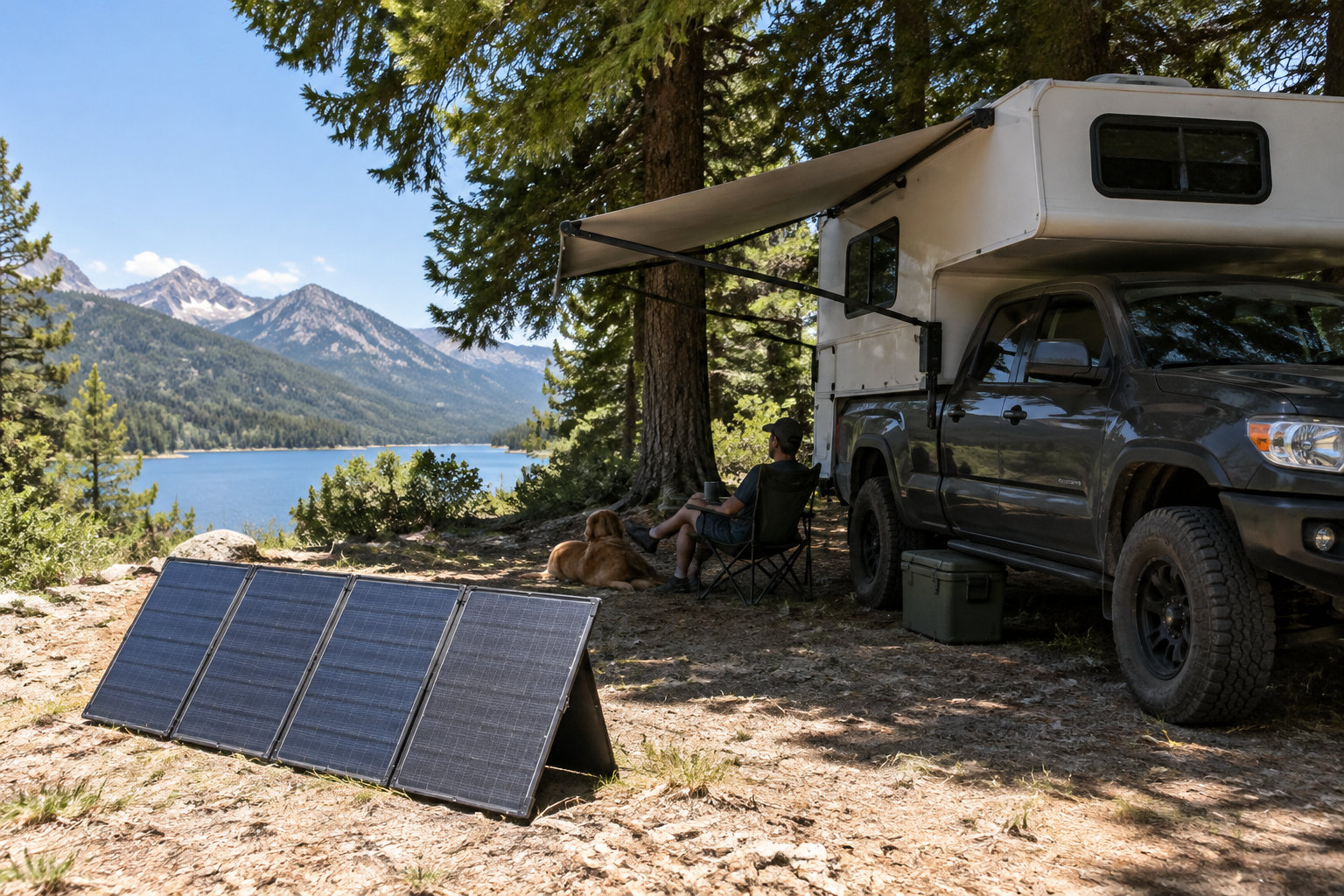
Park in shade and set the panel in full sun. A portable array can out-produce a roof panel shaded by trees.
Folding suitcase panels pack into two or more rigid sections. Goal Zero’s Nomad 200 folds to one-quarter of its open size and is rated at 200 W. Renogy sells 100 W and 200 W suitcase kits with a controller.
Connect portable panels to the camper
MPPT controllers track the panel’s maximum-power voltage. They turn the extra voltage into charging current. They cost more, but they suit larger arrays, cold weather, long cable runs, and higher-voltage panels.
Do not connect a portable panel’s built-in controller to your camper’s controller unless the manufacturer supports it.
Before you connect a portable panel
- Confirm in writing that the manufacturer supports connecting its controller to your camper’s controller.
- Check that both controllers’ settings are designed for parallel charging.
- Check the wiring diagram for both controllers before you connect anything.
Controller, battery, and wiring ratings must match the array
Match the charge controller
Select the controller from array current and voltage. A 400 W array on a 12V battery can send roughly 33 amps before losses. A 40A controller gives the working margin you need. A 30A controller suits 200 W at 12V but leaves little room to expand.
Check maximum PV voltage, not only wattage. Four 100 W panels wired in series add their open-circuit voltages. Cold weather raises that total. BougeRV’s 40A controller accepts up to 100V PV input and up to 600 W on a 12V system.
Choose the battery bank
AGM batteries cost less up front. They tolerate a wide temperature range, but store less usable energy. A 12V 200Ah AGM bank stores about 2,400 Wh nominally. At a 50% regular-use limit, it gives roughly 1,200 Wh.
Set the controller to the battery chemistry. AGM and LiFePO4 need different absorption, float, and low-voltage settings. Select the correct profile before you connect the battery.
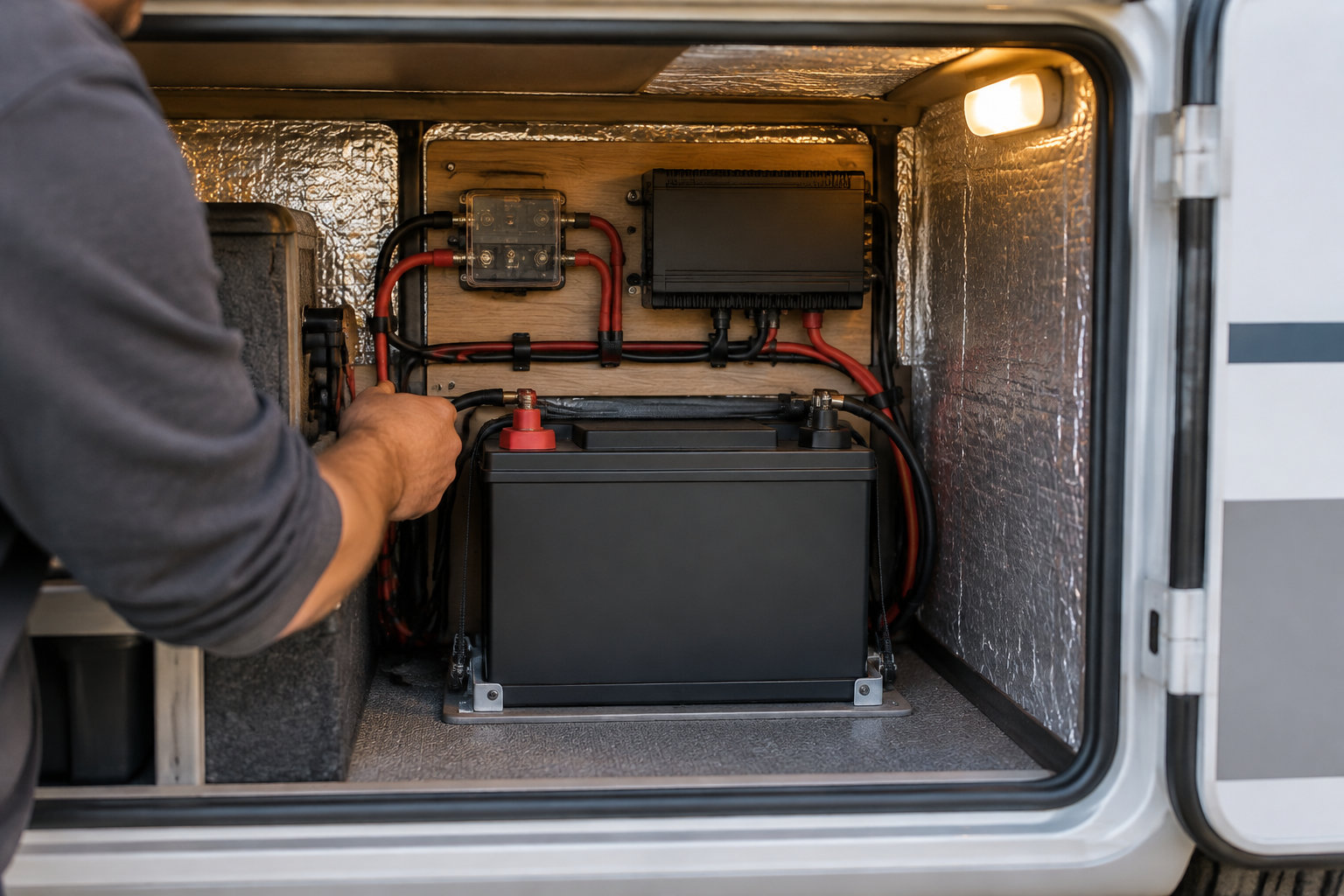
LiFePO4 batteries need a battery management system, or BMS. The BMS protects against overcharge, over-discharge, excess current, and temperature faults. Many lithium batteries refuse to charge below 32°F. Winter campers need low-temperature protection or a heated battery compartment.
Size the wiring and protection
Install the array fuse or breaker near the controller. Put battery protection near the battery. Size each device for the cable and the expected current. A fuse protects the wire from a short circuit. It does not make an undersized wire safe.
Cover the panels or disconnect the solar input before you change any wiring. Connect the battery to the charge controller first. Then connect the solar array. Reversing that order can damage some controllers.
Wiring check before you connect
- Confirm the controller profile matches your battery chemistry, AGM or LiFePO4.
- Check the controller’s maximum PV voltage against your series wiring.
- Confirm a BMS is fitted on any LiFePO4 battery.
- Cover the panels or disconnect the solar input.
- Connect the battery to the controller first, then connect the solar array.
Four solar kits trade price, controller type, and roof fit
These four kits cover the main truck camper choices. Each one trades price, controller type, and roof fit differently. Manufacturer prices can change with promotions.
Four kits compared: price, parts, and roof fit
Renogy 200W 12V Essential Solar Panel Kit
- Price: $289.99
- Parts: two 100 W N-type rigid panels, 30A PWM controller, wiring, mounting brackets, Bluetooth monitoring
- Panel size: about 34.1 by 22.8 inches, 13 pounds each
- Fit: flat roof with room for two framed panels
BougeRV 12V 200W TOPCon Rigid Solar System Kit
- Price: $599.99
- Parts: one 200 W bifacial rigid panel, 30A MPPT controller, 12V 100Ah LiFePO4 battery, 1,000 W pure sine wave inverter
- Panel size: 50.67 by 30.20 inches, 22.5 pounds
- Controller: accepts 12V or 24V batteries, up to 450 W of PV at 12V
BougeRV 12V 200W Arch Pro Flexible Solar System Kit
- Price: $829.99
- Parts: 200 W flexible panel, 40A MPPT controller, 12V 100Ah LiFePO4 battery, 2,000 W pure sine wave inverter
- Panel size: about 53 by 31 inches, 7.9 pounds
- Fit: flexible body suits curved shells; 40A controller takes up to 600 W at 12V
Goal Zero Nomad 200
- Price: $599.95
- Parts: folding 200 W portable panel; battery and charging adapters sold separately
- Folds to one-quarter of its open size
- Use: when the truck camper must stay in shade; plan controller, battery-port adapter, and cable separately
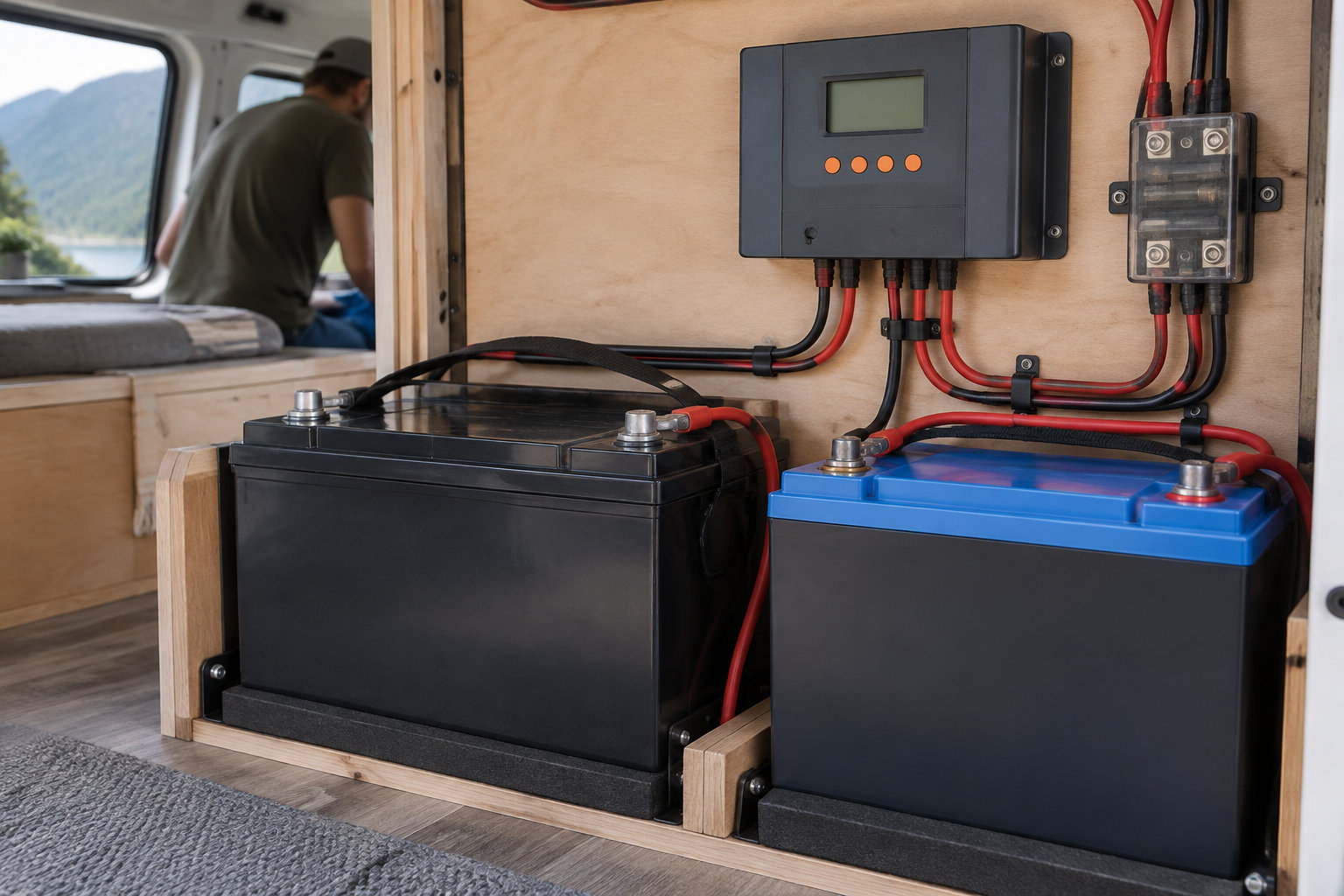
Check battery voltage first. BougeRV systems support LiFePO4 and AGM settings. A portable panel needs a compatible controller or a power station with one built in.
Before you drill or bond anything, read your camper manufacturer’s roof warranty. A wrong adhesive, a screw through a roof rib, or an unapproved sealant can shift repair responsibility onto you. Check the warranty first, then order the panels.
FAQ
Will a 400 W solar panel run a fridge?
Yes, a 400 W array can run a 12V compressor fridge, but only with a battery.
The fridge uses about 300 to 600 Wh per day, and it runs after sunset when the panel produces nothing.
How long will a 400W solar panel take to charge a 200Ah battery?
A depleted 12V 200Ah battery takes about two clear days to recharge from one 400 W panel.
The battery holds about 2,400 to 2,560 Wh. The array makes about 1,280 Wh per day at four peak sun hours.
How long will a 200W solar panel take to charge a 12V battery?
A 200 W panel needs about two clear days to fill an empty 100Ah 12V battery.
It makes about 640 Wh per day at four peak sun hours. A 50Ah battery can approach one clear day.
Can a portable solar panel charge a truck camper battery?
Yes, when the panel connects through a charge controller or a power station with a solar input.
Check that voltage, polarity, and battery chemistry match before you connect anything.