A plug-in solar kit can sit on a balcony or a roof and feed power into your home through a normal outlet. But where does that power go, and does it still work during an outage?
This article explains how the panel, the microinverter and the plug connect, which rules apply in your state, and what a kit can really save.
Plug-and-Play Solar Microinverter Explained: What It Does in a Kit
Sunlight makes the panel produce direct-current (DC) electricity. The microinverter, a small box behind the panel, converts that DC into alternating current (AC), which home appliances use.
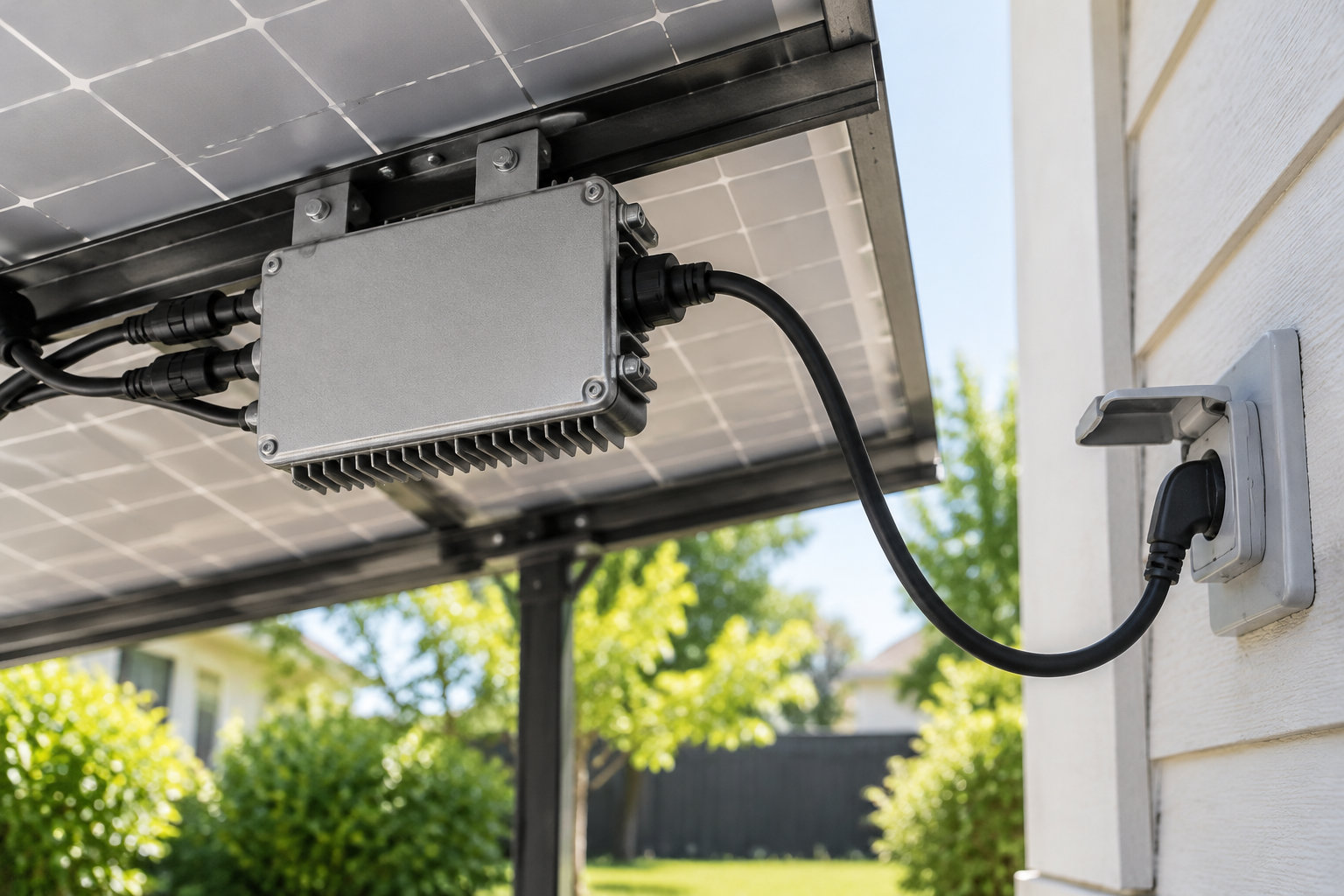
A cable carries that AC to a plug, which fits a standard 120V outlet, so the power reaches your home wiring. Compare plug-and-play solar kits with microinverters before you choose one.
Here is what the kit does and does not do, and how it compares with a full installation:
- It lowers what you buy from the grid while the sun shines.
- It does not power one appliance straight from the panel, because its power goes into the home wiring.
- Extra power is either sent back to the grid or stored, depending on how the system is set up.
Why a Grid-Tied Kit Shuts Off During a Power Outage
A grid-tied kit shuts off in a power cut by design. Its anti-islanding protection stops the microinverter from feeding a cut-off section of grid, which protects utility workers on that line.
The IEEE 1547-2018 standard requires the kit to detect this island and stop energizing it within two seconds. Before you plug anything in, check how to install balcony solar panels safely.
Without a battery, a grid-tied kit produces no power during an outage, even in full sun. In 2025, the median customer across the 50 states and Washington, D.C. was without power for 255.7 minutes, including major events.
If you plan to rely on the kit during an outage, choose a battery from the start. A battery stores solar energy for later use, including when the grid is down.
Which States Allow Plug-In Solar, and When the Rules Apply
Ten states have passed plug-in solar laws, including California, New Jersey, Colorado and Utah. Passing a law does not mean it already applies, though. Check when it takes effect in your state before you buy.
Being on the list is not enough. To see which rules apply to you and what a kit can save, read the benefits of plug-and-play solar for a home.
Each state sets its own limit and start date.
| Criteria | Maine | Maryland | Colorado | California |
|---|---|---|---|---|
| Power limit (AC) | 420 W, or 1,200 W with an electrician | 1,200 W | 1,920 W | 1,200 W per dwelling |
| In force | July 1, 2026 | July 1, 2026 | August 12, 2026 | January 1, 2027 |
| Landlord and HOA rules | Not covered | Not covered | From January 1, 2027 | Not covered |
| What to check | Notify utility within 30 days above 420 W | Notify utility before installing | Landlord and HOA rules | Utility may require an online notice |
What a 400 to 800 Watt Kit Can Actually Run
In Boston, Portland, San Diego and Bakersfield, a 400-watt kit could offset all the electricity a refrigerator uses. The catch is timing.
The panel only produces while the sun is up, and the fridge runs day and night, so the kit covers only the daytime share.
Run the washing machine at midday, when the panel is producing, and the kit covers part of its load as it runs. To see how the parts connect, read how plug-and-play kits are set up.
Three loads, one grid
Window air conditioner
- Running power: 710 W
- Annual use: about 532 kWh
- Fit: marginal, only with an 800 W kit, and only in full sun
Portable electric heater
- Running power: 1,500 W on high
- Annual use: 900 kWh (4 hours a day, 150 days)
- Fit: too big for any 400 to 800 W kit
Wi-Fi router and modem
- Running power: about 10 W, day and night
- Annual use: about 88 kWh
- Fit: easy, but night hours still come from the grid
Small Kits Cost $500 to $1,500 and Save Roughly $13 to $50 a Month
A typical plug-in kit rated 400 to 800 watts costs $500 to $1,500. These are estimates. Monthly savings on the power bill are roughly $13 to $50, depending on local sunlight and electricity prices.
Your own result depends on your sun and your rates, so check your bill first. For an 800-watt kit, estimates put the price near $1,500 and the payback at two to five years.
The same 400-watt system saved $214 a year in Boston and $296 in San Diego, so sunlight and your local rate matter. Permit or electrician fees come out of those savings, and they vary by state and system, so ask your utility whether notice is required. For the panel side, read about how panel efficiency is improving.
UL 3700 Is the Standard Written for Plug-In Systems, but Few Kits Meet It Fully
UL 1741 covers inverter safety and grid connection, and IEEE 1547 sets the grid rules. Neither is written for plug-in kits. UL 3700 is the standard made for plug-in solar systems.
The APsystems EZ1 has CSA certification to UL 3700. The Hoymiles HiFlow Pro is only described as compliant, which is not a third-party certification. Both are only inverters, so ask for proof covering the whole kit.
Before plugging in, check these points, and see how to connect plug and play solar to the grid safely:
- Under one permitted layout, the main breaker plus 125% of the kit’s output current must not exceed 120% of the busbar rating.
- Do not assume a 15-amp outlet is safe; check the other loads on that circuit.
- Avoid extension cords and power strips, and don’t overload the circuit.
A Small Kit Trims Part of a Bill, Not the Whole Home’s Load
Plug-in kits are small: common sizes run 400 to 800 watts. A rooftop system is built to cover a whole house, so the two do different jobs.
An 800-watt kit on a 1,200-square-foot apartment makes 70 to 110 kWh a month (kilowatt-hours, the unit on your bill). That covers 12% to 18% of the roughly 600 kWh used, so it trims part of the bill.
A plug-in kit lowers your grid use only while the sun shines. It produces nothing during a power cut unless you add a battery.
Check when your state’s law takes effect, then compare the likely savings with your own bill. Ask for certification that covers the whole kit, and check the other loads on your circuit before you plug in.
Frequently asked questions
Do I need an electrician to install a plug-in solar kit?
Not always. It depends on your city, state and utility. Some places let you plug in the kit yourself, while others require a licensed electrician or a permit.
Your utility may also need to be told before you connect it, so check those rules first.
Can I take a plug-in solar kit with me when I move?
Usually yes, but only if the new home allows it. Before you move, check the new state’s law, the utility’s notice rule, and any landlord or HOA rules. Then check the outlet’s circuit before plugging in.
Does a plug-in solar kit affect my home insurance?
It can, so ask your insurer before you install the kit. Policies differ, and some may not cover a panel that was added without telling them.
Describe the kit and its wattage, then ask whether it is covered if it is damaged or causes a fire.
Can a plug-in solar kit be used in an RV or van?
Usually not. A plug-in kit is grid-tied: it feeds a home’s wiring and shuts off in a power cut, and an RV or van has no grid to feed. Vehicles need an off-grid setup with their own battery instead.