Buying a solar panel for a teardrop trailer is easy. Knowing whether it can keep up with your fridge is harder. The wattage on the label tells you very little about that.
This guide shows you which setups work and how to wire them safely.
Solar panel for teardrop trailer systems range from 100W add-ons to factory packages
Factory packages start at 120W or 140W. Larger teardrop trailers now carry 310W roof arrays, 100Ah lithium batteries, and built-in inverters for 120V appliances. Know that gap before you decide how much power you need.
- nuCamp TAB 320: 180W of solar and a 100Ah lithium battery in the standard package, with dual 190W panels and a 200Ah battery available as upgrades.
- nuCamp TAB 400: 310W of solar, a 100Ah lithium battery, a 1,200W inverter, an external solar port, and battery monitoring.

Usable roof space is smaller than the outside dimensions suggest. A roof fan, the curve of the hatch, a rack, edge clearance, and service access all take their share first.
Measure the flat mounting area, not the trailer’s total length. A 100W rigid panel measures about 34.1 by 22.8 inches and weighs 13 pounds. A 100W flexible panel measures about 43 by 22.9 inches and weighs just 5.3 pounds.
The weight difference alone can decide which one a light trailer can carry.
Measure before you buy
- Measure the flat mounting area, not the total length of the trailer.
- Subtract the roof fan, the curve of the hatch, the rack, the edge clearance, and the service access.
- Compare the panel weight with what your trailer can safely carry.
Roof-mounted and portable panels suit different camping conditions
A roof-mounted panel charges while you drive. It needs no setup at the campsite.
A portable panel lets you park in the shade. You place the panel 20 or 30 feet away in direct sun. That often produces more energy than the roof ever will.
Fixed panels reduce daily setup work
Roof mounting keeps the panel ready every day. But it asks for drilling, sealant, cable routing, and wind-load planning. It also adds permanent weight above the center of gravity.
Plan those before you buy, not after the first leak.
Flexible panels fit curved fiberglass roofs. They skip the four mounting holes. Their five-year material and output warranty is much shorter than the 25-year performance warranties on some rigid panels.
Choose by how long you expect the panel to last.
Portable panels trade storage space for better sun access
A portable suitcase panel needs a dry, clear storage spot. It also needs a weatherproof cable path and several minutes of setup each day.
In return, its adjustable legs let you face the sun directly. You are not stuck with whatever angle the roof gives you.
The 400W Renogy suitcase folds to about 27.9 by 33.7 by 3.2 inches. It weighs 30.2 pounds.
It needs a charge controller. The exception is the version with a 40A MPPT controller already included.
A practical mixed setup pairs 100W to 200W of fixed solar with a 200W portable panel. The fixed panel handles maintenance charging. The portable panel covers shaded campsites, winter trips, and weekends when the refrigerator runs hard.
Daily watt-hour use determines panel and battery size
A 60W refrigerator running 10 hours uses about 600Wh. Multiply watts by realistic daily runtime before you choose panels or batteries. Guessing at this number is where most undersized systems begin.
| Load | Daily estimate | What it means |
|---|---|---|
| 12V compressor refrigerator | 400 to 600Wh | The main load on many teardrops, especially in hot weather. |
| LED lights | 10 to 30Wh | Four 5W lights used for one to two hours remain a small load. |
| Roof fan | 30 to 120Wh | Runtime and fan speed matter more than the fan’s maximum rating. |
| Phones and USB devices | 20 to 60Wh | Several daily charges rarely match refrigerator demand. |
| Water pump and controls | 10 to 40Wh | Short operating cycles keep the total modest. |
A light setup using lights, phones, a fan, and occasional water-pump use may stay near 200Wh per day. A refrigerator-based setup commonly reaches 400Wh to 600Wh. That is double the load, and it needs a correspondingly larger array.
For panel sizing, divide daily watt-hours by realistic peak-sun hours, then allow for wiring, controller, heat, angle, and cloud losses. A 500Wh load with four peak-sun hours needs about 167W of panel at 75% system efficiency.
A 100W panel may produce roughly 400Wh to 500Wh on a good sunny day. Winter sun, forest shade, coastal cloud, and low panel angles can cut that figure sharply. Treat the best-case number as a ceiling, not a plan.
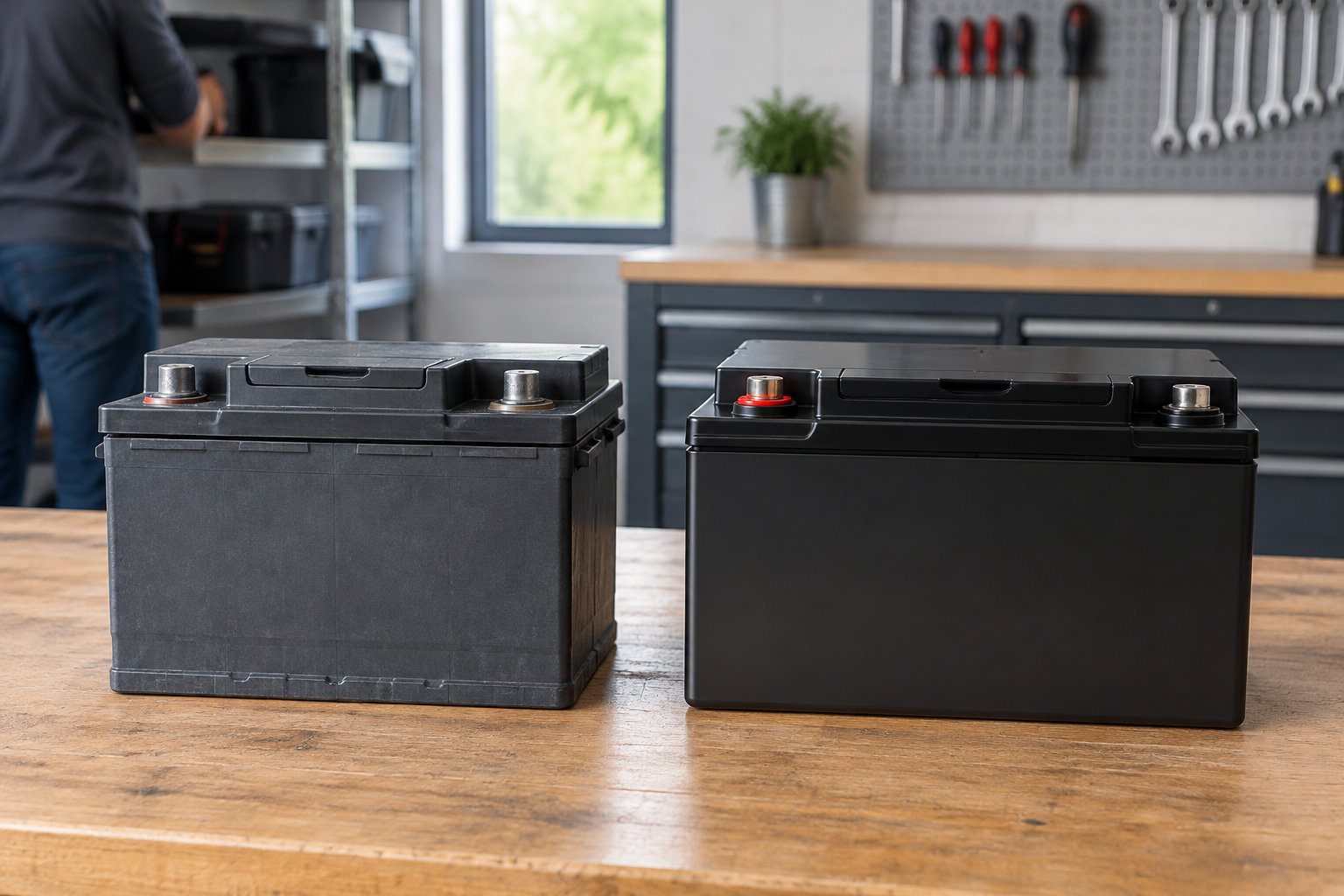
A 100Ah AGM battery offers roughly 600Wh of practical storage. A 100Ah LiFePO4 battery offers close to 1,200Wh. At the same amp-hour rating, lithium gives you about twice the useful energy, because you can draw it down much further without damage.
For light loads, pair 100W to 200W of solar with a 50Ah to 100Ah battery. For a refrigerator and daily fan use, 200W to 400W with 100Ah to 200Ah of lithium gives a workable reserve.
An inverter powering a coffee maker, microwave, or hair dryer uses energy as it converts 12V DC to household AC. Think of it as a pressure regulator in the line: it takes energy to do the conversion. Plan for a larger battery and array.
Keep one to two days of battery reserve for ordinary trips. Keep two to three days for forest campsites, winter weather, or long stretches without a backup charging source.
Before you size the system
- List every 12V load with its daily runtime, from the refrigerator to the phone chargers.
- Use the peak-sun hours of the season you camp in, not the summer best case.
- Decide how many days of battery reserve your trips need before you buy anything.
Controllers, wiring, and total cost shape the installation
The basic path runs from panel to charge controller, then to battery, then to DC loads. An inverter connects to the battery to supply 120V AC power. Every link has to match the others. The weakest one limits the whole system.
MPPT suits larger trailer arrays
A PWM controller is the cheaper choice for small, closely matched 12V panels. An MPPT controller turns excess panel voltage into extra charging current. That makes it the better fit for arrays above about 200W, or for panels wired at higher voltage.
A factory controller may be rated for the installed panel. Adding a 100W or 200W panel can still exceed its current or voltage limits, even when the battery is large enough. Check the controller’s rating before you add a panel, not after it trips.
Safe wiring protects the trailer
Connect the battery to the controller before connecting the solar panels, and disconnect the array before the battery. This lets the controller read battery voltage safely. Reversing that order can damage the controller.
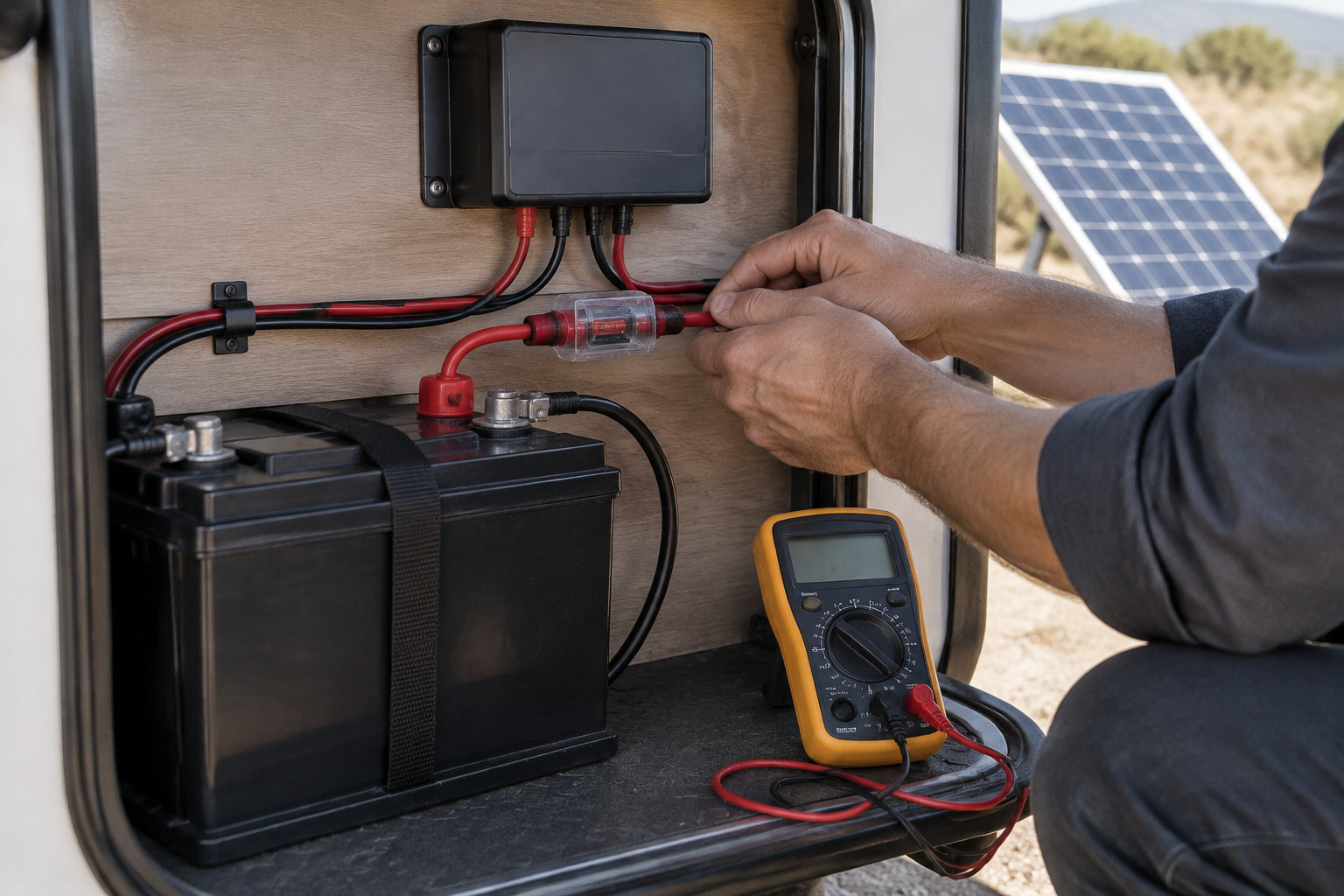
Install a fuse close to the battery on the positive controller-to-battery cable. Verify polarity with a meter. Keep voltage drop near 3% or less. Long, thin cable is like a narrow pipe: power still flows, but less reaches the battery.
Roof glands, brackets, sealant, cables, and monitoring can add hundreds of dollars beyond the panel price. A professional roof entry adds more.
Current official component prices, before installation:
- 200W panel kit: about $230 to $290
- 400W starter kit: near $395
- 400W kit with DC-to-DC charging: near $800
- 400W suitcase panel: about $496
A tow-vehicle DC-to-DC charger adds power while you drive. It regulates alternator energy for the trailer battery. MPPT models can also combine vehicle charging with solar input.
A small 12V teardrop usually needs a solar panel, a controller, a battery, a fuse block, and an optional inverter.
A 400W system with DC-to-DC charging, lithium storage, roof hardware, and monitoring needs a full wiring plan. Make that plan before you drill anything.
Check these before you add a panel
- Confirm the controller’s current and voltage ratings cover the new panel
- Place the fuse close to the battery on the positive cable
- Verify polarity with a meter before connecting anything
- Keep voltage drop near 3% or less
- Get a complete wiring plan before drilling the roof
Before you buy anything, write down your daily watt-hour use for every device you run. That total, not the wattage printed on a panel box, should decide whether you need a roof array, a portable panel, or both.
Frequently asked questions
Can a teardrop trailer charge while you tow it?
Yes. A solar panel can charge the battery through its controller, and a DC-to-DC charger adds a second charging path while you tow.
A DC-to-DC charger adds a second path from the tow vehicle. It works when solar output is weak or unavailable.
Can solar panels run air conditioning in a teardrop trailer?
Usually not: a small solar array cannot sustain air conditioning, because the compressor creates a large, repeated load.
Some factory DC air-conditioning options still call for a portable generator between battery charges, even with a 140W panel and a 120Ah lithium battery.
Does a solar panel need a charge controller to charge a 12V battery?
Yes, unless the panel feeds a complete power station or another device with a built-in controller.
The controller regulates voltage and charging stages. On a 12V system, a 400W panel can require about 33A of battery-side capacity.
Can a 400W solar panel run a 12V compressor fridge?
Often, yes. At four peak-sun hours and 75% efficiency, a 400W panel makes about 1,200Wh a day, compared with a typical fridge’s 400 to 600Wh. Winter sun and shade can reduce that output.
At four peak-sun hours and 75% efficiency, it makes about 1,200Wh a day. Your fridge needs 400 to 600Wh, so winter and shade are the real limit.