Most boat solar kits come with a panel, a controller and cables, but no battery.
So the real question is whether that kit can cover what your boat uses each day. This article shows you how to choose the panel type, size the array, wire it safely and check whether the cost is worth it.
Top picks at a glance
A 20 to 30 W kit, like the EcoWorthy 25 W (about $42) or the NewPowa 30 W (about $60), only tops up a small boat’s battery.
It can’t run a fridge every day. Neither includes a battery or an inverter.
For daily use, add up your appliances’ watt-hours per day first. That total sets the array size, not the kit name. For a boat without dock power, start with off-grid solar power for beginners.
How many watts your boat really needs
Adding up your daily energy use
Start with each appliance: multiply its current in amps by its daily hours of use. The result is amp-hours per day. Then multiply by battery voltage to get watt-hours. On a 12 V boat, 50 Ah becomes 600 Wh.
A 40 to 60 litre compressor fridge draws 4 to 6 A when running. In a hot cabin, it runs 40 to 50% of the time and uses 40 to 60 Ah a day. Then add your other devices.
Turning energy into panel size
For a small mobile setup, start with 100 W to 200 W folding panels. For a fixed boat, size the array with this calculation:
- Divide your daily energy by the hours of full sun you get. For 720 Wh (60 Ah at 12 V) and 4 hours, that is 180 W.
- Divide that result by 0.7 to cover heat, salt, cables and charging losses: 180 ÷ 0.7 ≈ 260 W.
- If the boat sits in shade or in a cloudy area, add margin on top of that figure.
Monocrystalline, polycrystalline or thin-film: which to pick
For a boat with little roof space, choose monocrystalline. It gives more power per square metre than polycrystalline, which runs at 15 to 17% efficiency and needs more area for the same wattage.
Thin-film panels sold for portable use run at 11 to 16% efficiency. Thin-film covers several technologies, so check the cell type in the product details instead of assuming one.
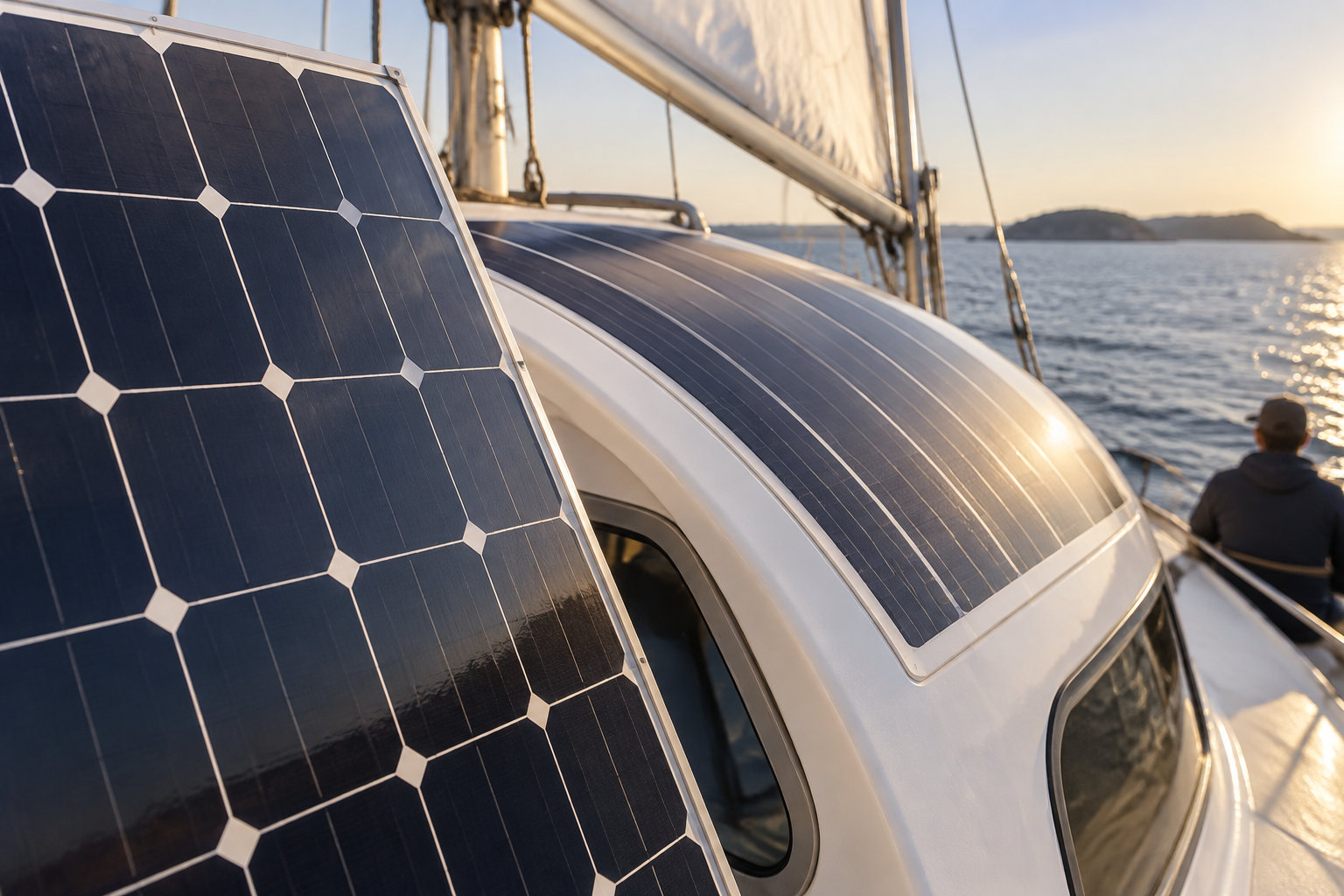
Rigid panels with a frame suit a flat surface you can bolt them to.
Flexible panels follow a curve, but check the bend limit of the model you pick. To compare kits and mounting steps, see the camper solar panel kit guide.
Charge controller and wiring basics
MPPT or PWM: which controller to choose
Pick an MPPT controller when your panels produce more voltage than your battery takes. It turns that extra voltage into charging current, so you get more from the same panel. The real gain depends on panel, battery and temperature.
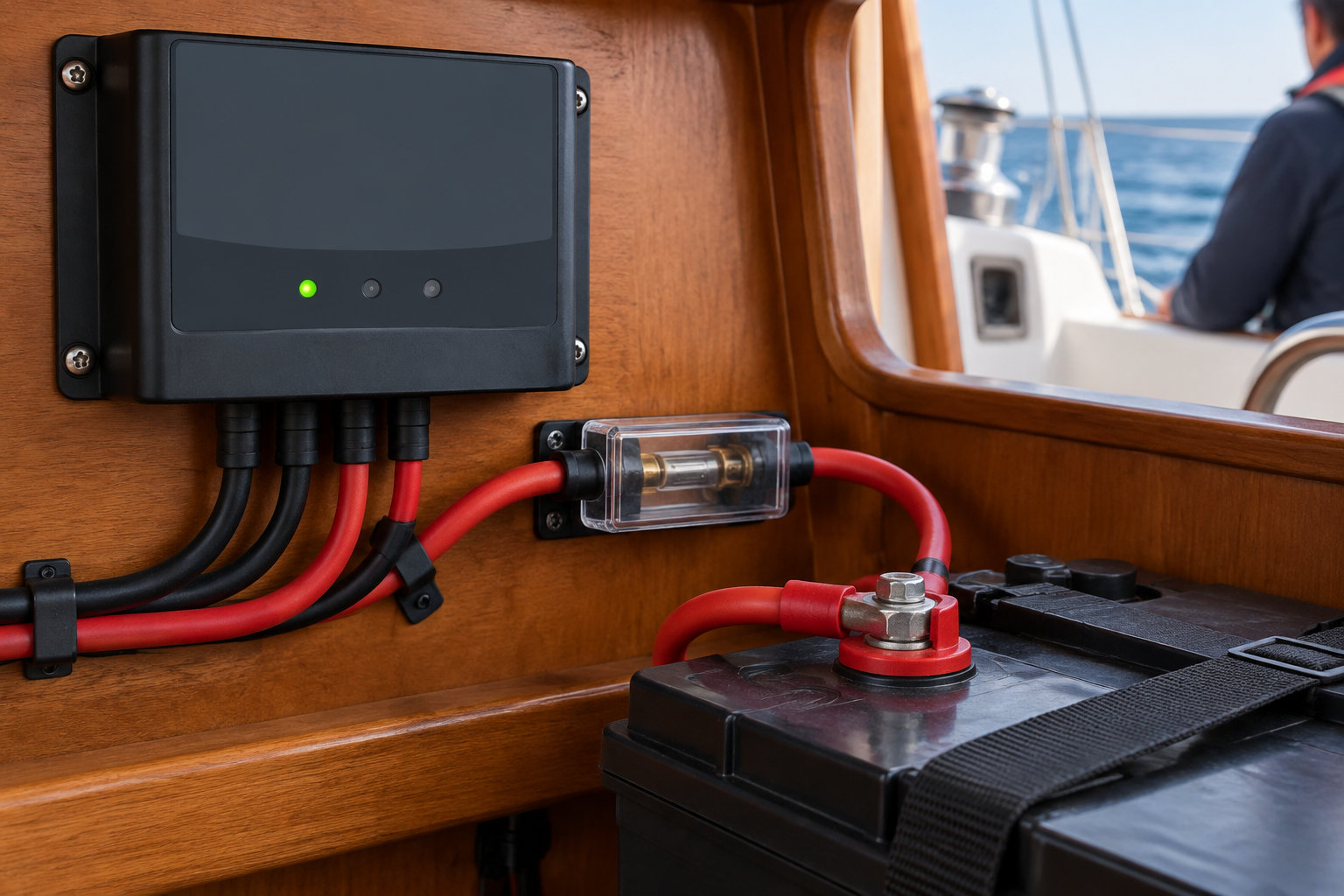
A PWM controller costs less, but it works best when panel and battery voltages match. Choose by battery voltage, panel power and voltage, and battery chemistry. For a full off-grid setup, see complete off-grid setups guide.
Safe connection order and fusing
Power flows from the panels to the controller, then to the battery. To connect it safely, follow this order:
- Connect the battery to the controller first.
- Then connect the panels to the controller.
- Put a fuse on the positive cable between the controller and the battery.
- Choose the fuse rating to suit the controller, cable and circuit, and check the equipment instructions first.
- Size each cable for its current, its length and your acceptable voltage drop, since one size does not fit every boat.
Mounting on deck and surviving salt water
Mount the panel high, often on the bimini, away from shade. A panel lying nearly flat catches sun whatever the boat’s heading. Check the shadow from rigging first, because shade cuts output.
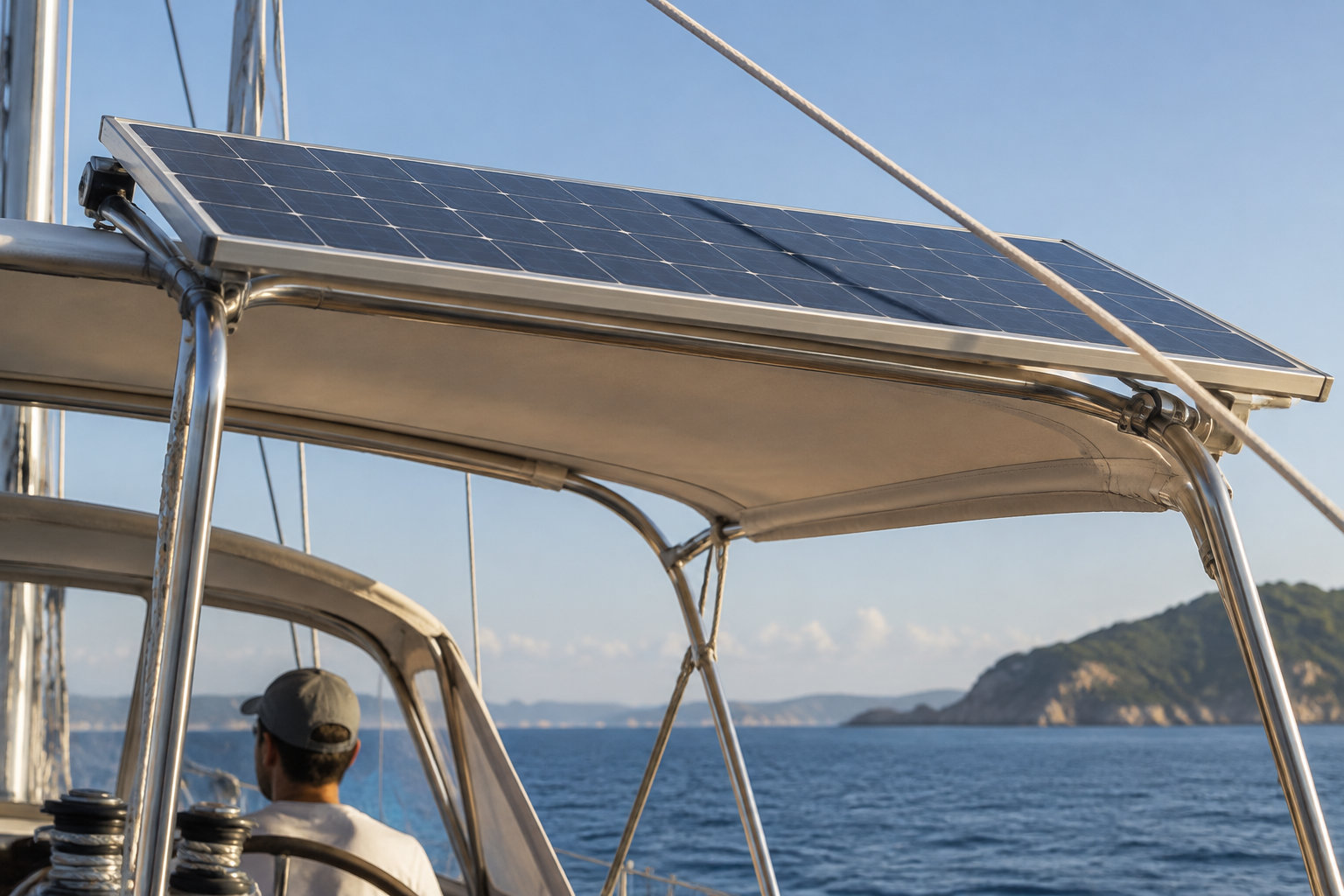
Choose IP67 panels for spray and rain: SunPower 170 W, Renogy 100 W flexible, or NewPowa 30 W. The EcoWorthy 25 W kit is only IP65. Check the controller and connectors too.
Rinse panels with fresh water every six months to remove salt. Check cables and connectors for corrosion at the same rhythm, then check fittings after a strong storm. For a flat, low mount, see low-profile panel setup.
Which kit fits your kind of boat
Small boats and emergency backup
A 20 W panel can keep a small boat’s battery topped up, or give emergency backup when the battery runs low.
Use a 20 to 30 W kit only if your daily use stays light: it cannot run a fridge all day. Each kit already has a panel, controller and cables. You only add a battery to store the energy.
Cruising sailboats
A cruising sailboat needs far more than a 20 to 30 W kit, so check these three points:
- Daily use: a compressor fridge alone draws about 20 to 45 Ah a day on a 12 V system.
- Panel output: a 100 W panel makes roughly 400 to 500 Wh a day, or about 33 to 42 Ah at 12 V.
- Full recharge: five hours of full sun won’t fully charge a 100 Ah battery, because losses and the starting charge count.
Portable kits for a dinghy or temporary use
A portable kit suits a dinghy or a boat used only now and then. It unfolds in the sun and packs away after use, so you can stow it between trips.
Check that your boat has a battery and a safe spot for the panel. The Renogy 100/200 W kit, with a 20 A controller, starts at about $230. For winter, see how to store mobile solar panels.
Our pick and whether the cost pays off
Start with your daily watt-hours, the energy you use each day. A 100 W panel makes roughly 400 to 500 Wh a day, or 12 to 15 kWh over 30 days if the sun stays much the same.
Compare that with what shore power or generator fuel costs you. A Renogy 100 W flexible panel costs about $150 alone, a SunPower 170 W about $399 alone. If it covers most of your daily use, it pays off.
Add the controller, wiring and mounts, which those prices leave out. For a full kit with mounts and wiring, see how to size, install and power a kit.
Remember this: a 20 to 30 W kit only tops up a battery. A boat with a fridge needs an array sized from its daily watt-hours.
Next, list each appliance’s daily watt-hours and add them up. That total sets the array size. Then compare kits, and count the controller, wiring and mounts before you decide.
Frequently Asked Questions
Can a 100 W marine solar kit keep a fridge running all day?
Not reliably. A 100 W panel makes about 33 to 42 Ah a day, while a compressor fridge draws about 20 to 45 Ah a day.
Whether the panel keeps up depends on the sun, shade and the other devices on board.
Do I need a battery to use a boat solar kit?
Yes, if you want to use power when the panel makes none. A battery stores the energy for later use, so you can run devices at night or on cloudy days. Follow the controller’s instructions when you connect it.
Can I connect a solar kit to my boat’s existing battery bank?
Yes, if your battery bank’s voltage, chemistry and charging profile suit the controller. Check those three points first. Then connect the battery to the controller, and only after that the panels, following the equipment instructions.
How long do marine solar panels last?
The clearest figure is the warranty: the SunPower 170 W flexible panel has a five-year warranty on its materials and its power output. Check the warranty of the model you pick, then inspect its cables and connections regularly.