On a multi-day hike, your phone drains fast when you use maps, photos and GPS all day.
A power bank runs out too, and it cannot refill itself on the trail. This article compares compact solar panels by weight, output and price, and shows when a panel beats a power bank.
Which panel to pick for your hiking style and budget
Pick a panel by pack weight, daily charging load and budget. A panel only works as a power bank top-up: it makes power in sun, while the bank holds energy for night use.
For a weekend, a charged power bank is simpler. For a week or more with several charges, a panel is worth carrying. Before you buy, work out the wattage you need.
Compare the four panels on weight, wattage, price and one-hour output.
| Criteria | FlexSolar E10 Mini | Blavor 10W | BigBlue SolarPowa 14 | FlexSolar 40W |
|---|---|---|---|---|
| Weight | 7.3 oz | 12.6 oz | 12.0 oz | 26.1 oz |
| Rated wattage | 10W | 10W | 14W | 40W |
| Listed price | $28.99 | $49.99 | $49.99 | $64 |
| Direct sun output | 1,247 mAh | 1,401 mAh | 1,178 mAh | 4,302 mAh |
| Indirect light output | 235 mAh | 295 mAh | 275 mAh | 1,038 mAh |
FlexSolar E10 Mini: the lightest panel for ultralight trips
The FlexSolar E10 Mini is a 10W panel with monocrystalline cells. It folds to 6.3 × 4.7 × 1 inches and weighs 7.3 oz in testing, so it fits in a small pocket and adds little to a pack.
Its low weight and flat fold make it the ultralight pick. Two carabiners clip it to your pack. For a heavier load, compare camping and hiking panels.
In a one-hour test, the E10 Mini added 1,247mAh to a 10,000mAh bank in direct sun, but only 235mAh in indirect light. That gap means the test is not a reliable charging time for a trip. Use the panel to top up a power bank in open sun, not for a steady direct phone charge.
The USB-A port is exposed, so keep dust and water off it when you carry or use the panel.
Blavor 10W: the best buy among light panels for direct sun
For sunny trail days, the Blavor 10W is the best-value light panel. It has a USB-A and a USB-C output, each rated for up to 2A, so two devices can charge at once.
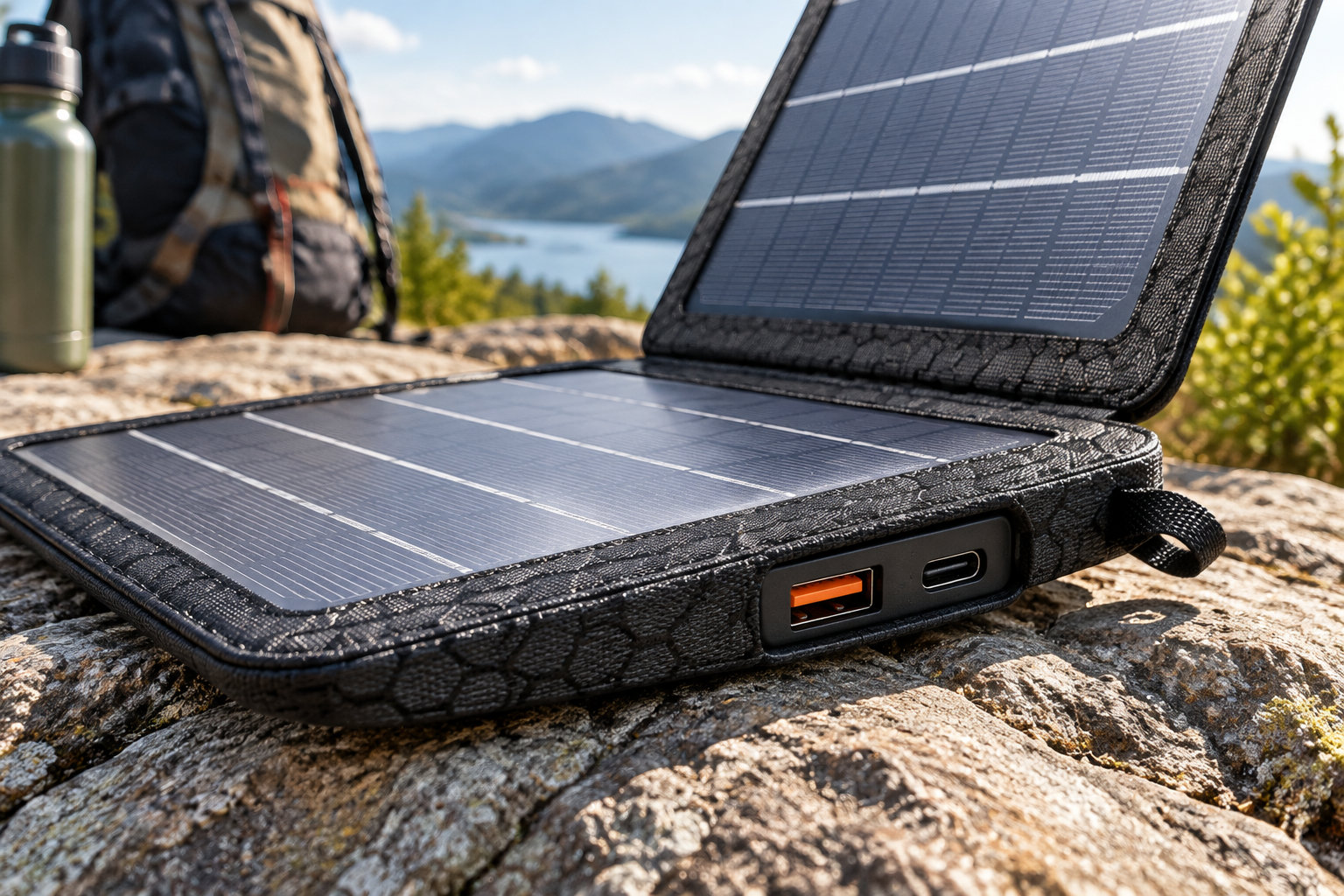
It weighs 12.6 oz and folds to 7.5 × 7.5 × 1 in. In one hour of direct sun, it produced 1,401mAh, against 295mAh in indirect light, so put it where the sun hits it directly.
BigBlue SolarPowa 14: more rated wattage at a light weight
The 14W rating is a best-case ceiling under ideal sun, not field output. In a one-hour test, the SolarPowa 14 produced 1,178mAh in direct sun and 275mAh in indirect light.
Plan for the indirect figure on overcast days and the direct one on clear afternoons. The panel’s pocket holds a 10,000mAh power bank, so the bank stores what the panel collects while you walk.
Use these placement steps to get the most output from the SolarPowa 14 in the field:
- Hang it from your backpack or a tree with the attachment holes and included carabiners, so the panel faces the sky.
- Keep it in full sun. Deep shade or a shadowed canyon sharply limits charging, so move into the open before you stop for a charge.
- Check the angle every hour or so, because the sun moves across the sky during the day.
FlexSolar 40W: the group-trip panel for charging several devices
The FlexSolar 40W is the panel to pick when your group needs to charge several devices each evening.
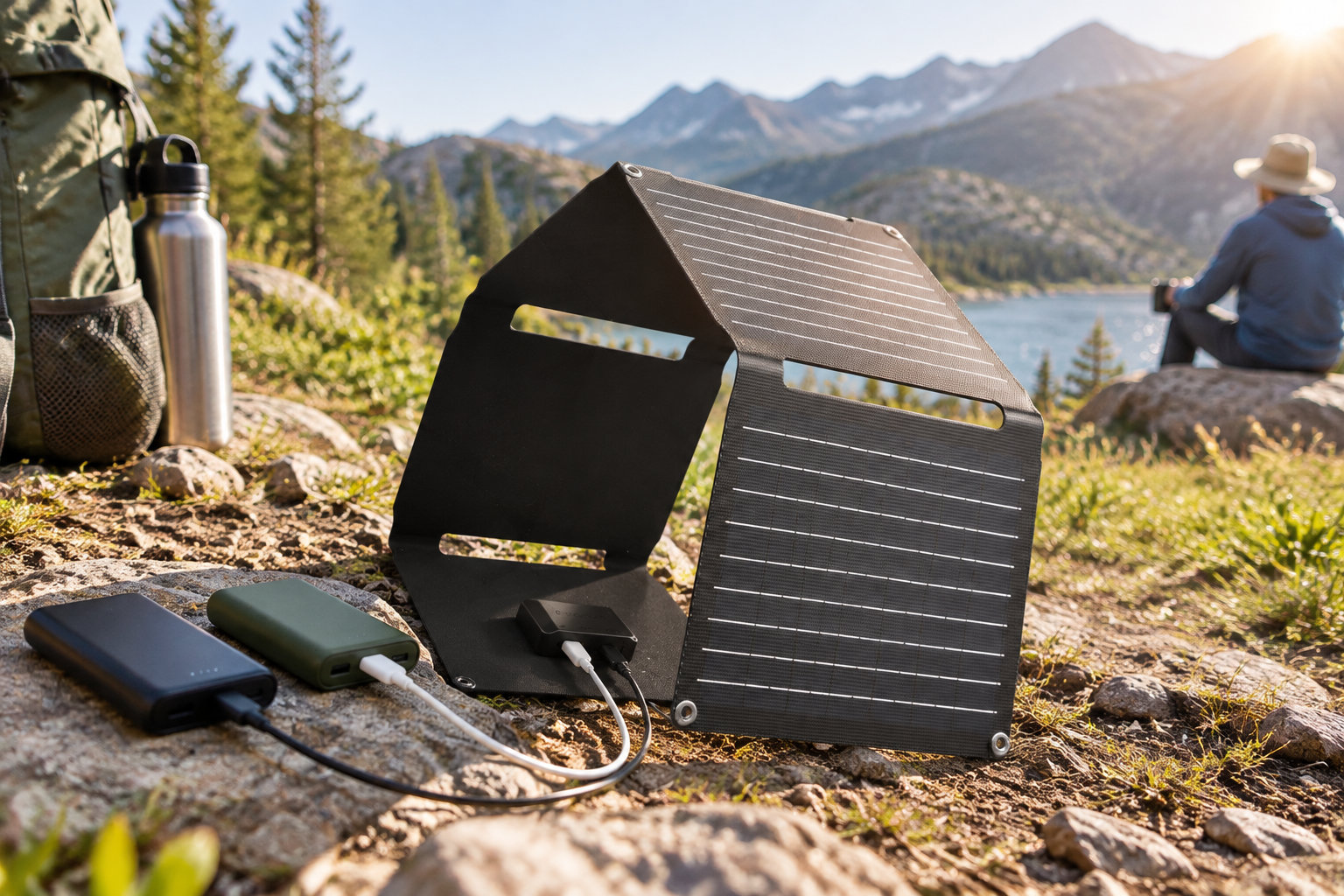
It weighs 26.1 oz in a test and folds to 10 × 9 × 1.5 in, so it fits in a backpacking load. In full sun, it recharged two phones in under two hours.
Its USB-A and USB-C ports each deliver up to 18W, and its DC port delivers up to 40W. Several people can plug in at once, so one panel can cover the whole group’s phones and gear.
Confirm before the trip
- Count every device that needs charging each evening, and add up their battery capacity.
- Check that your phones charge through the 18W USB ports, and that any power station uses the 40W DC port.
- Pick a camp spot in open sun, because shade cuts the output.
- Agree who carries the panel and who sets it up at camp.
- Bring a power bank for cloudy days, since indirect light gave only 1,038mAh in an hour.
Nitecore FSP30: three ports and 30W for camp charging
The Nitecore FSP30 offers 30W and three ports, so several devices can charge at one camp. At 1.38 lb, it suits car camping or a basecamp better than a backpack.
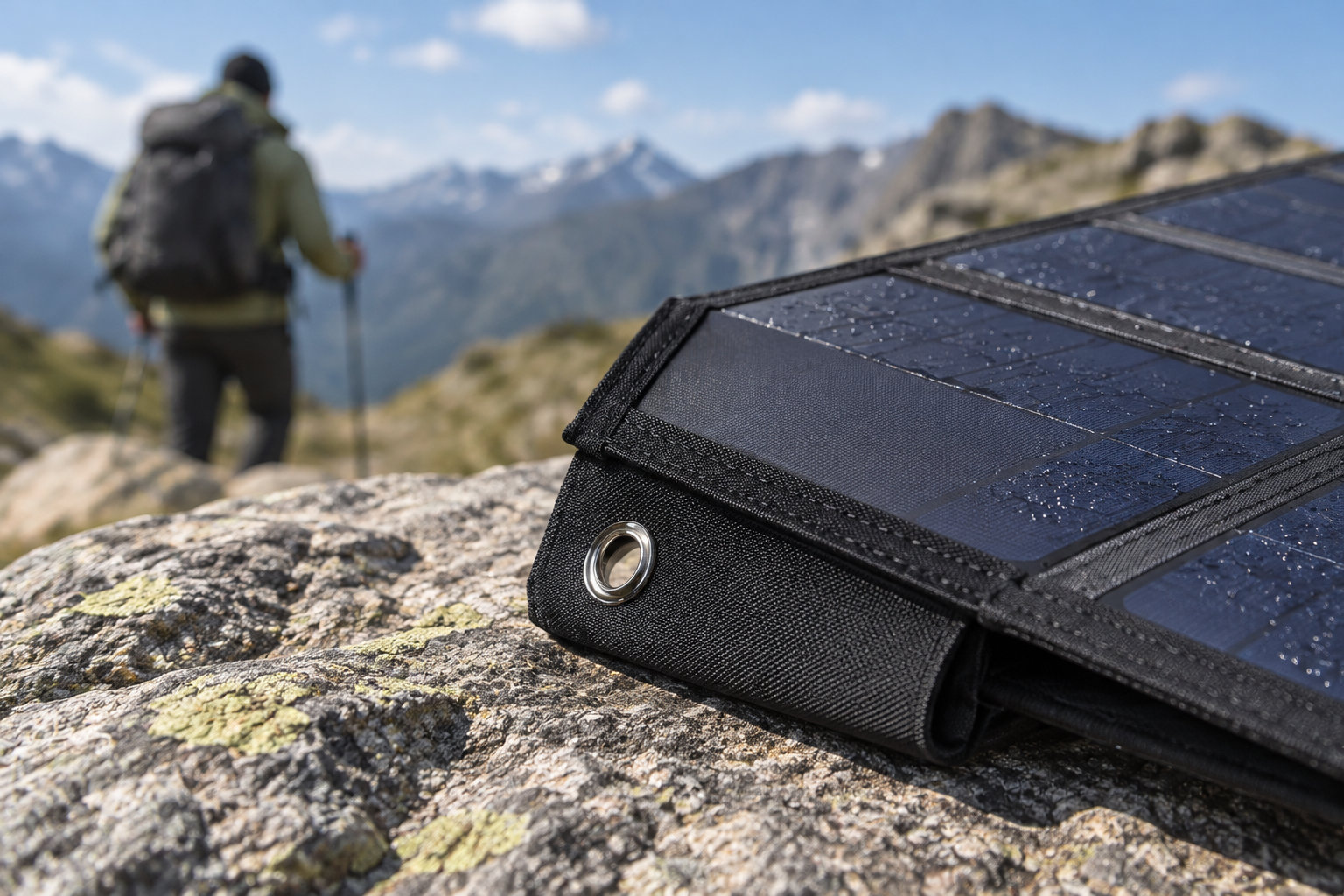
Folded, it measures 11.61 x 6.69 x 1.77 in. Opened, it runs 34.65 in long, so you need a flat spot at camp. If you carry it all day, the weight matters more than the wattage.
The two USB-A ports share one limit, and the USB-C port has its own:
- Both USB-A ports together put out 5V/3.1A, so two devices charge more slowly than one.
- The USB-C port reaches 18W, which suits a newer phone or tablet.
- A built-in pocket holds a small device while the panel charges.
- Metal loops at all four corners let you clip the panel to a pack or tie it to a tent line.
Anker SOLIX PS30: weather-resistant, but heavy for a backpack
The Anker SOLIX PS30 is weather-resistant, but it is heavy for a backpack. At 2.4 lb, it weighs about 1.0 lb more than the Nitecore FSP30 at 1.38 lb.
Its 30W rated output suits car camping or a basecamp. Set it in the sun at the tent and charge phones and lamps in the evening. If you hike in, choose a lighter panel.
IP65 covers rain and spray, not immersion. Dropping it in a stream or leaving it under water can damage the electronics.
Before you count on it, time a phone charge on a sunny day and on an overcast one, so you know its real output.
Pick your panel by pack weight, daily charging load and budget. A panel only tops up a power bank while the sun is out, so the bank still has to hold enough energy for the night.
Your next step is to list the devices you will charge each day. Then work out the wattage you need before you buy.
Frequently asked questions
Can a small solar panel fully charge a phone on a hike?
Yes, but only in steady sun. A small panel can charge a phone when the sunlight stays constant, yet its output drops sharply in clouds or shade.
Put a power bank between the panel and the phone so the bank evens out the charging.
How long does it take a 10W solar panel to charge a 10,000mAh power bank?
Expect several hours, and the sun sets the pace. A 10,000mAh bank holds far more energy than one hour of sun adds, so a 10W panel needs a long stretch of sun. Clouds or shade stretch the wait further.
Do portable solar panels still work on cloudy days?
Yes, portable solar panels still make some power on cloudy days, but far less than in full sun.
Clouds, fog and shade cut the sunlight reaching the panel, so output drops and a top-up takes longer. Expect a slow charge on overcast days.
Is a solar panel worth carrying on a weekend hike?
No, a solar panel is rarely worth carrying on a weekend hike. A charged power bank is simpler, and a panel only tops it up while the sun is out.
It pays off on a week-long trip with several charges, if it sits in open sun.