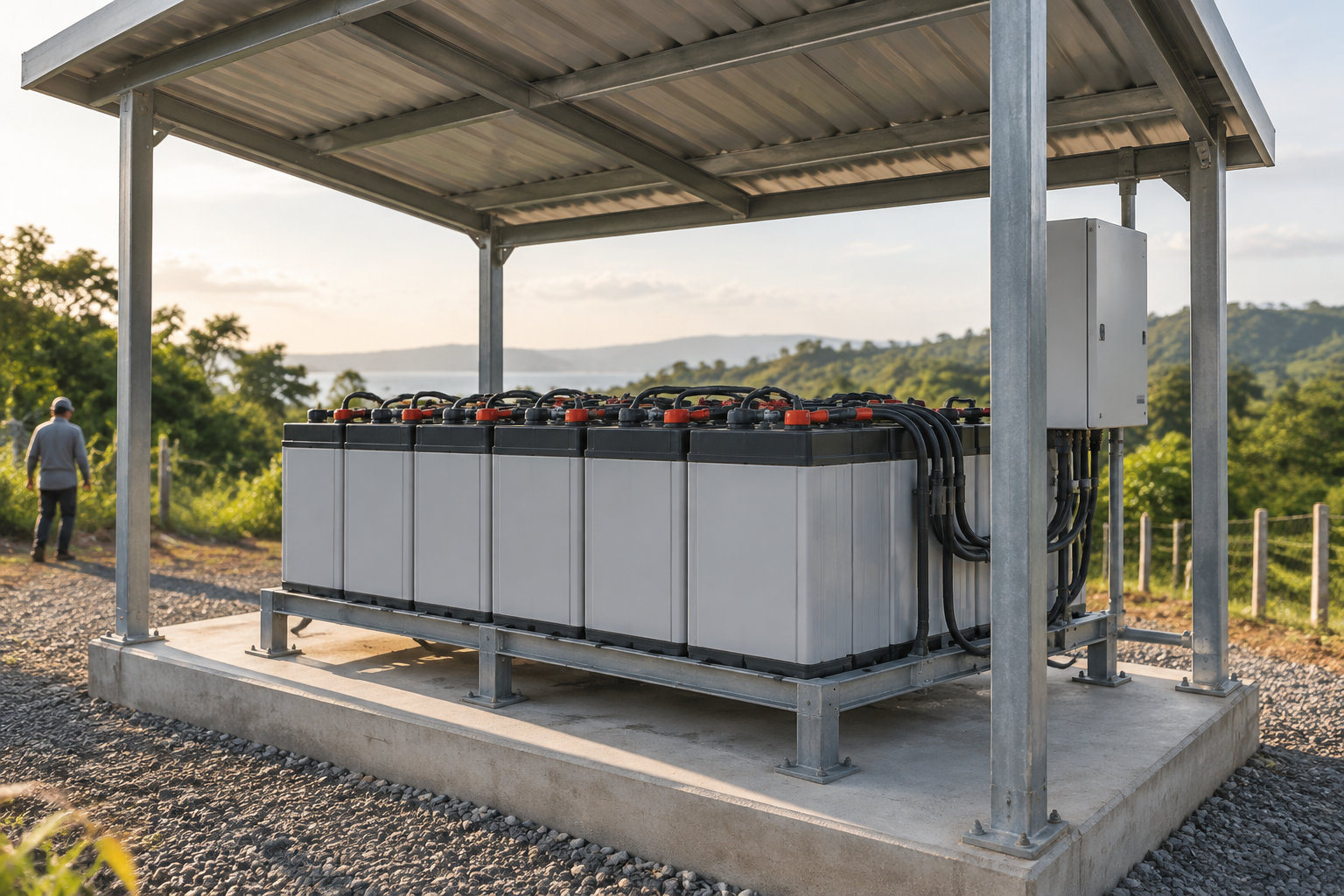
An old car battery in the garage can look like a free place to store solar power.
The real question is whether it can handle the daily charging and discharging that a solar system demands. This article explains why a car battery falls short and which options suit everyday solar storage.
The short answer: possible, but rarely the right tool
Yes, a car battery can store solar energy, but only for a small, occasional test. A standard car battery is an SLI battery (starting, lighting, ignition), built for one strong burst of current, not for deep discharge.
Solar storage draws power slowly over hours and repeats deeper discharges, so a starting battery fails quickly. For daily use, choose a different type.
Look for “deep-cycle” or “LiFePO4” on the label. A plain starting battery is the wrong type.
Skip cold-cranking amps (CCA). Group 65 car batteries range from 540 to 880, which tells you nothing about storage.
Benchmark cycles: 70 to 100 for flooded starting types, 2,500 for LiFePO4 marine batteries.
To shortlist alternatives, see solar panel battery options.
Why a starter battery wears out under daily solar cycling
A starter battery is built for a short, high-current burst that cranks the engine. After that, the alternator gives it a light top-up, not a full charge.
A solar system works differently. It draws power slowly for hours, then needs a full recharge every day, which a starting battery is not designed to handle.
Before you buy, learn how battery cycles affect life, and check these three factors:
- Deep discharge: the deeper each cycle, the shorter the life. Keep deep-cycle use between 50% and 80% of capacity.
- Discharge rate: a lead-acid battery usually gives less capacity at a high draw, so fast use cuts what you actually get.
- Deep-cycle design: a starter battery is built for brief bursts, not for daily deep drawdown.
How big a battery bank a solar setup really needs
List each appliance’s power in watts, from its label. Multiply watts by hours of use, then divide by 1,000 to get kilowatt-hours (kWh). A 60 W bulb running 5 hours uses 0.3 kWh.
Add the results for a day. Average U.S. homes use about 29 kWh daily, but yours may differ, so size the battery from your own total.
Size the bank in this order:
- Start from your daily total in kWh: at 24 volts, 1 kWh a day needs about 42 Ah of useful capacity.
- Useful capacity is what you plan to draw, so the rated capacity must be higher.
- kWh measures stored energy; kW measures how fast the battery charges or discharges.
- Count batteries from stored energy, voltage and usable capacity, never from panel wattage.
- Then compare LiFePO4 vs lithium-ion options for your voltage.
How a solar panel charges a car battery, and why the controller matters
The role of the charge controller
The charge controller sits between the panel and the battery. It controls the voltage from the panels and the voltage going into the battery, and it helps prevent overcharging.
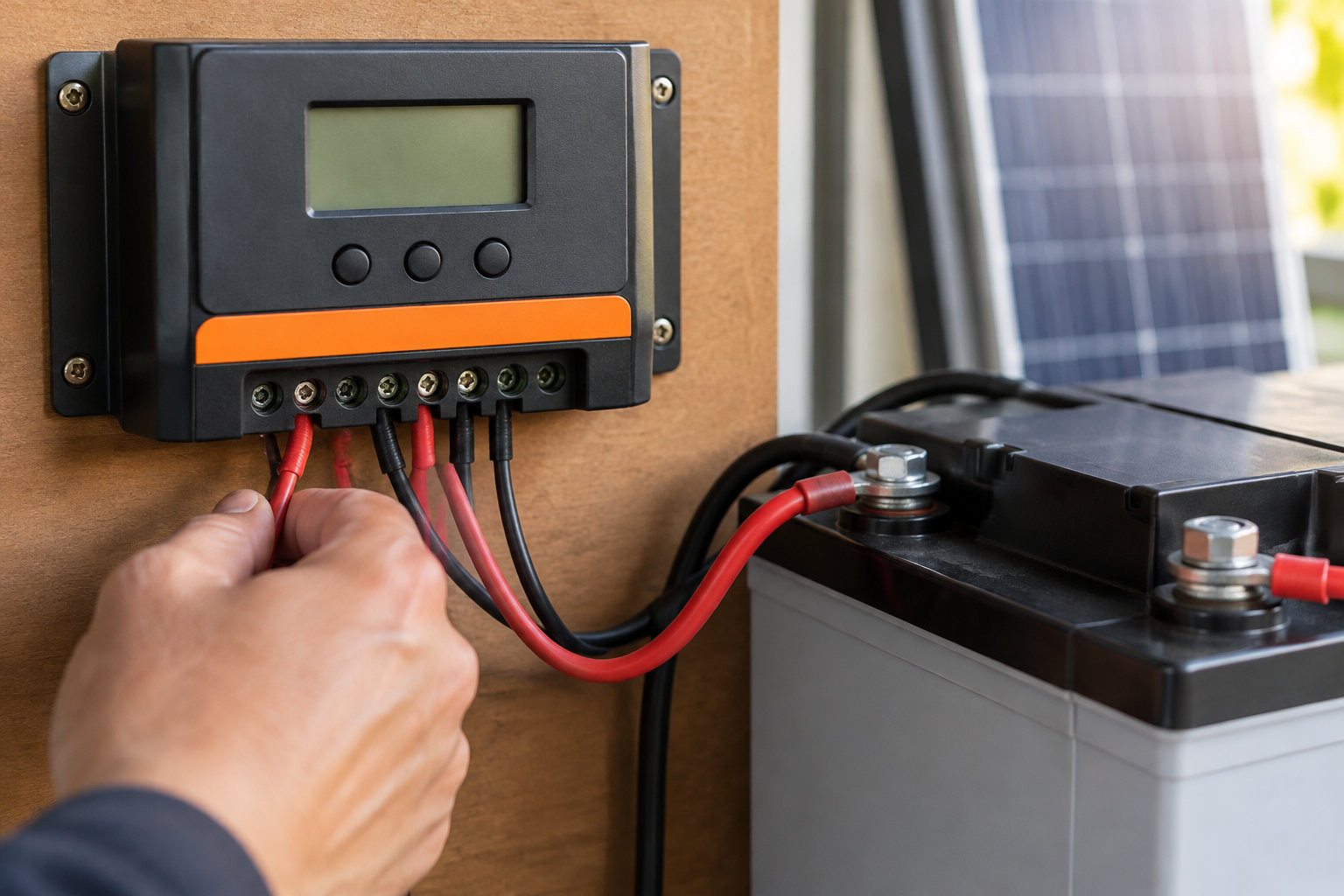
Match the controller to your battery chemistry. Lead-acid batteries need specific charging stages to last longer. A controller set for the wrong type can undercharge or overcharge the battery, so check its settings against the battery label first.
How long charging takes
No single charging time fits every setup. Panel wattage assumes ideal sunlight and temperature, while roof direction, tilt, shade, dust and wire losses cut the energy reaching the battery.
Use the energy-balance method: take the watt-hours (Wh) you use each day, divide by your site’s peak sun hours, then add a 20% safety buffer. For a camping setup, follow the step-by-step sizing guide to run your own numbers.
A 400-watt panel does not deliver 400 watts all day. Sun, angle, shade and system losses cut what it really collects, so a battery sized on the rating stays partly empty. Before the first charge, check the controller settings against the battery label, because a wrong setting undercharges or overcharges the battery.
Better options: deep-cycle, AGM and lithium batteries
Deep-cycle flooded lead-acid
Flooded deep-cycle lead-acid is the budget choice. The Interstate GC2-ECL-UTL is a 6-volt battery rated at 225 Ah (amp-hours, its stored energy) and lists at $214.95 suggested retail.
That price applies to this model only, not to every deep-cycle battery.
The upkeep is the catch. Check the water level often, and add only distilled water when it is low.
AGM and gel deep-cycle
Sealed AGM batteries skip water top-ups. Their electrolyte sits in a glass mat, so nothing spills and no water needs adding.
But the charger matters. Use one made for AGM, because a mismatched charger can damage the battery or shorten its life. Check the label and manual before buying, since AGM and gel batteries have their own charging requirements.
LiFePO4 lithium
LiFePO4 lithium gives the longest cycle life of the three options, and most units include a built-in management system that guards against overcharge and over-discharge.
Cycle counts depend on the model and on depth of discharge, the share of capacity you use each cycle. One Victron model gives 5,000 cycles at 50% depth of discharge, against 2,500 at 80%.