High-efficiency N-Type solar cells now reach over 24% efficiency, providing the maximum power density required for restricted deck spaces. We often struggle to maintain battery levels when mast shadows or salt corrosion degrade system performance. Reliability is non-negotiable when you are miles from the nearest coast.
We have analyzed the best solar panel kits for sailboats to help you secure total energy autonomy. This guide breaks down the top-performing marine hardware for 2026 so you can choose a system that thrives in harsh saltwater environments.
- Core Standards for the Best Solar Panel Kits for Sailboats in 2026
- Renogy 200W Marine Kit for Reliable Off-Grid Power
- Energie Mobile 150W Semi-Rigid Kit for High-Performance Decks
- SunPower Maxeon Flexible Series for Curved Bimini Surfaces
- Victron Energy BlueSolar Kit for Advanced MPPT Integration
- Calculating Your Daily Energy Budget for Marine Autonomy
- Strategic Mounting Solutions for Sailboat Environments
Core Standards for the Best Solar Panel Kits for Sailboats in 2026
Top marine kits in 2026 require N-Type monocrystalline cells for 22% efficiency and IP67 ratings. Systems must handle mast shading using MPPT controllers to protect battery health effectively.
The efficiency of these systems starts with underlying cell technology, specifically how N-Type and PERC layers optimize limited deck space.
Prioritizing High-Efficiency N-Type and PERC Cells
Monocrystalline PERC panels outperform standard cells by reflecting light back via a passivation layer. This significantly boosts energy density on board.
N-Type cells offer superior results for tight marine decks. They experience much less light-induced degradation during long-term offshore voyages.
Stable output is paramount. High efficiency remains the best way to maximize power when your available surface is strictly limited.
N-Type: High efficiency with lower degradation. PERC: Reflects light back into the cell. Back-contact: Maximizes sunlight absorption surface.
Evaluating IP67 Waterproofing and Salt-Spray Resistance
IP67 ratings are mandatory for junction boxes to prevent shorts. We recommend sealed housings to block internal corrosion and avoid kit failure.
Salt corrosion ruins frames and contacts. Anodized aluminum must resist pitting in humid maritime air to ensure long-term hardware durability.
Small shadows from masts can drop output by 50%. Use bypass diodes or half-cut cells to mitigate these power losses.
Renogy 200W Marine Kit for Reliable Off-Grid Power
While technical standards provide the foundation, specific hardware like the Renogy 200W kit puts these theories into practice for coastal cruisers.
The Renogy 200W kit serves as a versatile entry point for sailors. It effectively balances cost and performance for your vessel. The kit includes a 20A MPPT controller to maximize energy efficiency. It perfectly supports weekenders needing power for lights and small pumps.
These rigid panels offer impressive durability against harsh marine elements. They handle heavy wind loads with ease during coastal passages. The mounting brackets allow for a simple installation on stainless steel rails or hard biminis.
Setting up this system is incredibly straightforward, even for non-experts. You can easily learn how plug-and-play solar kits work to simplify your installation. Reliable off-grid power is now within your reach.
Energie Mobile 150W Semi-Rigid Kit for High-Performance Decks
If your boat lacks flat surfaces, the next step up involves semi-rigid technology designed to follow the slight curves of a modern deck.
The Energie Mobile 150W kit features a unique, durable build. It utilizes a semi-rigid substrate specifically engineered for marine stability. This clever design allows for slight bending without cracking the delicate silicon cells protected inside.
We prioritize the ETFE coating because this material is non-stick and highly transparent. It resists UV damage significantly better than cheaper PET plastics often found in budget kits. The surface also provides a slight anti-slip texture, making it much safer for crew members walking across the deck.
Semi-rigid panels bridge the gap between heavy glass modules and ultra-thin films, offering a 20-year lifespan in high-UV marine zones.

SunPower Maxeon Flexible Series for Curved Bimini Surfaces
For sailors prioritizing weight and aesthetics, SunPower offers a solution that literally wraps around the boat’s existing canvas structures.
The Maxeon cell technology features a solid copper foundation. This robust design prevents the panel from failing even if micro-cracks develop. Constant movement on the water won’t kill your power supply.
When comparing flexible vs rigid solar panels, these units excel in marine environments. They adapt to curves where heavy glass panels simply cannot go. You get high-efficiency energy without the bulk.
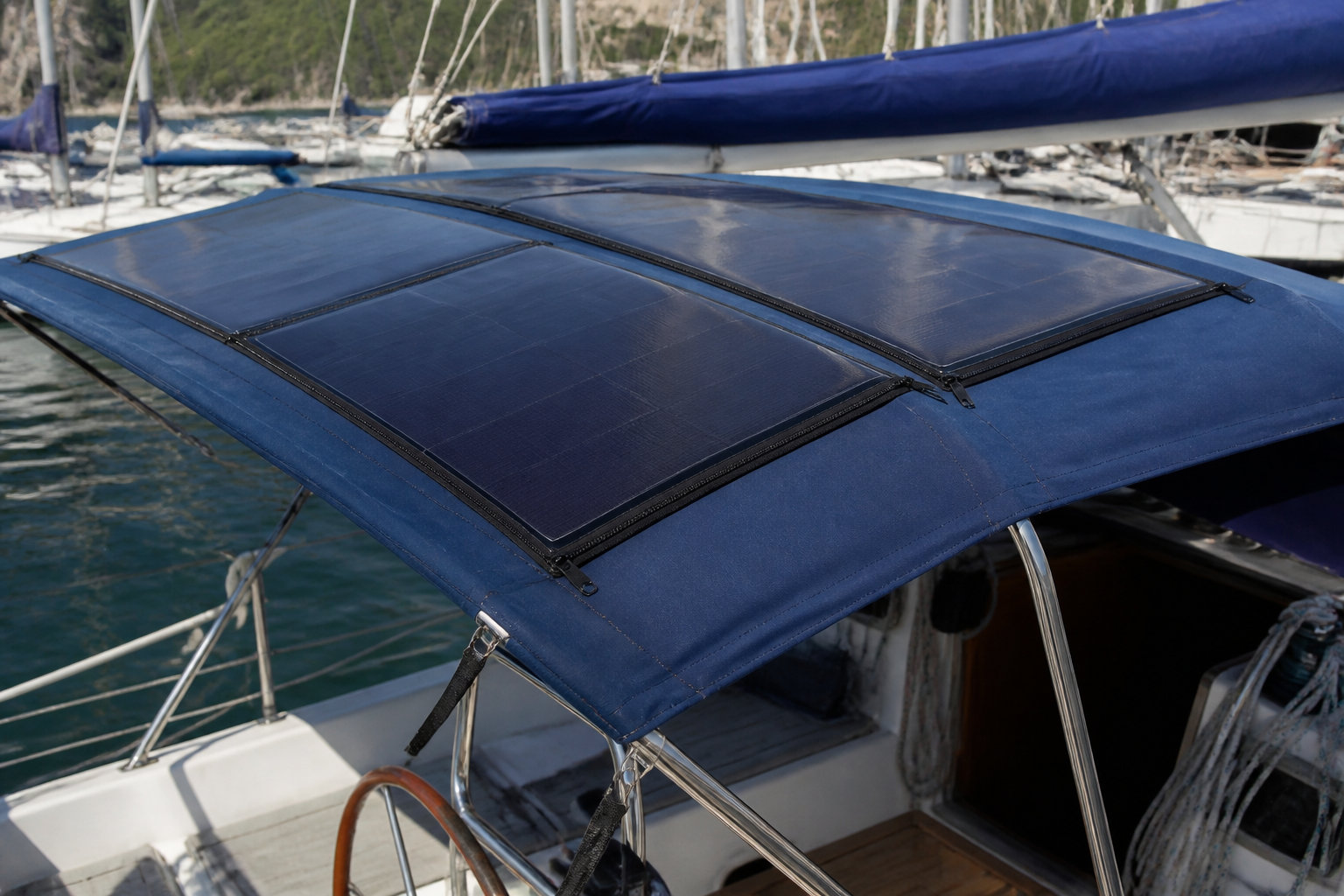
These panels are incredibly light and won’t sag your canvas. Heavy stainless steel arches are no longer a requirement for solar. You can mount them with zippers or specialized grommets. This creates a clean, aerodynamic look for the Best solar panel kits for sailboats and marine use in 2026.
Victron Energy BlueSolar Kit for Advanced MPPT Integration
Beyond the panels themselves, the “brain” of the system determines how much energy actually reaches your batteries, which is where Victron excels.
The BlueSolar MPPT controller is a powerhouse. It tracks the maximum power point with extreme speed. This is vital on a boat where clouds or sails cause frequent, rapid shading changes.
| Kit Component | Renogy 200W | Victron BlueSolar | SunPower Flex |
|---|---|---|---|
| Controller Type | MPPT vs PWM | Advanced MPPT | MPPT |
| Panel Weight | 12-15 kg | 0.165 kg (Unit) | 2.2 kg |
| Best Mounting | Arch / Rail | Vertical Wall | Bimini / Deck |
| Target User | Cruiser | Tech Enthusiast | Racer |
We love the ecosystem benefits. Victron components talk to each other via Bluetooth. You can monitor your real-time harvest directly from a smartphone app while sitting at the helm.
Calculating Your Daily Energy Budget for Marine Autonomy
Choosing a kit is useless if it doesn’t meet your actual needs, so you must run the numbers before buying hardware.
Converting Appliance Wattage Into Daily Amp-Hour Requirements
Calculating your needs is simple math. Divide total Watts by your battery voltage. For a 12V system, a 60W fridge running 50% of the time consumes 60 Amp-hours daily.
- Refrigeration: 50-80Ah
- Navigation Instruments: 20Ah
- LED Lighting: 10Ah
- Water Pump: 5Ah
Factoring in Shading and Solar Irradiance Variations
Mast shadows are silent power killers. Even a small shadow can drop a panel’s output by 50%. Use bypass diodes to mitigate these losses in series-connected sailboat arrays.
Safety margins are vital for seasonal fluctuations. Always add a 20% buffer to your daily consumption estimates. This protects your autonomy.
Winter sun is weaker. Plan for the worst-case irradiance scenarios to avoid empty batteries.
Strategic Mounting Solutions for Sailboat Environments
Once the budget is set, the final challenge is physically securing the panels against wind, waves, and salt. We must ensure every watt is protected from harsh marine elements.
Integrating Solar into Existing Boat Canvas and Biminis
Heavy-duty zippers or industrial Velcro allow for quick removal during heavy storms. These methods offer flexibility for canvas integration without permanent structural changes.
Backing plates provide essential support for soft tops. Thin aluminum plates distribute weight evenly, preventing fabric stretching while maintaining a stable surface for your solar array.
Comparing Mechanical Fasteners Against Marine Adhesives
Mechanical fasteners offer maximum security for rigid panels. However, 3M VHB tape avoids drilling holes in the deck, significantly reducing the risk of fiberglass leaks.
Thermal expansion can tear adhesives apart if you don’t leave a small gap for air circulation under rigid modules.
Hot panels lose efficiency without airflow. We prioritize ventilation to maximize the performance of the Best solar panel kits for sailboats and marine use in 2026.
Leave a small air gap under rigid modules to prevent heat buildup, as high temperatures reduce solar cell efficiency.
Achieving energy autonomy at sea in 2026 requires high-efficiency N-Type cells, robust IP67 waterproofing, and smart MPPT integration to overcome shading. Don’t let power shortages anchor your dreams; upgrade to a professional marine kit today to ensure your electronics never fail. Secure your offshore independence now for a limitless horizon.
FAQ
Which solar cell technologies offer the highest efficiency for sailboats in 2026?
For sailors facing limited deck space, N-Type monocrystalline cells are the gold standard, achieving efficiencies between 23.5% and 25%. These advanced cells, along with PERC (Passivated Emitter and Rear Cell) technology, provide superior energy density compared to traditional panels.
We recommend these high-efficiency options because they suffer from zero Light-Induced Degradation (LID) and perform better in high temperatures. This ensures you get maximum power harvest even during scorching summer days on the water.
How do I protect my marine solar kit from saltwater corrosion?
Durability is non-negotiable in maritime environments, so you must prioritize hardware with an IP67 waterproof rating. This rating ensures your junction boxes and connectors are completely sealed against dust and can withstand temporary immersion in water.
Top-tier kits also feature salt-mist certified frames and specialized coatings like ETFE. These materials resist the corrosive effects of salt spray and UV rays, preventing electrical shorts and structural pitting that typically plague standard residential panels.
Is the Renogy 200W kit a good choice for off-grid marine use?
Absolutely! The Renogy 200W Marine Kit is a fantastic entry point for cruisers seeking a balance between cost and performance. It typically includes a 20A waterproof controller and flexible panels that utilize half-cut PERC cell technology for improved efficiency.
This kit is designed for versatility, capable of producing roughly 1000Wh per day under ideal sun conditions. It is perfect for powering essential lights and small pumps while remaining easy to install for DIY boaters using plug-and-play solar systems.
What are the benefits of using SunPower Maxeon flexible panels on a bimini?
The SunPower Maxeon Flexible Series is engineered for high-performance aesthetics and extreme durability. These panels feature a solid copper foundation, which prevents system failure even if the surface develops micro-cracks from the constant movement of the boat.
They are incredibly lightweight and aerodynamic, making them the ideal solution for mounting on curved bimini surfaces. Unlike heavy glass modules, these flexible units won’t sag your canvas, and they offer industry-leading efficiency of up to 25.4%.
How do I install solar panels onto my boat’s existing canvas or bimini?
You have several professional mounting options to choose from, depending on how permanent you want the setup to be. For a sleek, wind-resistant finish, we suggest using heavy-duty YKK zippers or wide Velcro strips sewn directly onto the textile.
If you need a more temporary solution, stainless steel grommets or LOXX quick-release fasteners allow for rapid removal during heavy storms. For those comparing flexible vs rigid solar panels, flexible models are vastly superior for canvas integration due to their low profile.
Why is an MPPT controller better than PWM for sailing?
In the marine world, shading from masts and sails is a constant challenge. A Victron BlueSolar MPPT controller acts as the “brain” of your system, tracking the maximum power point with lightning speed to harvest up to 30% more energy than a standard PWM controller.
We love the Victron ecosystem because it allows you to monitor your real-time harvest via Bluetooth on your smartphone. These controllers also manage battery health intelligently, ensuring your expensive house bank lasts for many seasons to come.
How do I calculate my boat’s daily energy budget?
To find your target, you must convert the wattage of every appliance into Amp-hours (Ah). Simply divide the total Watts by your battery voltage (usually 12V). For example, a 60W fridge running half the time consumes about 60Ah per day.
Don’t forget to factor in your navigation instruments (20Ah) and LED lighting (10Ah). We always recommend adding a 20% safety buffer to your final calculation to account for cloudy days or unexpected power needs while at anchor.
What is the role of bypass diodes in a sailboat solar array?
Bypass diodes are essential for mitigating the “mast shadow” effect. If one part of your panel is shaded by the rigging, these diodes allow the electrical current to flow around the shaded cells, preventing the entire panel from shutting down.
Without these diodes, a tiny shadow could drop your entire output by over 50%. By providing an alternative path for the current, bypass diodes keep your energy production stable and prevent dangerous hot-spots from damaging your solar cells.