Solar panels don’t always fill a battery. A few cloudy days in a row, or a short winter day, can leave it half empty.
So can a generator top it up when the sun falls short? This guide shows you which setups accept one, how to connect it safely, and which limits to respect.
What Charging a Solar Battery From a Generator Involves
Yes. You can charge a solar battery from a generator when the system has a compatible AC charging input. Two setups are common.
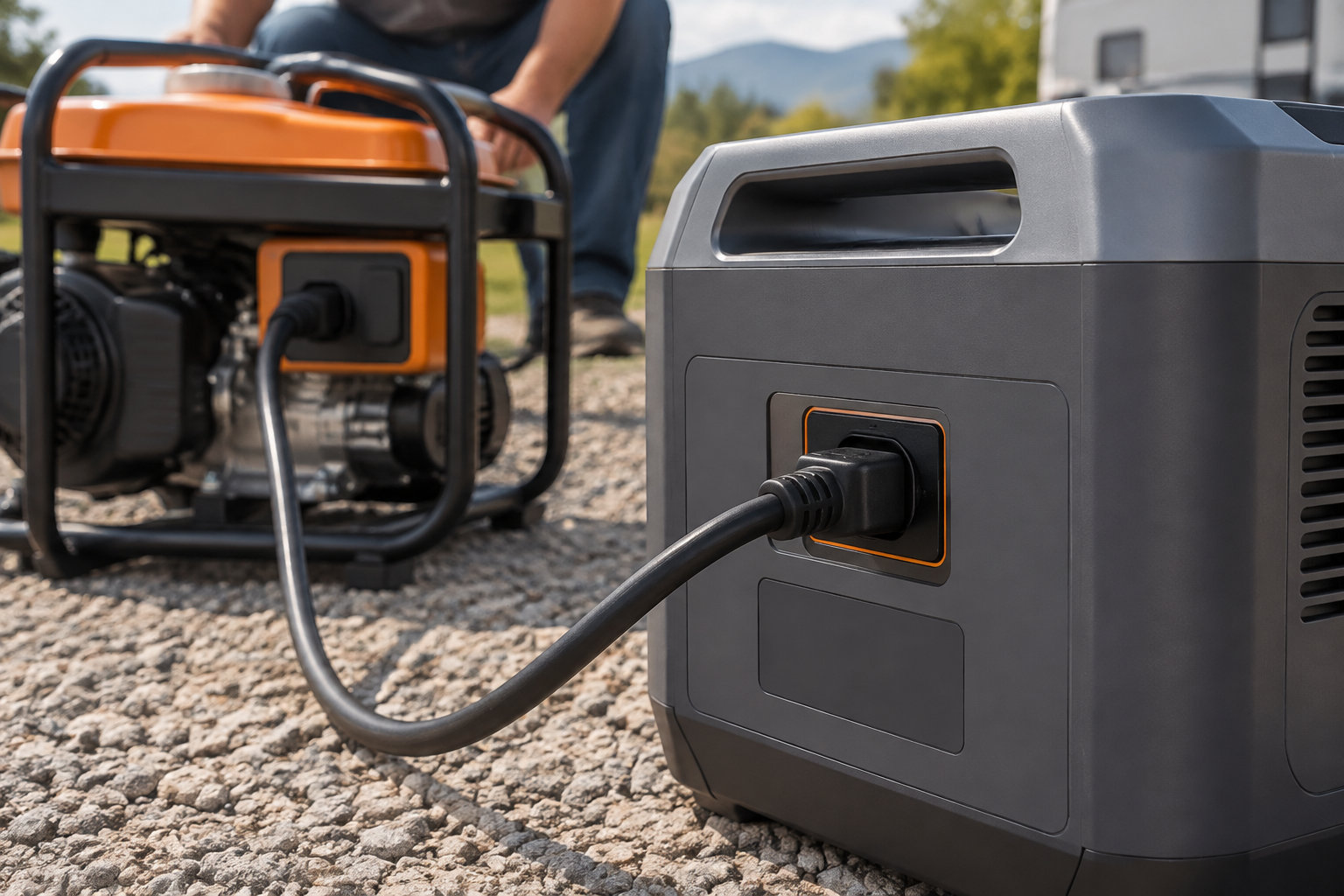
With a portable power station, plug the generator into its AC input. With a battery bank, plug it into an inverter/charger, the unit that turns AC power into battery charge through its DC side.
If you are still choosing between a battery and a generator for home backup, start with solar battery backup vs generator.
A generator is a backup source. Use it when the sun is not enough to fill the battery. The charge goes in through the AC input of the power station, not through the solar port.
Look for a socket marked “AC IN” or a plug symbol on the back or side panel.
Read the AC input limit in the manual. The BLUETTI AC200L accepts up to 2,400 W through its AC charging cable.
Compare the generator’s output voltage and frequency with the unit’s specifications before you connect anything.
Portable Power Station or Battery Bank With Inverter-Charger: Which Do You Have?
Check which setup you own first. For help choosing, see solar panel battery options.
| Criterion | Portable power station | Battery bank with inverter/charger |
|---|---|---|
| Connection | All-in-one: battery, inverter, charger and AC input. | Needs a compatible charger, such as an inverter/charger. |
| Charge control | Set by the unit; check the manual. | Victron MultiPlus-II 3 kVA: 32 A AC input limit by default, adjustable. |
| Expansion | Fixed by the unit. | Add batteries if the charger supports it. |
If everything sits in one box with a handle, a screen and an AC port, you have a portable power station.
The BLUETTI AC200L takes up to 2,400 W at its AC port, and the EcoFlow DELTA 3 1500 up to 1,500 W.
If your batteries sit in a rack or cabinet with a separate inverter/charger, you have a battery bank. The generator plugs into that charger, not into the batteries. Look up the charger’s AC input limit before you connect.
Generator Charging Is Not the Same as Generator Backup
Running your home circuits from a generator is backup. Charging your battery from that same generator is a separate job. A Tesla Powerwall, for instance, does not charge from a backup generator, since the two systems are not directly integrated.
With a manual transfer switch, you flip it by hand to power home loads from the generator, and you flip it back later to reconnect them to the battery or the grid.
For a whole-house plan, read emergency backup power with solar batteries.
A generator that powers your backup circuits does not automatically charge the battery. Check the manual for an approved generator-charging path before you plan the connection.
Never plug a portable generator into a wall outlet to feed the house. The power flows back into the utility lines, where it can electrocute line workers and start a fire.
Using Solar and a Generator to Charge the Same Battery
Solar and a generator can both charge the battery at the same time. Which one gets priority depends on the unit, not on a universal rule.
On an EcoFlow DELTA 3, solar comes first, and the generator on the AC input adds power only when solar output is too low.
Another power station or inverter/charger may work differently, so check its input rules before you plan the setup. To plan a generator as backup for your solar system, start with off grid solar power for beginners.
Before you plan the connection, check these points in the manual:
- The priority rule: which input the unit uses first when solar and the generator are both connected.
- Whether solar and AC charging can run together, or whether one input pauses the other.
- The solar input limits: on an EcoFlow DELTA 3, keep the array within 60 V open-circuit voltage and 15 A short-circuit current.
- The controller limits: on a 48 V battery, the solar charge controller must support the array’s open-circuit voltage and the battery’s charging voltage and current.
What a Generator Can’t Do for Your Battery
The power printed on a generator is not the power that reaches your battery.
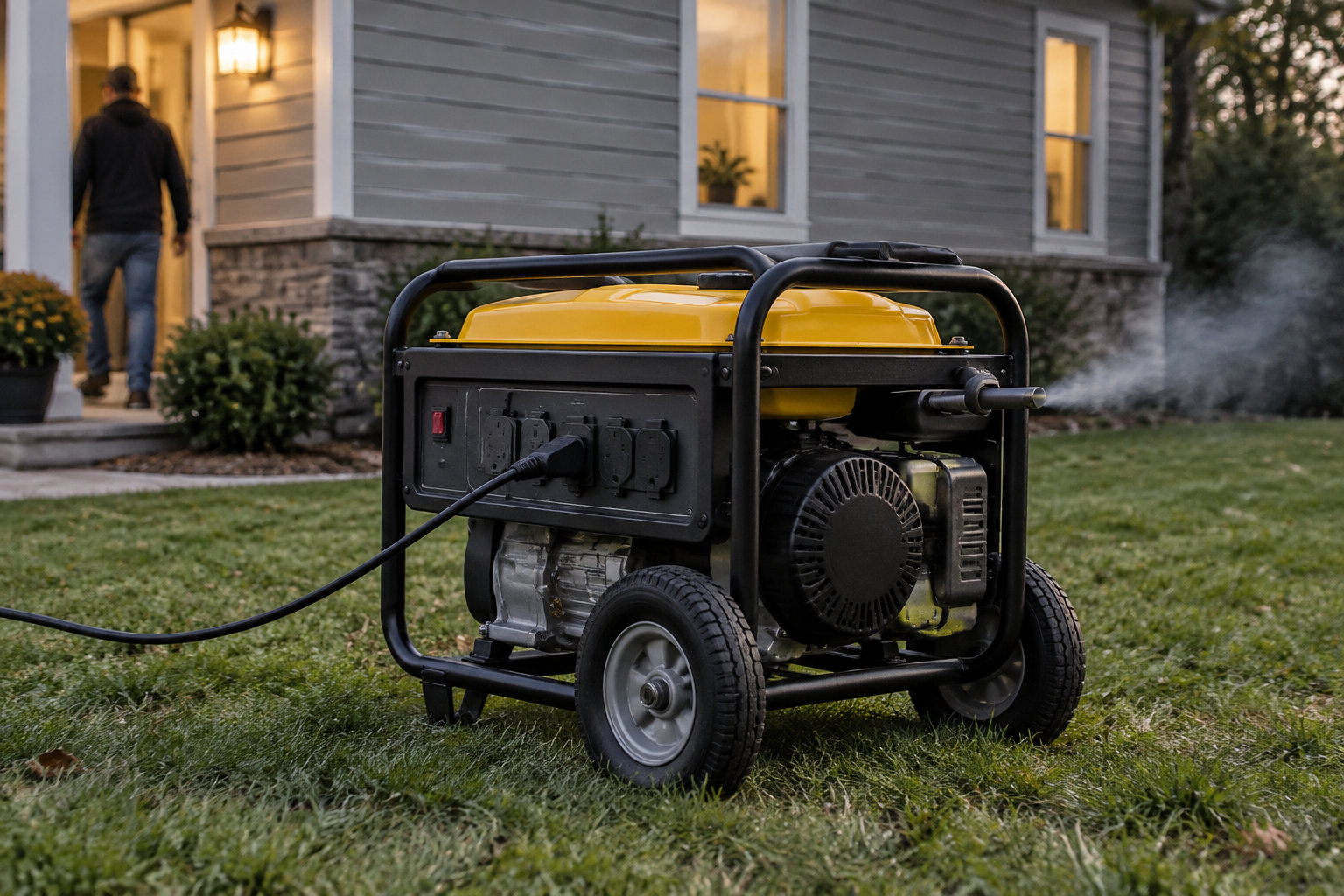
The Honda EU2200i is rated at 1,800 W at 120 V, with a 2,200 W maximum. Size the charger to the rated 1,800 W, not the peak.
Your charger shares that power with your other AC loads. On a Victron MultiPlus-II, a low AC input current limit or a kettle on the same input leaves less for the battery. So check what is left after your loads.
For a backup that needs no fuel, see portable solar panel kits for home power outages, and follow these generator rules:
- Run it outdoors, at least 20 feet from the home, with the exhaust pointed away.
- Never run it inside a home or garage, even with doors or windows open.
- Never plug it into a wall outlet. For home circuits, have a qualified electrician install a transfer switch.
- Use an outdoor-rated extension cord rated above the connected load. Inspect it first, and skip it if damaged.
How to Charge a Battery Bank From a Generator, Step by Step
Start with compatibility: check that your inverter/charger accepts the generator’s AC voltage and frequency. Then set its AC input-current limit within the generator’s rated output.
Set the charger profile to your battery’s chemistry and the maker’s values.
For Victron Lithium Smart batteries, absorption is 14.2 V on a 12.8 V battery, 28.4 V on 25.6 V, and 56.8 V on 51.2 V.
If you’re unsure which chemistry fits, compare lithium and lead-acid storage first. Then connect the generator to the AC input, not the battery, and start it.
Charge the battery in steps
-
Set the input current limit
Start at 0.5C: 50 A for a 100 Ah battery. Lower it if the generator has less spare output after the other loads.
-
Read the charge current
It should sit close to your limit. If the generator slows or the voltage sags, lower the limit until it runs steadily.
-
Confirm the percentage rises
Check it at set times. Going from 20% to 100% on a 100 Ah battery takes about 1.6 hours at 50 A, and longer near full.
A solar battery can take a generator’s charge, but only through the right input: the AC port of a power station, or the inverter/charger of a battery bank.
Your next step is to open the manual, find that input and its power limit, and set the charge below the generator’s rated output. Run the generator outdoors, and check the battery percentage as it rises.
Frequently asked questions
What is the best generator for off-grid battery charging?
The best generator is the one whose rated output, the steady power it runs at, covers the charger’s AC input demand plus your other loads. Its voltage and frequency must also fit the charger’s input range.
Can I charge my solar battery from the grid overnight?
Yes, if your battery system has a compatible AC charging path and the grid meets the charger’s input requirements.
Plug the charger into a wall outlet, and check its limits in the manual first. It then runs overnight if the power stays on.
How long does it take to charge a solar battery with a generator?
Count on at least 1.6 hours to replace 80 Ah at a steady 50 A.
Capacity and charging current set the time, and it grows near full. To estimate yours, divide the Ah to refill by the current, then add some time.