A portable solar panel has a metal frame, and a fault can leave that frame live. Touching it then risks a dangerous shock.
Off-grid, with no utility system to rely on, how do you connect that frame to a proper grounding path? This article explains when grounding is required, which equipment you need, and how to connect the frame safely.
Does a portable solar panel need grounding at all?
Yes, the frame needs grounding. The US electrical code (NEC, section 690.43) requires every exposed metal frame on a PV panel to be connected to an equipment grounding conductor, whatever the voltage.
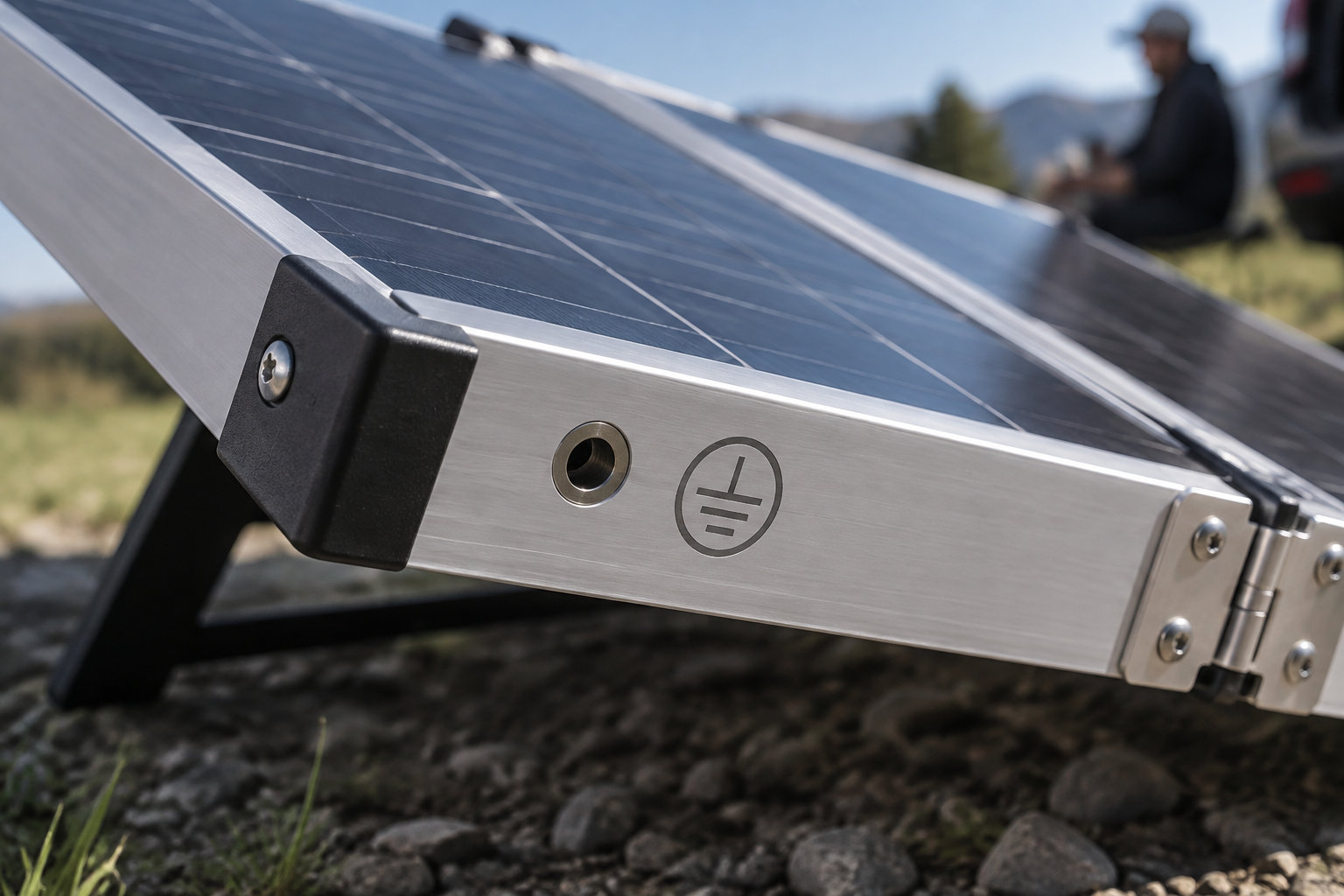
Why? An ungrounded frame can stay live after a fault, and touching it can give a potentially lethal shock.
Connected to the equipment grounding conductor, the frame gives fault current a path that trips the protection. This is a wire run to the grounding point, not a rod pushed into the soil.
Start from the grounding point marked in your panel manual. The manuals of your other components decide the rest of the path, so read them before you buy anything.
The NEC rule applies at any voltage, so a 12 V portable panel needs it too. On Renogy modules with marked grounding holes, use those holes for the ground wire only, never for mounting. If you power an RV, compare RV solar panel kits and their wiring before you pick the parts.
Grounding and bonding: don’t mix them up
Grounding connects a system to the earth. Bonding joins metal parts into one continuous electrical path, so a fault current has a way to flow back. The two jobs are related, but they are not the same.
A ground rod on its own does not bond your frame. It only links one point to the earth.
To make a fault trip the protection, the frame must sit on a continuous conductor that leads to the grounding point marked in your manual.
Keep the negative off the frame
Frame grounded, negative as designed
The frame goes to the grounding point marked in your manual. The PV negative stays where your controller design puts it. For a truck camper, check your wiring against truck camper and shell setups.
Negative tied to the frame or a rod
This gives the negative a second earth reference. With a non-isolated controller like the Victron MPPT, the PV negative already sits at the same potential as the battery negative, so grounding it can upset the charger.
Ground rod or grounding conductor: which one do you need?
Ground rod as an auxiliary electrode
A ground rod is an optional extra electrode. It is not required, and the code does not make you install one. If you do add one, it can be connected to the module frames or their support structure.
Keep the equipment grounding conductor in place even if you add a rod. The rod never takes its place.
A rod-type electrode must be at least 8 ft long and at least 5/8 in. in diameter, unless it is listed for a smaller diameter.
A rod also gives lightning current another path into the ground, so plan it as part of the whole system. Adding one is not an automatic safety upgrade.
Equipment grounding conductor as the fault path
The equipment grounding conductor and the ground rod do different jobs, so check each one against the table below.
| Criteria | Equipment grounding conductor | Ground rod |
|---|---|---|
| Job | Carries fault current back to the system so the protection trips | Adds a connection from the system to the earth |
| Where it ends | At the grounding point marked in the panel manual | In the soil, at the rod |
| Main risk | A loose or missing wire leaves the frame energised after a fault | Earth is not allowed to be the effective fault-current path |
Start from the grounding point marked in your panel’s manual. Keep the equipment grounding conductor on the path that conductor and the manuals of your other components set, since it is the part that carries a fault.
Add a rod only if the manufacturer and the code allow it.
For camping setups, check how to ground a portable solar panel safely.
What a ground rod will not do
Before you count on a rack, check the camper solar panel mounting guide for hardware identified for bonding your panels:
- The clamps must make electrical contact through the assembled metal parts.
- A metal rack alone does not replace the equipment grounding conductor.
- Without that identification, use the grounding conductor and the point your panel manual marks.
Do not charge the station from a wall outlet while the Jackery Grounding Adapter is connected.
Before you use the adapter, check that your exact station model is compatible, because the adapter only works with compatible Jackery power stations.
Before you bond the frame, know what common parts will not do:
- The Jackery adapter plugs into the USB-A and 120 V AC outputs. It does not bond the panel frame.
- On Renogy modules with marked grounding holes, never use those holes to mount the panel.
- Use approved bonding hardware at the marked point, then confirm the path in your panel and station manuals.
How to ground the frame of a portable panel
For a van, compare your options in van solar panel kits, then check these points:
- Find the frame grounding point marked in your panel manual, and use only its approved method.
- With Renogy modules, use the ILSCO GBL4-DBT lay-in lug, where the wire slides under the screw, rated 600 V.
- The lug accepts stranded 4 to 14 AWG grounding wire.
Fit the lug
-
Fit the star washer
Place it under the lug, with stainless M3 or M5 hardware. It cuts through the anodized coating.
-
Tighten to torque
M3 assembly: 0.8 N·m. M5 assembly: 1.5 N·m. The lug must not turn.
-
Strip the wire
Strip 16 mm of insulation before inserting the wire into the lug.
-
Route the wire
Run it to the path your system design specifies.
Check the path with a multimeter set to continuity. Touch one probe to the lug and the other to the frame nearby. A reading near zero means the lug is bonded.
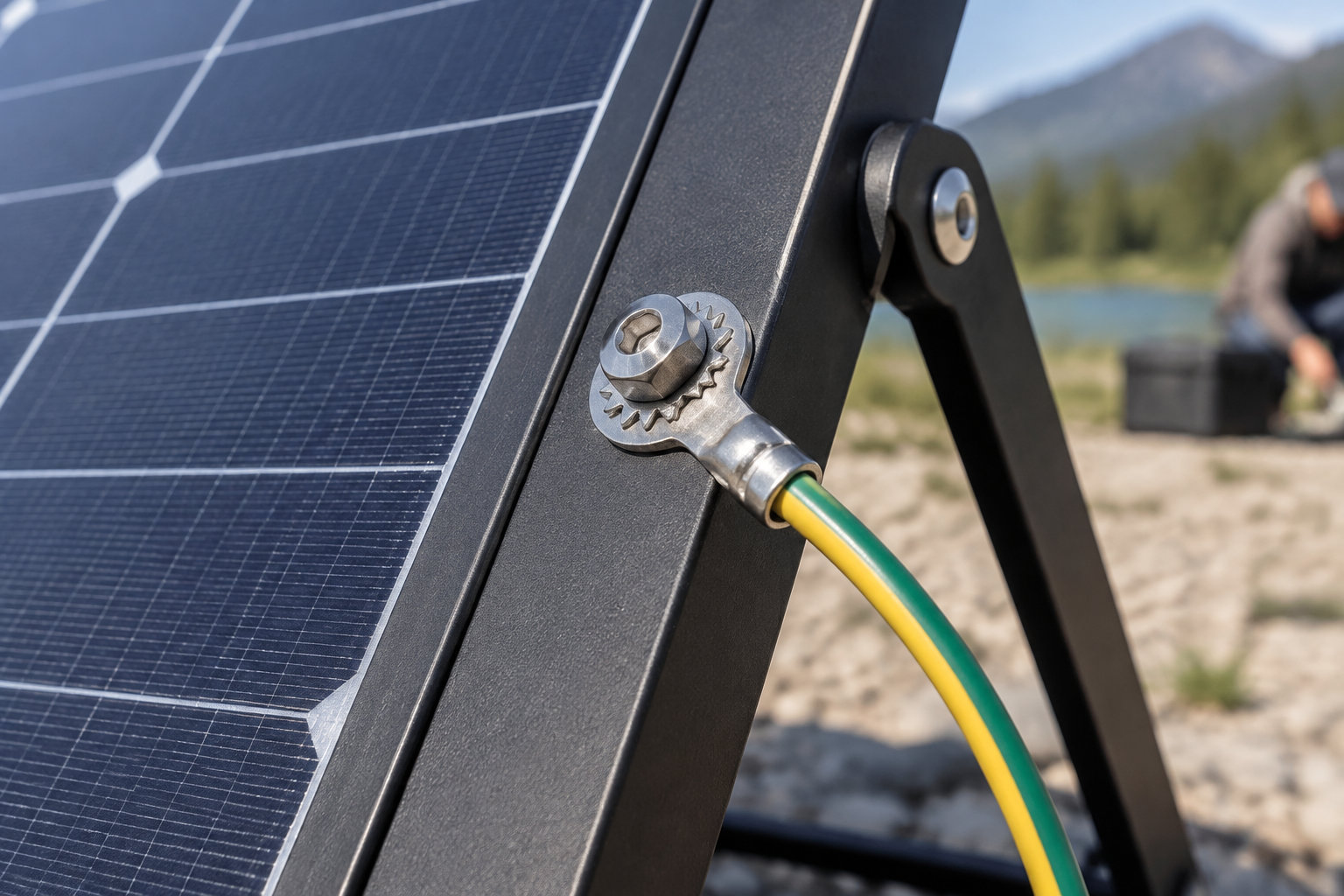
No beep? The lug is not cutting through the oxide film. Loosen, check the washer, and retighten to the torque in your manual. Never drill a new hole.
The frame must be connected to an equipment grounding conductor, at any voltage. Run it to the point marked in your panel manual. A ground rod alone does not do this job.
Your next step is to read your panel and station manuals before you buy parts. Then fit the lug, tighten it to torque, and check continuity with a multimeter.
Frequently Asked Questions
Can I ground a portable solar panel to my van or RV chassis?
Yes, but only if your system design and the panel and controller instructions allow that connection. If they do not, keep the frame bond and the panel’s negative wire grounding separate.
Do I need an electrician to ground a portable solar panel?
Not always. Follow your local electrical rules and the exact instructions for your panel and controller. If you cannot check a connection safely, ask a licensed electrician to look at it before you use the panel.
What happens if my portable panel frame is never grounded?
A fault can leave the frame energized, and touching it can cause a potentially lethal electric shock.
Without a grounding path, fault current has nowhere to go, so the frame stays live. Connect the frame to the marked grounding point to close that gap.
Can a grounding lug be reused after it has been removed?
Only if your lug and panel instructions allow reuse, and the lug still makes secure electrical contact. If they do not allow it, replace the lug.
Look for damage on the lug and washer before you refit them, and ask a licensed electrician to check the connection if you cannot tell that it is secure.