Cold weather lowers how much power a solar battery can deliver, and a battery that freezes can be permanently damaged.
So your problem is keeping the battery working, charging and lasting through winter without letting it freeze.
This article explains how cold affects each battery type, how to protect it safely, and whether solar still pays off in the winter months.
What Cold Does to Your Battery’s Capacity
Cold cuts the energy a battery can deliver. A 100 Ah Battle Born LiFePO₄ gives about 80 Ah at 32°F and 70 Ah at 0°F. Warm it up, and the capacity comes back.
A Trojan deep-cycle battery gives about half its rated capacity at 0°F, so size it with extra margin. Protect it with off-grid battery maintenance tips.
The charge limit and the discharge limit are different numbers, and they change from one model to another. A Battle Born 100 Ah cuts charging below 32°F but can still discharge down to −4°F. A Victron Lithium Smart accepts charging only between 41°F and 122°F. Use your battery’s manual as the reference for both numbers before you use it in winter.
LiFePO4 or Lead-Acid: Which Holds Up Better in Winter?
LiFePO4 in the cold
Some LiFePO4 batteries still deliver power below zero. The Battle Born LiFePO4 can discharge down to −4°F.
Charging is another matter. The 100 Ah Battle Born model blocks charging below 32°F, and the Victron Lithium Smart needs at least 41°F. For a freezing recharge, see lithium vs lead-acid for solar storage to compare.
Lead-acid in the cold
A fully charged Trojan battery’s electrolyte freezes at about −92°F. At 40% charge, the same electrolyte can freeze at about 16°F, so a lead-acid battery that sits half-empty on a cold night can be damaged. Keep it charged before winter arrives.
Here is how the two chemistries compare in the cold.
| Criterion | Lead-acid | LiFePO4 |
|---|---|---|
| Discharge in the cold | Loses capacity in the cold | Some models work below zero |
| Charging in the cold | Check the manual’s limit | Blocked below a set temperature |
| Freeze risk | High when charge is low | Built-in protection |
| Maintenance | Keep it charged | Little upkeep |
For a cold climate, pick LiFePO4: it still works below zero.
Insulation and Heating: Don’t Confuse Them
Insulation and placement
Insulation and heating do different jobs. Insulation only slows heat loss, it does not warm the cells. So an insulated box does not make a charge below the model’s limit safe.
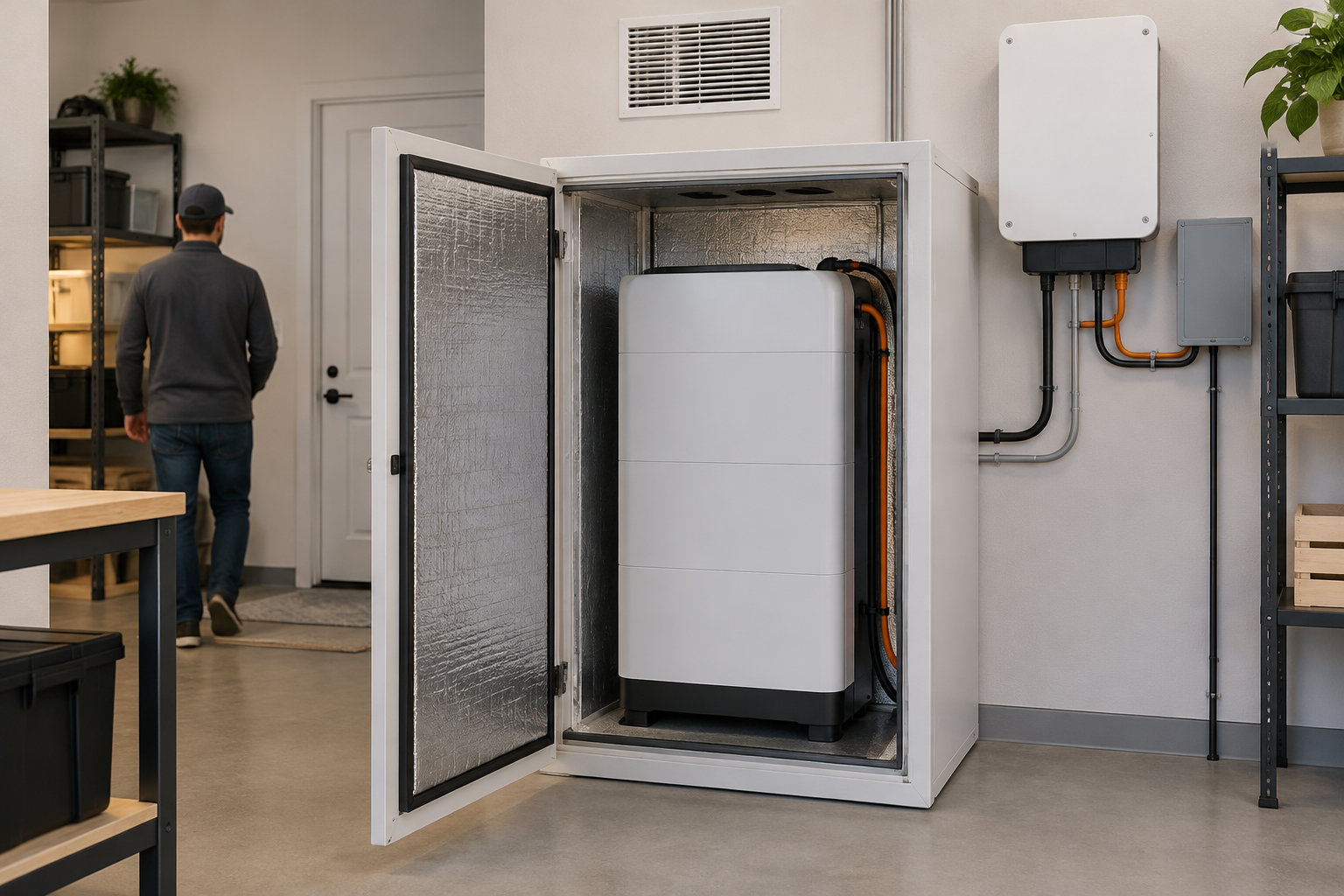
Place the battery somewhere dry and sheltered. Keep the clearances and ventilation your model requires, since distances vary by battery and enclosure. For a battery in a shed, see insulated battery boxes and shed setups.
Built-in heaters and their power draw
Some Battle Born models have an optional built-in heater:
- It turns on around 35 °F, when the heating function is enabled and a charge source is present.
- While it runs, it draws about 28 W.
- For winter storage, turn the heating function off so the battery draws no power.
Don’t force a cold charge
What Works
Wait for the cells to warm up. The controller then starts charging on its own.
What to Avoid
Lowering the minimum charge temperature below 41 °F to charge in the cold voids the warranty on a Victron Lithium Smart.
What Works
Check your model’s minimum charge temperature in the manual before winter.
What to Avoid
Bypassing the cutoff to charge a cold battery can damage the cells.
How to Charge Your Solar Battery Safely in Winter
First, find your battery’s minimum charging temperature in its manual. Below that limit, charging can damage the cells.
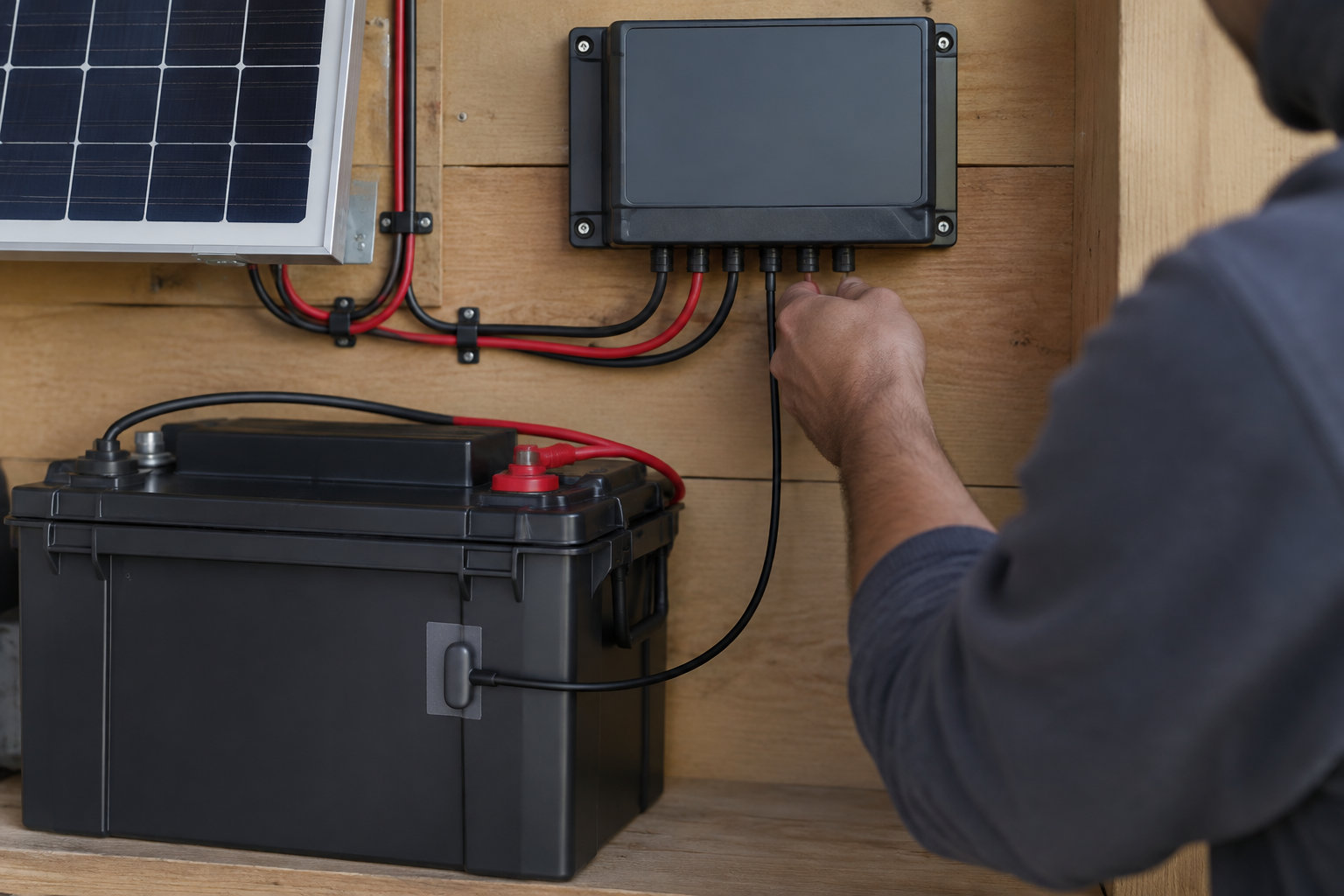
Then check the cell temperature before the controller starts charging, using a probe that is compatible with the controller. For a kit suited to cold months, see how to choose, size and install an RV solar kit.
Do these in order:
- Victron Lithium Smart: set Allowed-To-Charge to stop charging below its temperature limit.
- Trojan lead-acid: raise voltage 0.005 V per cell per °C below 25 °C.
- If winter sun won’t fully recharge lead batteries, cut non-essential loads.
- Confirm it charges and holds charge overnight. If not, see how to store mobile solar panels for winter.
What to Do if a Battery Has Frozen
If a battery may have frozen, stop charging and using it at once. Keep it out of service until a qualified person has checked it.
Then look at the case and the electrolyte, the liquid inside. A leak or a cracked case means damage, so never put the battery back into service. To avoid this next winter, see solar kits for tiny houses.
Never charge a lead-acid battery that has frozen. Freezing can cause permanent damage, and a recovery charge will not undo it. Have a qualified technician inspect the battery, or replace it before you use it again.
How Much Solar Output to Expect in Winter
Shorter days and snow cover
Solar still works in winter, but output drops because of short days, a lower sun, and snow. In Minneapolis, December and January average about 2 peak sun hours a day, meaning 2 hours of full-strength sunlight.
Snow blocks part of the light, so output drops for a while after each snowfall. For ways to keep panels working in cold months, read how to maintain solar panel kit efficiency in winter.
Run a PVWatts estimate for your address and the winter month you care about. In Minneapolis, a 10 kW system is estimated at 490 kWh in December. Orientation, tilt and losses change that number.
A steeper tilt helps snow slide off, but it catches more wind. Weigh snow shedding against wind load when you choose the angle.
Sizing for winter demand
Size the battery on your winter energy needs and on the low-production days it must cover, not on the yearly average. To get autonomy hours, divide battery capacity by average load: 10 kWh at 2 kW gives 5 hours.
For a garden office in the UK, see assess seasonal sun hours in the UK climate before you fix the panel area.
Cold reduces what a battery can deliver, and a freeze can cause permanent damage. Keep the battery charged, know its minimum charging temperature, and choose LiFePO4 if your winters are cold.
Your next step: open the battery manual now and write down its minimum charging temperature. Then charge the battery fully before the first hard frost.
FAQ
Is it okay to store lithium batteries in cold temperatures?
Yes, as long as the temperature stays within your model’s storage range. A Victron Lithium Smart can be stored between −49 °F and 158 °F.
Storage is not charging, though. Check the separate charging limit before you connect solar panels on a cold day.
Does snow on solar panels damage them?
Yes, if the snow builds up. It collects along the bottom edge of the panel and presses on the frame, adding load to the mounting.
After a heavy snowfall, brush the snow off that lower edge with a soft broom, standing on the ground.
Do I need a battery heater in a mild winter climate?
In a mild winter, you need a battery heater only if the battery risks dropping below its charge limit.
That limit depends on the model, so check your manual. On cold nights, measure the cell temperature and compare it with the minimum charging temperature.
Can a solar charge controller stop charging automatically when the battery is too cold?
Yes, if the controller receives a temperature reading from the battery and has a protection command that works with that battery. Without both, it keeps charging a cold battery, so check before winter that the two work together.