A battery bank can look big enough and still run dry after cloudy days. The usual cause is a guess about your daily power use.
This article shows you how to size a solar battery bank that keeps power on.
How to Size a Solar Battery Bank for Reliable Off-Grid Power
Start With a Realistic Daily Load Estimate

Begin by listing every device the battery must power. For each one, note its running wattage and how many hours it runs each day. Then add the totals. Don’t forget the small stuff: inverter standby draw, chargers, lighting, the refrigerator, water pumps, fans, heating gear, and occasional heavy loads.
Nameplate ratings are only a starting point. A plug-in power meter shows what an appliance really draws while it runs. An energy logger tracks household demand over several days. Measure cycling equipment like refrigerators, air conditioners, and pumps when you can, since their real use often differs from the label.
For each appliance, use this calculation:
Watts × hours per day = watt-hours per day
Before You Add Up Your Loads
- List every device the battery has to power, including small loads like chargers and lighting.
- Note the running wattage of each one, from the label and from a plug-in power meter where you can.
- Estimate how many hours each device typically runs per day.
- Log whole-house demand over several days to catch what you missed.
Decide Which Loads the Bank Must Carry
First, decide whether the battery will power the whole property or only the critical loads. A critical-load panel usually covers:
- Refrigeration
- Lighting
- Communications and medical equipment
- Water pumps
- Selected outlets
Electric cooking, water heating, and central air conditioning are usually left off a critical-load circuit.
Calculate Nominal Battery Capacity From Usable Energy and Backup Days
Set the Usable Energy Target
Pick your autonomy days based on how often you recharge, the local weather, and how much you rely on a generator. Two days can work if you charge often or have a dependable generator. Three days gives you a safety margin for remote homes, winter use, and van travel.
Autonomy is the number of days your solar panel battery bank must carry your loads without enough solar input to recharge. Multiply your daily energy use by that number of days to find the energy your loads need during the no-recharge stretch.
Convert Usable Energy Into Nameplate Capacity
For an AC-coupled system, use this formula:
Nominal battery capacity = daily load × autonomy days ÷ usable depth of discharge ÷ combined system efficiency
Depth of discharge (DoD) is the share of rated capacity you’re allowed to use. Take an 8 kilowatt-hour daily load, three days of autonomy, 80% DoD, and 90% combined efficiency. Then the result is:
8 × 3 ÷ 0.80 ÷ 0.90 = 33.3 kilowatt-hours nominal capacity
For a 48-volt bank, convert watt-hours to amp-hours: Amp-hours = watt-hours ÷ nominal voltage
| Bank voltage | Amp-hours for 33.3 kWh |
|---|---|
| 48 volts | About 694 Ah |
| 12 volts | Roughly 2,775 Ah |
A 33.3 kilowatt-hour bank at 48 volts works out to about 694 amp-hours, before you choose individual batteries and check their operating limits. The same energy at 12 volts would need roughly 2,775 amp-hours, with much higher current and much thicker cabling.
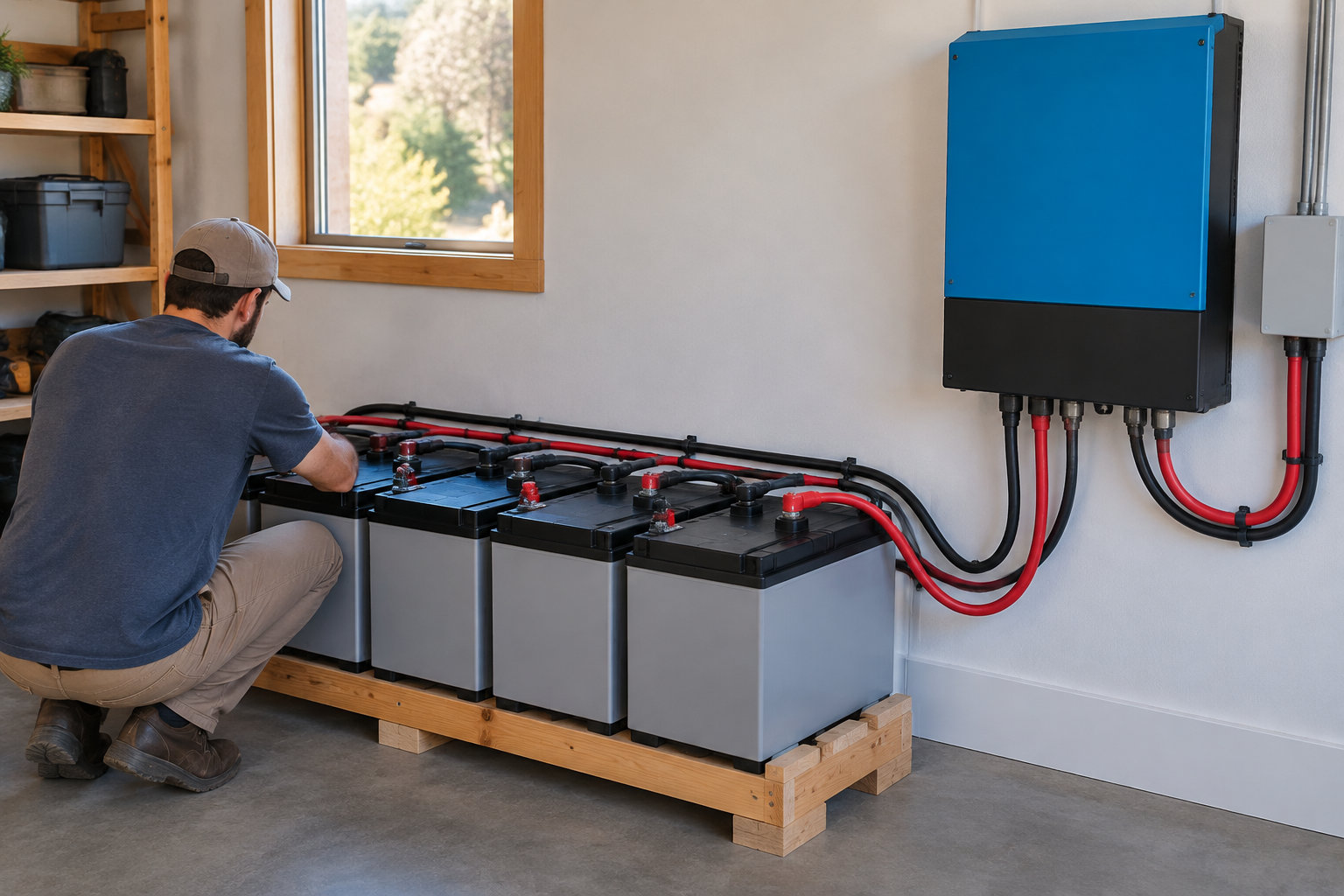
Battery capacity and inverter power are two separate specifications. A 33.3 kilowatt-hour bank can store several days of energy, but the inverter still needs a continuous rating above your expected simultaneous loads, plus a surge rating for motor and compressor startup.
Battery Chemistry and Operating Limits Set the Usable Capacity
Use the usable DoD printed for your exact battery model. Don’t rely on a generic chemistry label. As a rough guide, about 50% is common for lead-acid and 70% to 80% for lithium. Manufacturers may specify a different range.
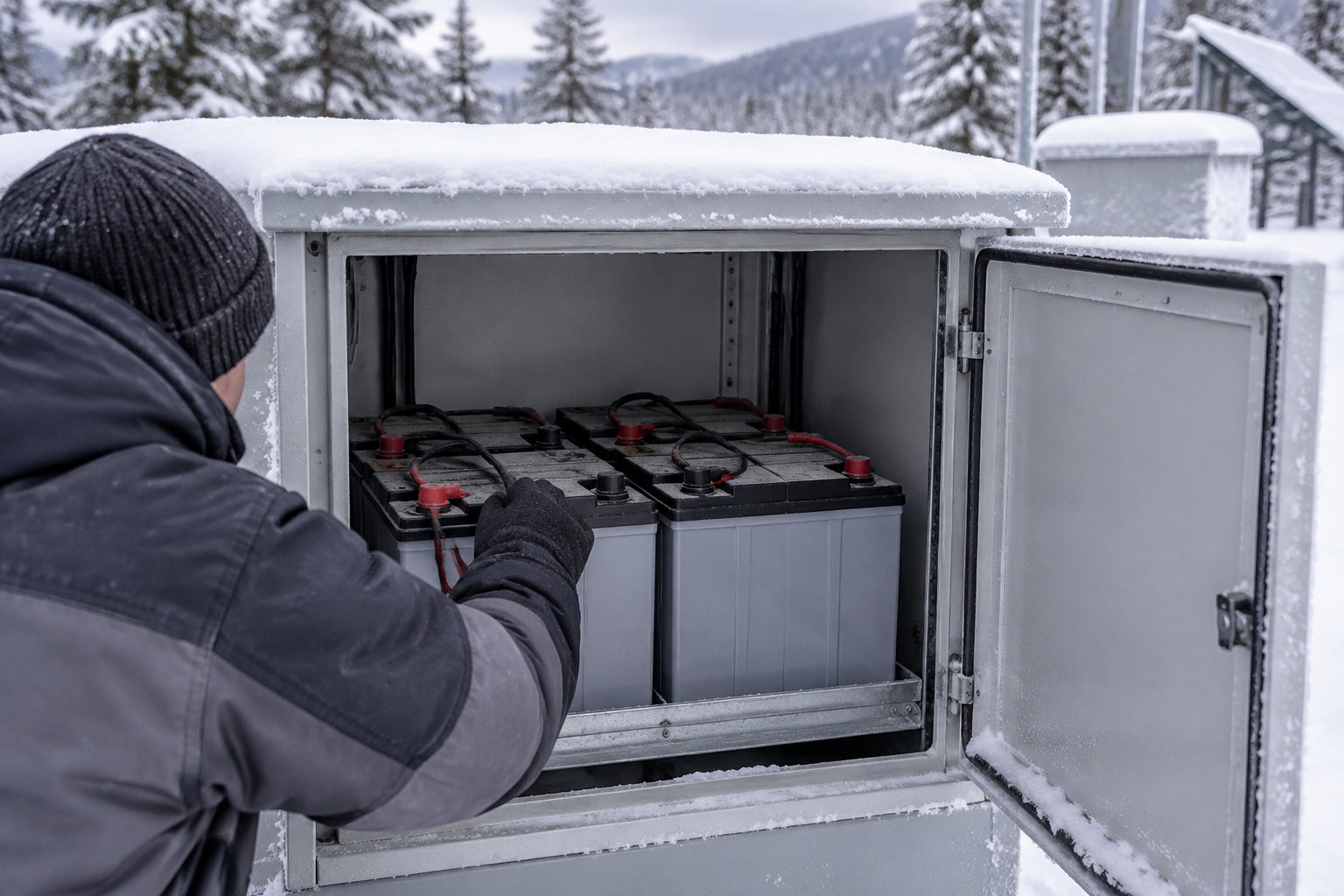
Cold cuts available lead-acid capacity. One manufacturer’s rule of thumb cuts capacity by about 10% for each 15°F below 80°F. An outdoor enclosure needs a temperature allowance based on the coldest conditions it will see.
Lithium batteries have temperature limits too. One LiFePO4 manual allows discharge at lower temperatures. It blocks charging below 39.2°F until the cells warm up. Check both limits before installing a battery in an unheated garage, shed, or van.
Before you install a battery
- Find the usable DoD printed for your exact battery model, not a generic chemistry label.
- Note the coldest temperature the battery will see, including inside an enclosure.
- Confirm the discharge limit and the charging limit, since they can differ.
- Make sure the battery can charge at the lowest temperature of its location.
Check Solar Production Against the Bank’s Recharge Needs
Estimate Production for Your Actual Conditions
Estimate production for your exact U.S. location, array size, tilt, azimuth, and shading. Historical weather data spanning 30 years provide an expected production range.
Enter your location and system size. Then check output month by month, not just the yearly average. For year-round off-grid use, size for your weakest month. Winter is often the hardest, especially where sunlight is short.
Plan for real losses. These include shade, dirt, wiring, heat, inverter conversion, charge control, and downtime. Even an unshaded roof makes less than its rated power on hot afternoons, cloudy days, and low-sun winter months.
Losses to Build Into Your Estimate
- Shade: check the sun path in every season, since trees and nearby buildings cast longer shadows in winter.
- Dirt: clean the panels on a set schedule, especially in dusty or dry months.
- Wiring: keep cable runs short and thick enough to limit voltage drop.
- Heat: leave airflow around panels and equipment, because hot panels produce less.
- Inverter conversion and charge control: budget for the energy lost each time power is converted and regulated.
- Downtime: count the days the system is offline for service or repairs.
Match Array Output to the Recharge Requirement
After three days with no recharge, at 8 kilowatt-hours per day, your loads have used 24 kilowatt-hours. At 85% charging efficiency, your array must make about 28.2 kilowatt-hours to refill that energy. It must also cover the next day’s use.
Use this starting formula for array size:
Array size in kilowatts = daily solar energy required ÷ peak sun hours ÷ overall derating factor

Peak sun hours are hours of full rated sunlight, not total daylight. Say you need 28.2 kilowatt-hours, you get 5 peak sun hours, and your derating factor is 80%. You will need about 7.1 kilowatts of solar. Add your next day’s load on top of that.
Before you buy anything, run the numbers on your own loads and your own worst month, then compare the result with the bank you were planning. A battery that looks generous on paper can still leave you short in January if the array cannot refill it. Write down your daily watt-hours, your autonomy days, and your lowest-production month, and keep that sheet with your equipment manuals so you can revisit it when you add a load.
Frequently asked questions
How many 12 volt batteries do I need for 400 watt solar panels?
A 400-watt panel rating alone cannot tell you how many 12-volt batteries your system needs.
Use your daily watt-hours and autonomy days to calculate the bank’s required capacity, then divide its amp-hours by the amp-hour rating of one battery.
Can You Use a Car Battery in an Off-Grid Solar Bank?
No, a car battery is a poor choice for an off-grid solar bank.
Choose deep-cycle batteries built for repeated discharge. Starting batteries are built for short bursts and can fail early when repeatedly discharged.
Should I choose a 24 volt or 48 volt battery bank?
Pick 24 volts or 48 volts for larger loads and longer cable runs.
Check your inverter’s required battery voltage first, since the bank voltage must match it. A 12-volt bank can work for smaller systems and many RV appliances, but it requires higher current and thicker cabling than a 48-volt bank storing the same energy.
Can I add batteries from different brands later?
Use batteries with matching chemistry, voltage, capacity, and age, and follow the manufacturer’s specifications. Avoid mixing different brands or models unless the manufacturer permits it.
Match chemistry, voltage, capacity, age, and manufacturer specifications. Mixed models can charge and discharge unevenly, and a lithium BMS may disconnect one battery early.