Installing solar panel kits for detached garage setups eliminates the need for expensive trenching and cable laying from your main home. A standard workshop configuration typically requires between 400W and 800W of capacity to reliably power everything from LED lighting to heavy-duty drills.
You likely face the frustration of limited power access or rising utility bills for your creative workspace. We will help you audit your energy needs and select the perfect off-grid or grid-tied components to ensure your tools never run out of juice.
- Solar Panel Kits for Detached Garage: Sizing Your Energy Needs
- Choose Between Off-Grid Freedom and Grid-Tied Stability
- Pick the Right Voltage and Battery Chemistry
- Mount Your System and Survive the Winter
Solar Panel Kits for Detached Garage: Sizing Your Energy Needs
A basic garage setup requires 400W to 800W of solar capacity paired with a 200Ah lithium battery. Total daily Watt-hours (Wh) dictate panel count, usually three 400W modules for standard power tools.
Thinking about cutting the cord? Solar panel kits for detached garages: a complete setup offers independence without the nightmare of trenching expensive cables across your yard.
Audit your daily appliance consumption
Start by listing every LED bulb, drill charger, and radio. Check labels for wattage ratings. Don’t guess these numbers at all.
Multiply wattage by the hours you use them. A table saw runs briefly, but lights stay on. Sum these to find daily Watt-hours. This number is the bedrock of your design.
Getting this right prevents system failure. Check out this solar kit for shed guide to see how smaller structures compare to your workshop needs.
Translate wattage into panel quantity
Look up local peak sun hours. Winter offers much less light than summer. Divide daily Wh by these hours to find the minimum solar array size needed.
Add a thirty percent safety margin for losses. Three 400W panels usually cover hobbyist needs. Efficiency drops are real, so plan for the worst weather to avoid darkness.
A 1200W array is often the sweet spot for a detached workshop using power tools intermittently during the weekend.
Choose Between Off-Grid Freedom and Grid-Tied Stability
Calculating the load is just the start, but now you must decide where that power actually lives.
Freedom of standalone off-grid systems
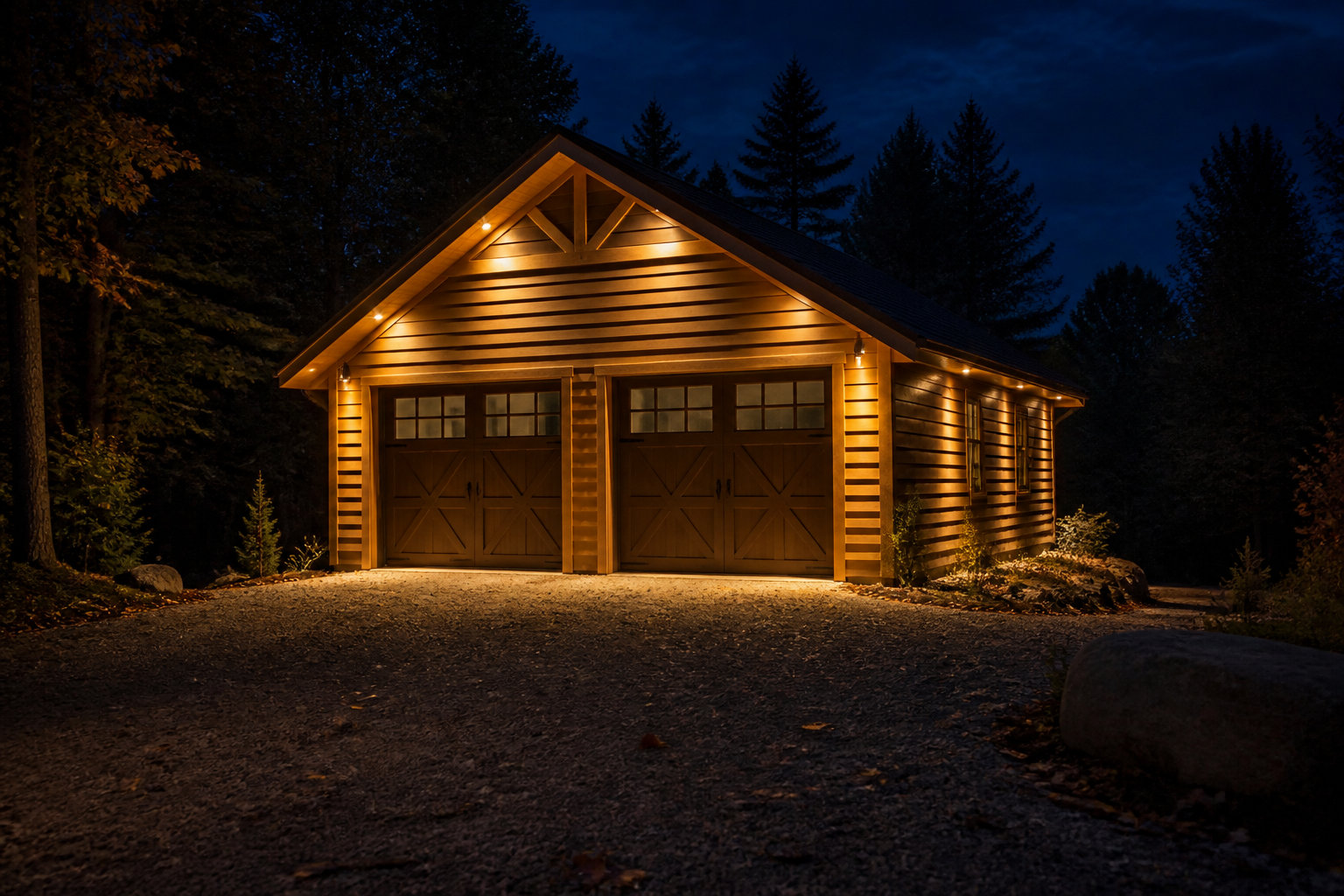
Off-grid means no trenching cables from your house. This saves thousands in labor and copper costs. You become your own utility provider, which feels great during a local neighborhood blackout.
You will need a significant battery bank for night work. Lithium is the modern standard for depth of discharge. Check our guide on portable power stations vs fixed batteries for storage insights.
Independence requires discipline. You must monitor your storage levels daily to prevent damaging the cells.
Utility connected setups and net metering
Linking to the grid provides a safety net. If the sun stays hidden, the house supplies the garage. It eliminates the immediate need for massive, expensive battery storage banks today.
Net metering lets you sell excess summer production back. This speeds up your return on investment significantly. Review the plug and play solar kit cost to see financial impacts.
Installation is more complex here. You will likely need a permit and a certified electrician for the final hookup.
Pick the Right Voltage and Battery Chemistry
Whether you stay off-grid or not, the internal guts of your system determine how hard you can work.
Choose between 12V, 24V, and 48V
Small sheds get by on 12V systems. They are simple and cheap to build. However, 12V struggles with high-wattage tools due to massive current flow and thick, expensive wiring requirements.
A 48V system is superior for heavy-duty workshops. It handles surges from table saws easily. We recommend this for efficiency.
| System Voltage | Ideal Use Case | Max Recommended Load | Wiring Complexity |
|---|---|---|---|
| 12V | Small lights/fans | Up to 1000W | Simple / Low |
| 24V | Medium tools | Up to 3000W | Moderate |
| 48V | Heavy machinery/EV charging | Over 3000W | Advanced / Efficient |
Deciding between lithium vs lead-acid solar storage is your next vital step. Lithium offers better depth of discharge.
Manage AC tools and DC lighting
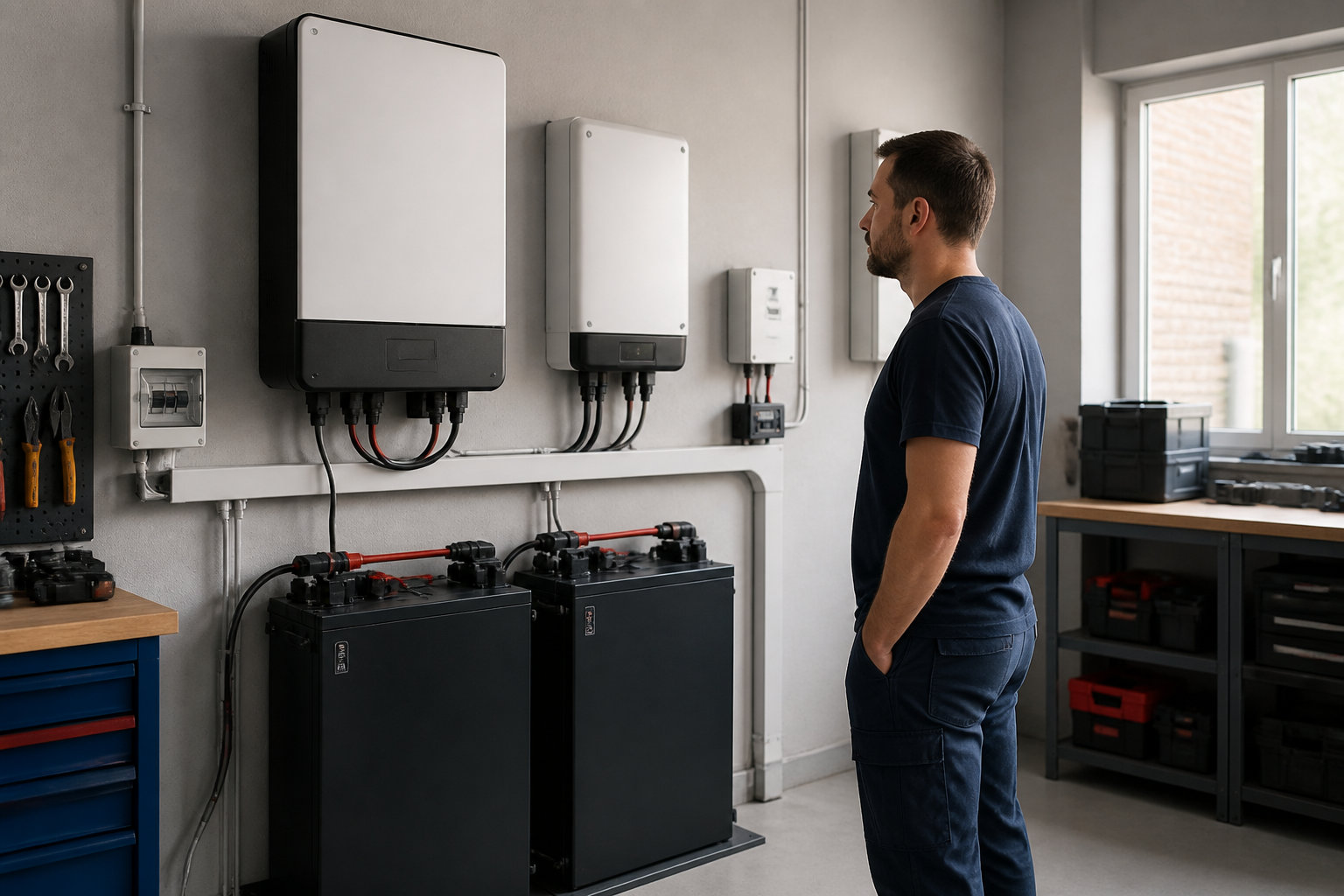
Run your lights on native DC power to save energy. Inverters waste electricity just staying turned on. Dedicated DC LED circuits are incredibly efficient for long hours of garage lighting.
Size your inverter for the “surge” of motor starts. A vacuum or compressor pulls way more power at startup than while running.
Always choose a pure sine wave inverter to protect sensitive electronics and tool chargers from damage.
Understanding the microinverter vs string inverter plug-play options helps you optimize your specific solar panel kits for detached garages.
Mount Your System and Survive the Winter
Once the components are picked, the physical battle against the elements begins on the roof.
Mount panels for maximum sun exposure
South-facing roofs are the gold standard for production. Tilt the panels to match your latitude for the best year-round harvest. Even partial shading from a chimney kills your output.
Use proper mounting rails and flashing to prevent roof leaks. DIY wiring must be tucked into conduit to avoid UV damage.
- Use stainless steel hardware
- Ensure air gap under panels
- Ground the metal frames
- Seal every roof penetration
Following these steps ensures solar panel kits for detached garages: a complete setup remains efficient and safely installed for years.
Protect your batteries during cold months
Lithium batteries cannot charge below freezing temperatures. You will destroy the cells if you try. Build an insulated box or use heating pads to keep them warm in winter.
Lithium batteries (LiFePO4) cannot be charged below freezing (0°C/32°F) without permanent damage; use insulated boxes or heating pads.
Snow is a total production killer for garage solar. Keep a soft roof rake handy to clear the panels after every storm to maintain extreme climate efficiency.

Check your battery state of charge more often in January. Low sun and cold temps are a brutal combination.
Empower your workspace with solar panel kits for detached garage to enjoy total energy independence and zero utility bills. By sizing your 1200W array and choosing 48V lithium storage, you ensure reliable power for every tool. Start your setup today to transform your garage into a sustainable, high-performance workshop.
FAQ
Is it possible to power a detached garage with solar panels?
Absolutely! Installing a solar panel kit is the ultimate solution for providing reliable, independent power to a detached garage. It allows you to run everything from LED lighting and garage door openers to heavy-duty air compressors and power tools without the massive expense and hassle of trenching electrical cables from your main house. ⚡
By choosing an autonomous setup, you gain total energy independence. This means your workshop or studio stays functional even during local grid blackouts, all while significantly reducing your monthly electricity bills and shrinking your carbon footprint. It is a smart, sustainable upgrade that adds real value to your property.
What size solar kit do I need for my garage?
Sizing your system perfectly depends on your daily “energy appetite.” For a standard hobbyist garage using LED lights (160 Wh/day) and occasional power tools (1000 Wh/day), a total daily load might reach around 4,000 Wh. We recommend sizing your kit to deliver 5 to 6 kWh of usable energy per day to account for cloudy weather and battery reserves. 🛠️
If you plan to run a refrigerator or a professional workshop, a 6 kW kit (producing about 13 kWh daily) is often the “sweet spot.” However, if you are looking to charge an Electric Vehicle (EV) or run a full HVAC system, you should step up to a 10 kW system to ensure you never run out of juice during intensive tasks.
Which solar kit is best for a detached garage?
The “best” kit depends on your specific goals. For maximum power and reliability, the Sunchees 6 kW kit is a top-tier choice, featuring high-efficiency 550W monocristalline panels and a robust 13.3 kWh LiFePO₄ battery. It’s designed as a complete, plug-and-play solution that handles everything from shop lights to heavy machinery. 🔋
If your needs are lighter, such as charging e-bikes or running basic lighting, a portable power station (like an EcoFlow or Jackery) paired with 500W of panels offers a great balance of cost and simplicity. For high-demand users, a 10 kW system with smart WiFi monitoring is the gold standard, providing enough capacity to share backup power with your main home.
Is a solar installation for a garage a good investment?
Yes, it is a highly strategic investment! A basic plug-and-play kit for an attached garage can see a return on investment in just 5.5 to 7.5 years. For detached structures, solar is often cheaper than the $800 to $2,500 cost required just to dig a 20-meter trench for traditional wiring. You save on labor and materials from day one. 💰
Beyond the immediate savings, these systems are built to last. Quality panels often come with a 25-year warranty, ensuring decades of free energy. Plus, by transforming your garage into a self-sustaining power plant, you increase your home’s market appeal and potentially qualify for financial incentives or surplus energy buy-back programs.
Can I install a solar kit on my garage roof myself?
Many modern kits are designed for the savvy DIYer, especially plug-and-play systems that use simple mounting rails and pre-tested components. Over-roof mounting is the preferred method because it preserves the roof’s integrity while ensuring excellent ventilation for the panels. 🏠
However, safety is paramount. You must ensure your garage rafters can support the additional weight (roughly 20 kg per square meter). For complex 10 kW systems or grid-tied setups involving net metering, we strongly recommend consulting a qualified professional to guarantee the wiring is up to code and the system is optimized for your local sun exposure.