Modern solar panel kits for off-road 4×4 vehicles now deliver up to 30% more energy harvest when paired with advanced MPPT controllers compared to traditional setups.
Relying on noisy generators often ruins the silence of the wilderness and leaves your starter battery vulnerable to deep discharge. We will help you select the perfect rugged power solution to ensure total energy independence during your next remote expedition.
- Solar Panel Kits for Off-Road 4×4 Vehicles: Your Key to Total Independence
- 3 Smart Solar Technologies to Power Your Remote Travels
- Seamless Technical Integration for Reliable Off-Grid Power
- Rugged Durability and Secure Installation for the Toughest Trails
Solar Panel Kits for Off-Road 4×4 Vehicles: Your Key to Total Independence
Off-road independence relies on 100W to 400W solar arrays paired with MPPT controllers to sustain 12V fridges and auxiliary systems. These setups eliminate generator noise while protecting the starter battery during extended stationary stays.
Switching to solar transforms a noisy campsite into a silent, self-sustained haven for every adventurer.
Why Energy Autonomy Changes Everything Off-Road
Staying stationary for days becomes effortless with solar. It prevents draining your starter battery in remote areas, providing total peace of mind while exploring.
Solar offers silent energy harvesting without the loud drone or exhaust smells of fuel generators. It is the ultimate upgrade for pristine campsites.
Maintaining food safety in 12V fridges is now guaranteed.
Reliable solar power transforms a vehicle from a simple transport mode into a fully functional, self-sustaining remote basecamp for weeks.
Your travel style shifts toward total independence. Adventure awaits.
How to Size Your Solar Array for 12V Fridges
To calculate your energy budget, total your daily amp-hour requirements for lights and pumps. This defines your baseline needs for consistent power.
Ambient temperature directly impacts fridge draw by increasing compressor cycles. Always include a buffer for cloudy days to ensure continuous operation.
Power your off-road adventures with rugged 4×4 solar kits by following these benchmarks:
- 12V fridge draw: 30-60Ah/day
- Solar capacity: 150W-200W per 100Ah
- Heat efficiency loss: 20-30%
3 Smart Solar Technologies to Power Your Remote Travels
Choosing the right hardware is just as vital as calculating your needs, as different environments demand specific gear configurations.
Fixed Roof Mounts vs Deployable Solar Blankets
Rigid roof panels offer a set-and-forget solution, charging your batteries while driving. Conversely, flexible blankets provide higher peak output when manually angled. You can explore more about solar panel for van setups to see how these integrate.
Charge while driving, aerodynamic drag, set-and-forget.
Shade flexibility, high peak output, manual setup.
Smart travelers park their 4×4 in the shade to keep the cabin cool. They simply place blankets in the sun nearby. This maximizes charging efficiency without overheating the vehicle.
Weight and aerodynamic impact on roof racks matter. Rigid glass panels add drag and height to your rig.
Hood-Mounted Panels for Stealth and Utility
Low-profile cells bonded to the hood are gaining massive popularity for 4×4 builds. They offer a low-profile charging solution that stays out of the way. These kits help you power your off-road adventures with rugged 4×4 solar kits effortlessly.
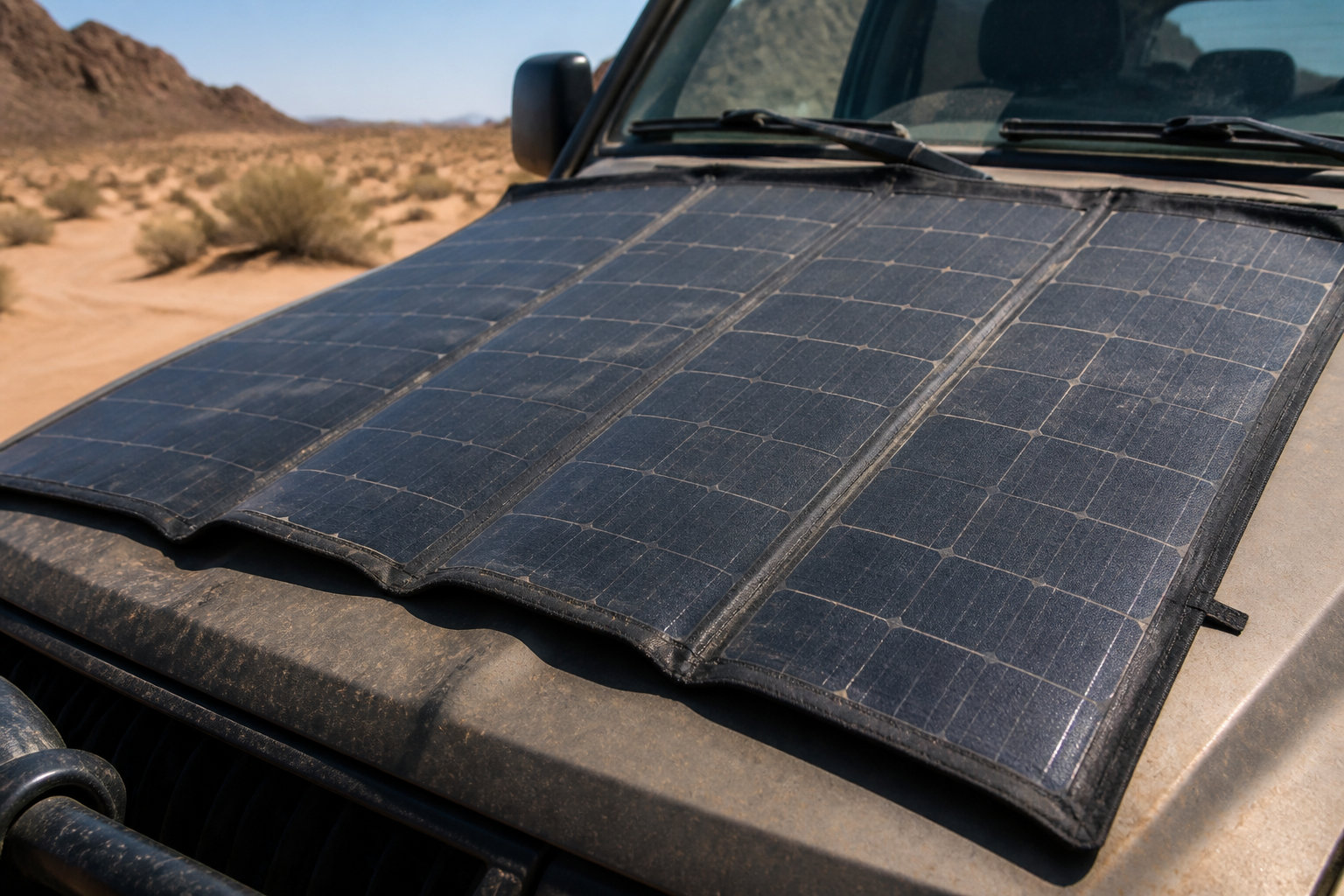
These panels provide essential trickle charging for your main battery. This clever setup prevents flat batteries after heavy winch use. It serves as a reliable safety backup in the wild.
These tough, glare-resistant panels handle low-hanging branches with ease. They are far more resilient against trail obstacles than traditional glass. You get durability without sacrificing precious roof space.
Seamless Technical Integration for Reliable Off-Grid Power
Even the best panels fail without a robust backbone to manage the flow of electricity into your storage system.
Maximizing Efficiency With MPPT Charge Controllers
MPPT technology outperforms PWM by handling variable shade effectively. High heat environments require this efficiency to power your off-road adventures with rugged 4×4 solar kits. Learn how plug-and-play solar panels work to understand these gains.
These controllers offer vital protection against overcharging and nighttime reverse current. Such precision extends the overall battery lifespan significantly during long-haul expeditions.
Match your controller’s amperage to the total array wattage. Ensure voltage compatibility to avoid hardware failure in remote areas.
Integrating Solar With DC-to-DC Battery Chargers
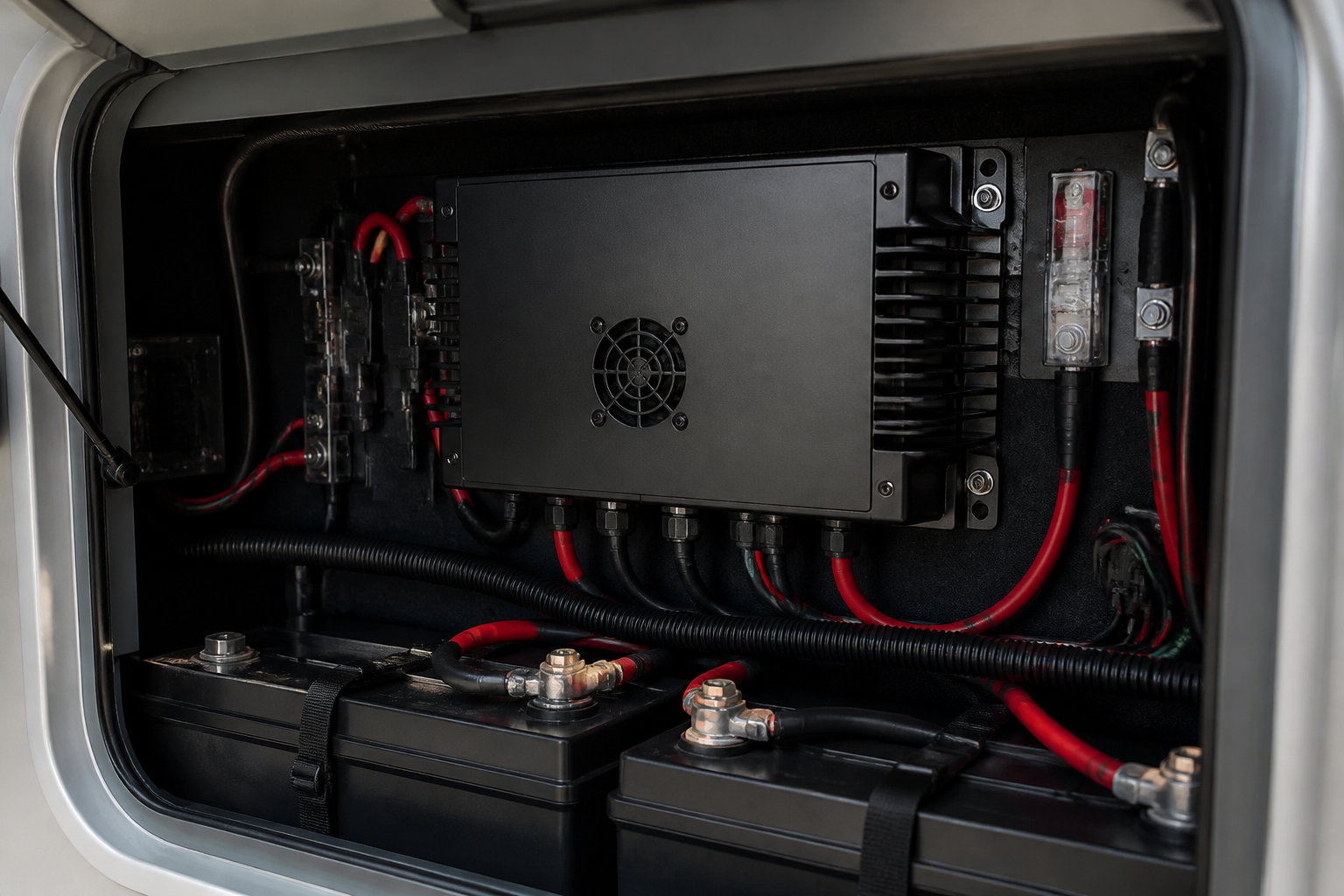
A dual-input system connects panels and the alternator simultaneously. This ensures your lithium vs lead-acid solar storage stays charged while driving through tough terrain.
Smart profiles for Lithium or AGM are mandatory for safety. Never mix charging profiles between different chemistries to prevent battery damage.
Never mix charging profiles between Lithium and AGM. Use fuses to prevent electrical fires caused by wire chafing on rough tracks.
Always install fuses and circuit breakers. Rough tracks cause wire chafing; proper protection prevents electrical fires in the bush.
Rugged Durability and Secure Installation for the Toughest Trails
Beyond the electronics, the physical survival of your gear depends on how it stands up to the brutal reality of off-road travel.
Weatherproofing Against Extreme Heat and Trail Dust
Components must survive water crossings with IP67 or IP68 ratings. Dust ingress is a major failure point. High-grade seals are mandatory for reliability.
Dust layers drop charging yield. Regular cleaning is mandatory in the desert. Even a thin layer drops output significantly.
Corrugated roads can crack internal connections in monocrystalline cells. Vibration resistance is the real metric for success. Choose formats that handle constant mechanical stress.
| Feature | Fixed Rigid Panel | Portable Blanket | Hood-Mounted Decal |
|---|---|---|---|
| Vibration Resistance | High | Low | High |
| Setup Time | Instant | 5-mins | Instant |
| Shade Flexibility | No | Yes | No |
| Theft Risk | Low | High | Low |
Secure Mounting and Cable Management Best Practices
Use heavy-duty zip ties on roof racks. Prevent snagging on low vegetation or branches. Power your off-road adventures with rugged 4×4 solar kits by keeping lines tight.
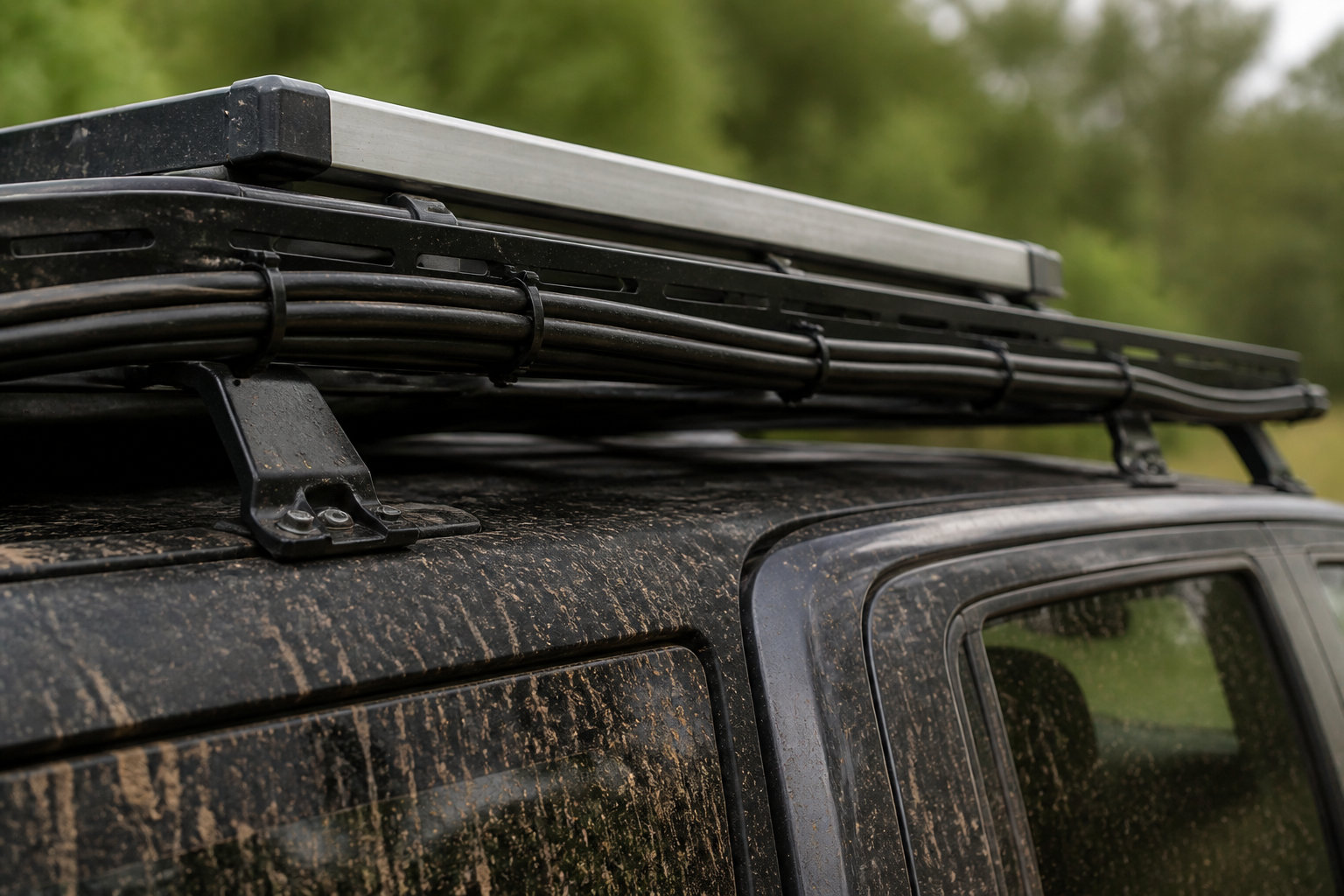
Recommend UV-resistant conduits and waterproof glands for roof entries. This prevents leaks during heavy tropical downpours. Protect every connection from moisture.
Regularly inspect mounting brackets as trail vibrations loosen hardware. Check torque settings before every major trip. Reliability requires constant mechanical vigilance.
A single loose cable can end a trip; secure every inch of your 4×4 solar wiring with redundancy.
Rugged solar panel kits for off-road 4×4 vehicles guarantee silent energy independence by protecting your starter battery and powering 12V fridges. Size your system with MPPT controllers today to secure reliable backup power. Your next remote expedition deserves the freedom of an endless, eco-friendly energy supply under the sun.
FAQ
Why should I choose a solar kit for my 4×4 adventures?
Stepping into the wild with a rugged solar kit is the ultimate way to achieve total energy independence. Unlike noisy and smelly fuel generators, solar power offers a silent, eco-friendly solution that lets you enjoy the pristine sounds of nature while keeping your 12V fridge running and your gear charged. It is the perfect way to transform your vehicle into a self-sustaining remote basecamp.
Beyond the peace of mind, these kits provide a vital safety backup by protecting your starter battery. By using dedicated solar arrays to handle your auxiliary loads, you ensure that your engine will always crank when it’s time to hit the next trail, even after days of stationary camping in isolated areas.
What is the difference between MPPT and PWM charge controllers for off-roading?
When you are navigating variable shade and extreme heat, MPPT technology is the undisputed champion of efficiency. It continuously tracks the maximum power point of your panels, delivering up to 30% more energy than a standard PWM controller. This is crucial for 4×4 builds where roof space is limited and every watt counts to keep your food fresh and your lights on.
While PWM controllers are a budget-friendly option for very simple, small-scale setups, they lack the sophisticated logic needed for complex off-road environments. For serious travelers who demand maximum performance and battery longevity, an MPPT controller is the smart investment to ensure your system thrives in all conditions.
How do I determine the right solar panel size for my 12V fridge?
Sizing your system starts with your daily energy budget. Most 12V fridges draw between 30-60Ah per day, but this can spike in hot weather as the compressor cycles more frequently. To stay fully powered, we recommend a solar capacity of 150W to 200W for every 100Ah of battery storage to account for efficiency losses and cloudy days.
Using online calculators can help you fine-tune these requirements based on your specific gadgets, such as pumps and LED lighting. Always aim for a slight surplus in wattage; having extra power ensures your remote autonomy remains intact even when the sun isn’t at its peak.
Can I charge my batteries from both the sun and my vehicle’s engine?
Absolutely! Integrating a DC-to-DC battery charger allows you to harness power from both your solar panels and your alternator simultaneously. These “booster” chargers are far superior to old-fashioned isolators because they provide a tailored charging profile for AGM or Lithium batteries, ensuring a 100% charge every time you drive.
This dual-input setup offers the best of both worlds: you charge at high speeds while cruising the highway and switch to sustainable solar harvesting the moment you park. It is the most robust way to manage your energy flow and maximize your independence on long-term expeditions.
How do solar panels handle the vibrations and dust of rugged trails?
Our off-road solutions are built to withstand the brutal reality of corrugated roads and desert dust. To ensure survival, look for components with IP67 or IP68 ratings, which provide total protection against dust ingress and water crossings. While monocrystalline cells are tough, the secret to longevity lies in secure mounting and high-quality junction boxes that resist mechanical stress.
Regular maintenance is key to keeping your yield high. Dust buildup can significantly drop your output, so a quick wipe-down after a day on the tracks is mandatory. By pairing durable hardware with redundant wiring and UV-resistant conduits, your solar system will remain a reliable partner through the toughest terrains on earth.