A small, efficient camping fridge uses about 320 watt-hours a day. A medium one uses 400 to 500.
Pick the wrong panel or battery and the fridge runs out of power before your trip ends. This article shows which panel and battery pairs run a camping fridge, and how to size your own.
The best setups for a camping fridge
Pick your setup from your fridge’s daily watt-hours, not its running watts. A small, efficient fridge using about 320 Wh per day needs a 100 W panel and at least 400 Wh of usable battery.
A medium fridge using 400 to 500 Wh per day needs a 200 W panel. Before buying, check the sizing steps for a 200 W kit.
Check how much plug-and-play solar kits cost before you buy, then compare these panels.
| Criterion | Renogy E.Flex 100 W | Renogy E.Flex 200 W | Jackery SolarSaga 200 W |
|---|---|---|---|
| Panel power | 100 W | 200 W | 200 W |
| Fridge size | Small, efficient fridge | Medium fridge | Medium fridge |
| Approximate price | About $125 | About $220 | About $379 |
How to size a setup from your fridge’s daily energy
Size your setup from your fridge’s daily energy in watt-hours (Wh), not from its running watts. A compressor fridge cycles on and off, so daily use depends on the heat and the temperature you set.
The Dometic CFX5 35 uses about 320 Wh per day at 90°F outside and 39°F inside. A hotter day or a colder setting pushes that number up.
To size your panel, follow this camping wattage method with your fridge’s daily Wh:
- Divide the daily Wh by peak-sun hours, then by 0.75 to allow for system losses.
- Use peak-sun hours, not daylight: a clear Phoenix summer day gives 14 hours of light but only about 7.5 peak-sun hours.
- Use the figure for your site: the US average is about 5 hours, but it ranges from 3.17 in Alaska to 6.54 in Arizona.
Battery capacity and how long it will run your fridge
Convert amp-hours to watt-hours by multiplying volts by amp-hours. A 12 V, 100 Ah battery gives 1,200 Wh of nominal capacity, which is its rated total.
Part of that is usable, and the share depends on the chemistry: lithium lets you draw more than lead-acid. Check your battery’s instructions before planning runtime. To match a panel, compare the best portable solar panels for camping.
Divide your battery’s usable Wh by your fridge’s Wh per day. A 1,000 Wh battery and a fridge using 347 Wh per day give about 2.9 days on paper. Heat and other devices on the battery make that shorter.
Count your nights and cloudy days.
If the result is lower, add panel or battery capacity.
Panels with a battery, or an all-in-one power station?
Separate panel, battery and charge controller
In a separate system, the parts link in this order: panel, charge controller, battery, fridge. The battery powers the fridge when the panel produces too little, including at night.
For an MPPT controller, divide panel watts by battery voltage, then multiply by 1.25. That gives the minimum current. A 200 W panel on a 12 V battery gives 20.8 A, so choose a controller rated above that.
All-in-one power station
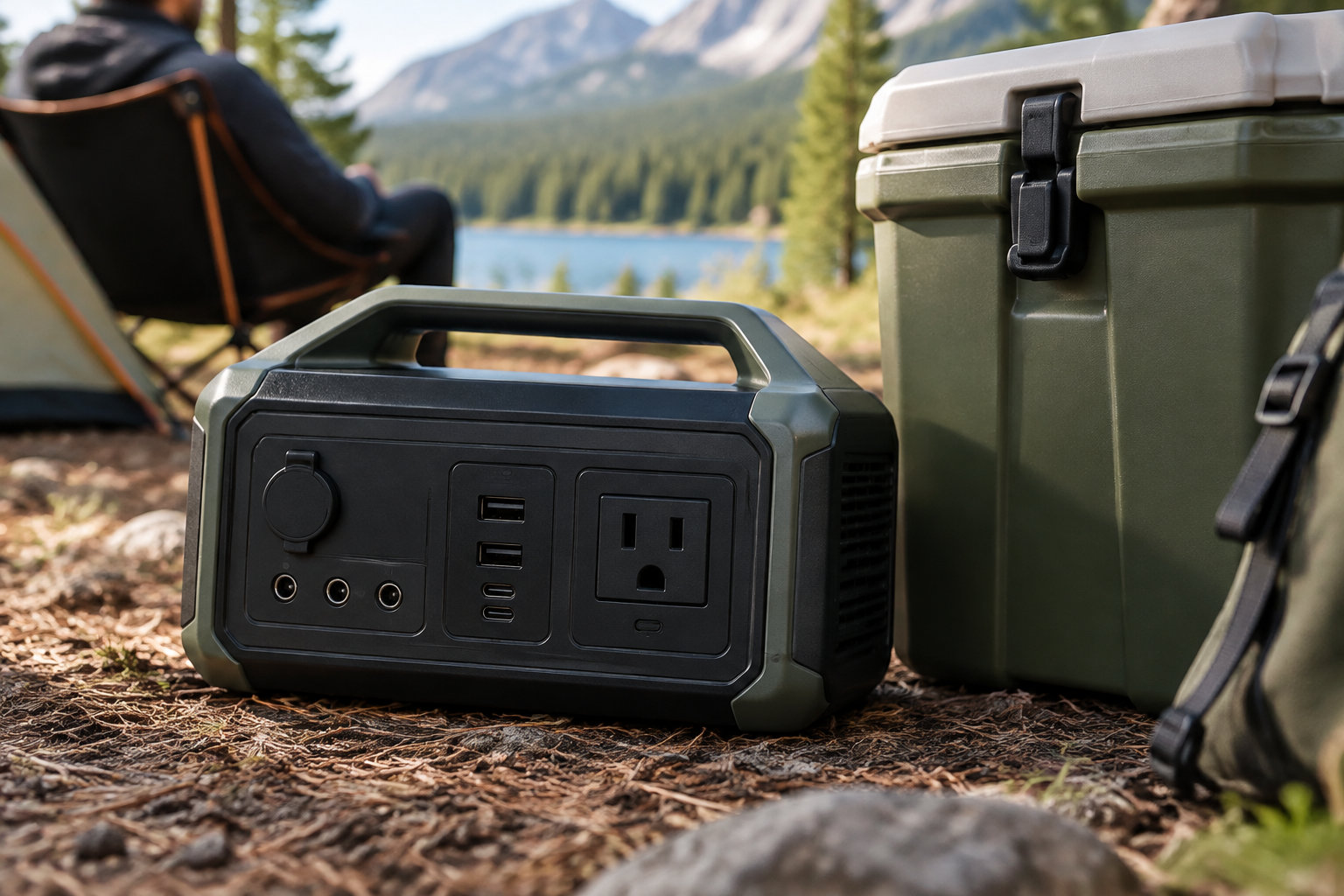
A power station such as the Jackery Explorer 1000 v2 combines the battery, controller and outlets in one unit. Check these three limits first:
- Capacity: 1,070 Wh. Compare it with your fridge’s daily watt-hours.
- AC output: 1,500 W continuous, 3,000 W surge. Your fridge’s running draw must stay below 1,500 W.
- Solar input: 400 W maximum. A panel rated above 400 W won’t charge the station any faster.
Direct 12V DC or an inverter
DC or inverter?
Direct 12 V DC
- Use it for a 12 V compact fridge.
- Plug it into the battery or the station’s 12 V outlet.
- No DC-to-AC conversion loss.
- Explorer 1000 v2: 12 V, 10 A outlet.
Inverter (AC)
- Needed for a standard mains fridge.
- Check the running draw against the continuous rating.
- Check the startup draw against the surge rating.
- For a battery that handles startup surges, see the refrigerator backup guide.
Which setup fits a weekend trip, and which fits a longer stay
For a fridge using 400 to 500 Wh per day, a 200 W panel with 500 to 1,000 Wh of battery gives you room for overnight use and weak-sun days. On a weekend, that spare capacity covers you.
On a longer stay, it matters more. Each cloudy day cuts into the reserve, so watch the battery level.
Three cases to adjust
-
Budget
Keep 100 W and 400 Wh. Shade or clouds? Add battery or panel power.
-
Station input limit
The Jackery Explorer 1000 v2 accepts up to 400 W of solar: one 200 W panel, or a larger array under that limit.
-
Long stay
Match panel output to daily use, and keep battery for nights and cloudy days. Dirty panels? See how to clean them while camping.
What your panel really delivers in the sun
The watts printed on a panel are its rated power, the maximum it reaches in ideal lab conditions. Nothing guarantees that power at your campsite: sun angle, shade, weather and heat all change the output.
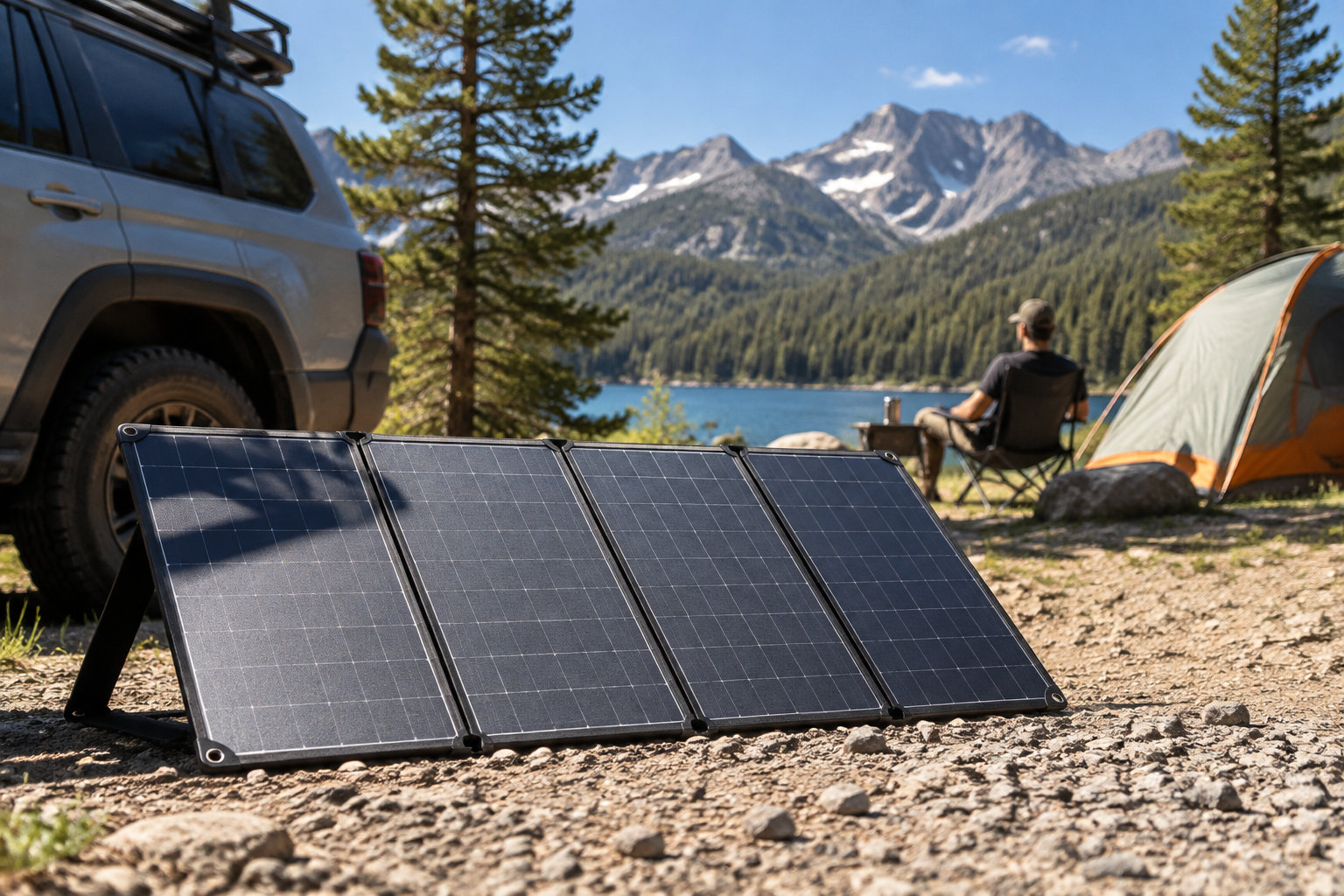
Heat hits hardest in summer. A hot panel produces less power, so plan on less than the rated watts when you size your setup.
To recharge every day, follow these steps, and to connect the panel safely, see how to ground a portable solar panel:
- Set the panel in direct sun and move it as soon as a shadow falls across it.
- Even a small shaded area can cut the panel’s output sharply.
- Keep a battery margin for nights and cloudy days.
Our pick: a mid-size panel and battery for most campers
For a 50 to 65 L fridge on weekends, start with a 200 W panel and a 500 to 1,000 Wh battery, since the fridge uses 400 to 500 Wh a day.
Want plug-and-play with no wiring? Check portable power stations vs fixed solar batteries before you buy one.
Before you buy the reference station
- Check that your fridge’s daily watt-hours fit within the 1,070 Wh capacity.
- Check that the fridge’s running power stays under the 1,500 W continuous AC output.
- Check that your panel stays under the 400 W solar input limit.
- Budget about $519 for the station alone, or about $879 with one 200 W SolarSaga panel.
- Buy through a qualifying sales channel, or the five-year warranty does not apply.
Start with one number: your fridge’s daily watt-hours. The panel, the battery and the runtime all follow from it, not from its running watts.
Next, write down that figure and the number of days you stay out. Then run the sizing steps and the runtime check, and add a margin for cloudy days before you buy.
FAQ
Can a 100W solar panel run a camping fridge all day?
Not on its own, for most fridges. A 100 W panel can run a low-use fridge in strong sun.
A fridge using 320 Wh a day needs about 64 W on average over 5 peak-sun hours before losses, so a battery covers cloudy days.
How long will a 100Ah lithium battery run a camping fridge?
A 100 Ah lithium battery runs a fridge using 320 Wh a day for about 3.75 days at most.
That figure divides the battery’s 1,200 Wh nominal total by 320 Wh, so it counts every watt-hour as usable. Other devices and heat shorten it.
Do I need an inverter to run a 12V camping fridge?
No. A 12 V camping fridge runs on direct 12 V DC, so you plug it into a compatible 12 V DC outlet on your battery or power station.
An inverter is only needed for appliances that run on AC power, such as a standard household fridge.
Can a solar panel keep a camping fridge running on cloudy days?
Only with a battery behind it. Solar output falls with cloud and shade, so on a cloudy day the panel produces too little for the fridge.
The battery stores energy and covers the gap. Size it for the cloudy days you expect.