On a trip away from campsites, your battery is often the only power you have. Panels come in many sizes, connectors and voltages, and a wrong match can leave that battery empty.
This article gives you a shortlist of portable and lightweight panels, with the criteria to compare them, so you can pick one that fits your vehicle and battery.
Which panel to choose for your trip, budget and setup
Camping a few nights away from the vehicle? A folding panel laid on the ground gets the most sun, because you can turn it toward the sun. For compact models, see portable solar panels for camping.
Parked for days at a time? A roof panel stays ready without setup. The BougeRV Arch Pro is one option: $269.99, 7.9 lb, and it does not fold, so it suits a flat or curved roof only.
Before you buy
- Compare the price in USD, adding any controller or cable you still need.
- Check your power station’s maximum solar-input voltage.
- Match the panel’s connector to your station’s input. Use an adapter only if its voltage, current and polarity match the station.
- For a 12V battery, check that the controller accepts the panel’s open-circuit voltage, the voltage with nothing connected. The Renogy Voyager 20A PWM accepts up to 25V.
Renogy E.Flex 200W N-Type: the best all-round pick for most setups
The E.Flex 200W suits most vehicle setups. Rated 200 W, its cells convert over 25% of the sunlight they get.
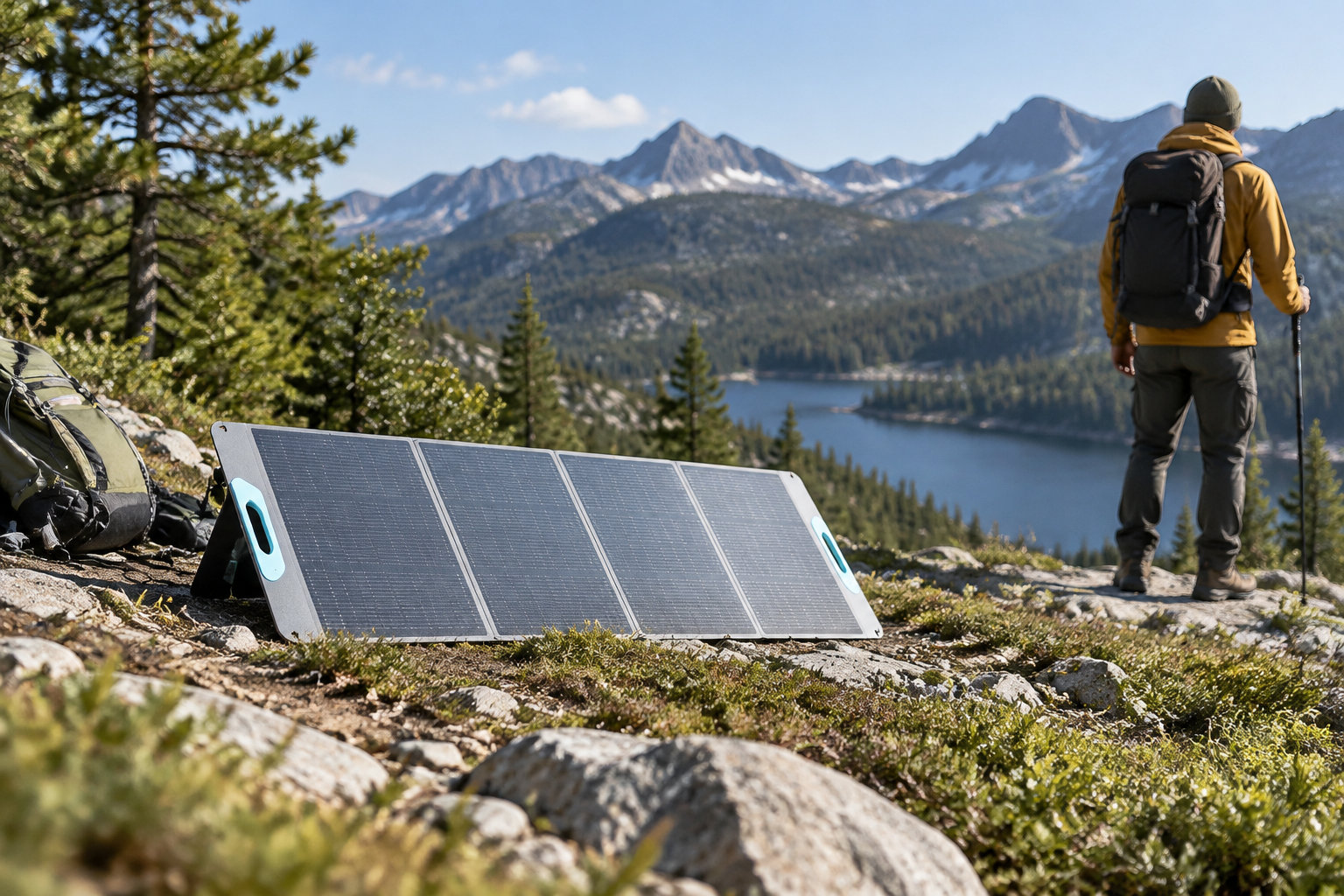
For a stealth van, plan 200 to 400 W of solar: read the stealth van setup guide before adding a second panel. Its IP65 rating resists dust and water jets, but keep it away from standing water.
Compare these numbers before you buy:
- Price: $224.99 in the U.S.
- Output: 177 W in the side-by-side test, or 88% of its 200 W rating.
- Charging: 192 W average in a two-hour check.
- Weight: 14.8 lb. Folded size: 23.7 × 23.0 × 2.0 in.
- Warranty: two years.
Match the cable end to your power station’s input: Anderson 45A, XT60, DC 8mm, or DC 5.5mm.
Check the panel’s MC4 leads, the connectors the four-in-one cable attaches to.
Set a multimeter to DC volts and point the panel at full sun. The open-circuit voltage should read about 21.6 V.
Jackery SolarSaga 200: the easiest to carry, with direct device ports
The SolarSaga 200 charges USB devices straight from the panel, so you don’t need a power station.
Its USB-C port delivers 5V at 3A and its USB-A port 5V at 2.4A, so USB-C is the faster choice for phones and tablets.
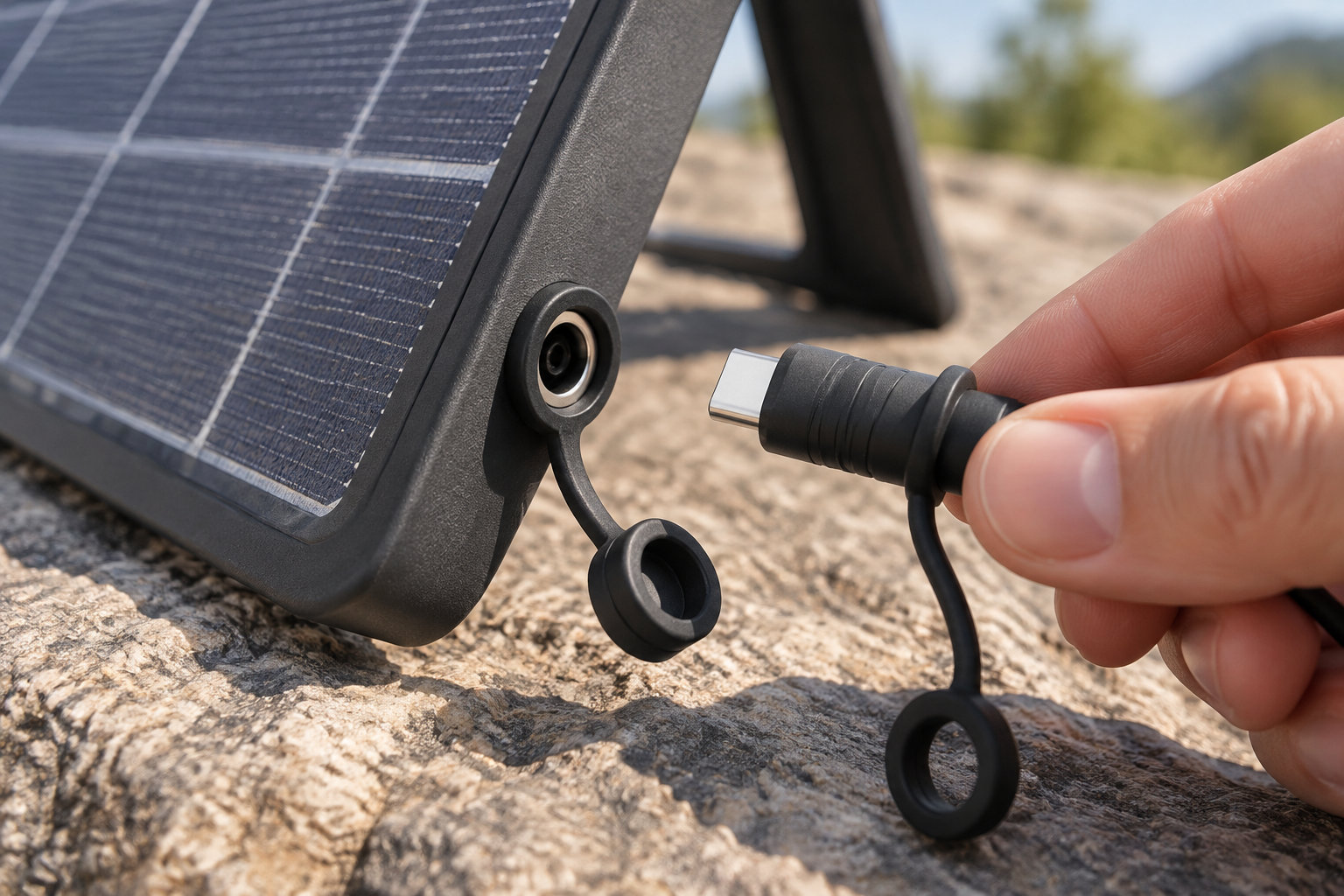
At 14.33 lb, folding to 23.62 × 23.50 × 1.57 in, it is light enough to carry by hand.
It costs $429. For a truck camper or small trailer, see how to size and mount a kit before you buy.
EcoFlow NextGen 220W Bifacial: the highest rated output and bifacial gain
The front is rated at 220W, ±5%, and the back at 175W. Those are ratings, not measured output. In a side-by-side test in clear sun at 6,300 feet, it made 193W, 88% of its 220W rating.
Bifacial means the back also collects light. The maker claims up to 28% more energy from the back side.
Treat it as a best case, not a field result. For a truck camper, check how to size the system for your roof before relying on that gain.
This panel reaches 21.5V open-circuit, meaning the voltage it puts out with nothing connected. If your power station’s maximum solar-input voltage is lower, plugging the panel in can damage the station’s input. Find that maximum in the station’s manual before you buy or connect anything.
The connector also varies: one version uses an XT60 cable, another uses MC4. Check the connector on the exact version you buy, or you may need an adapter that doesn’t fit.
BougeRV Arch Pro 200W: the lightweight flexible option for roof mounting
The BougeRV Arch Pro 200W weighs 7.9 lb and measures 53 × 31 × 0.01 in. It is thin and flexible, so it suits a flat or curved roof, not a setup on the ground at camp.
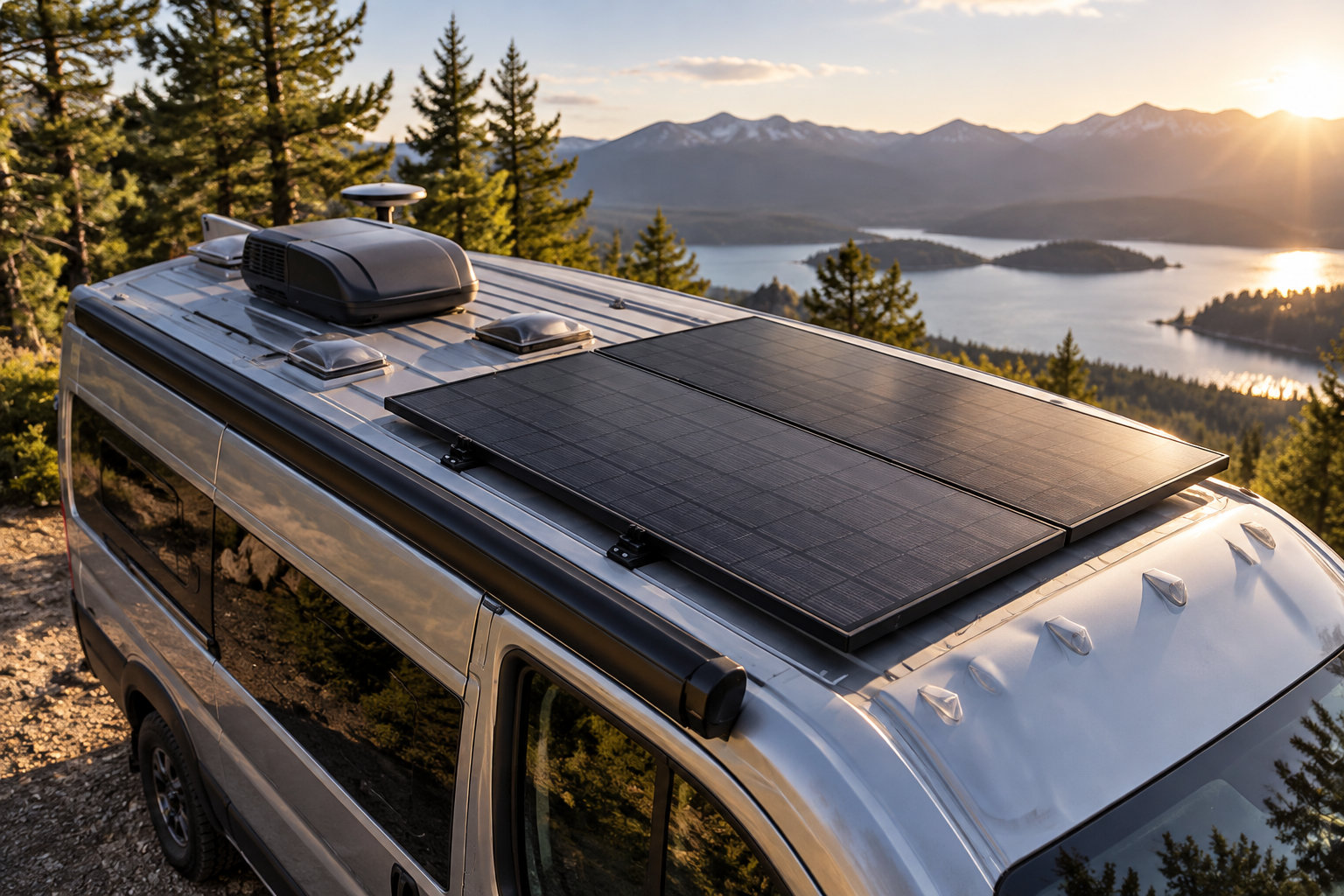
At $269.99, it is a fixed-mount panel. If you want to lay a panel on the ground, choose a folding model instead.
For a roof install with little space, see how to choose and fit an RV solar kit before you buy.
Test result or Pro specs?
Original BougeRV Arch 200W: test result
- Output measured: 166 W, or 83% of its rating
- Weight: 6.6 lb
- Size open: 58.1 × 31.0 × 0.08 in
- This test did not cover the Arch Pro, so the 166 W figure is not a result for the Pro.
BougeRV Arch Pro 200W: specifications
- Weight: 7.9 lb
- Size open: 53 × 31 × 0.01 in
- Connectors: MC4, IP68 rating
- Warranty: five years on materials and workmanship, 25 years on power output at 80%
Renogy 200W suitcase kit: a panel with its controller in one case
The Renogy 200W suitcase kit bundles two panels, a Voyager 20A PWM controller already installed, and a cable with alligator clips. You don’t buy the controller separately.
The clips connect the kit to your 12V battery, and the controller regulates the charge so the battery isn’t overcharged. It costs $229.99 in the US.
Compare these numbers with your vehicle and battery before you choose:
- Weight: 28.46 lb for the full kit, so check your roof or rack load limit.
- Folded size: 34.25 × 22.83 × 3.15 in, so measure your storage space first.
- Voltage: 21.47V open-circuit, below the controller’s 25V limit on a 12V system.
The controller works with sealed, AGM, gel, flooded and lithium batteries. If yours is another type, the kit is the wrong choice. The five-year warranty covers materials and workmanship, so read its coverage limits before you buy. For a van build, compare the top picks for mobile living.
Choose a panel by how well it fits your setup, not by its biggest rating. Real output falls below the rated wattage, so plan around measured figures, and match the connector and voltage to your station or battery.
Next step: write down your battery type, your station’s maximum solar input, and the storage space you have. Then keep only the panels that fit all three.
Frequently asked questions
How many watt-hours does a 200W panel produce on a sunny day?
On a sunny day, a 200W panel makes about 600 to 1,000 Wh.
Each full-sun hour gives 200 Wh, so three to five of them give 600 to 1,000 Wh before system losses. Clouds, shade or a poor angle lower that total.
Do portable solar panels still charge on cloudy days?
Yes, portable solar panels still charge on cloudy days, but more slowly. They make less power as less sunlight reaches them.
On an overcast day, count on a small charge, not a full one, and plan your battery use around that.
Can I leave a portable solar panel in the sun unattended at camp?
Yes, as long as you use the panel as its model directs. Set it on a stable spot, protect its cables and connectors, and read the product’s safety instructions before you leave it unattended.
Do I need an MPPT controller for a 200W panel on a 12V battery?
No, not always. Your 12V battery needs a charge controller, but an MPPT model isn’t required for every 200W panel.
Match the controller’s voltage and current limits to your panel and battery. The Renogy kit’s 20A PWM controller takes up to 260W of solar input on 12V.